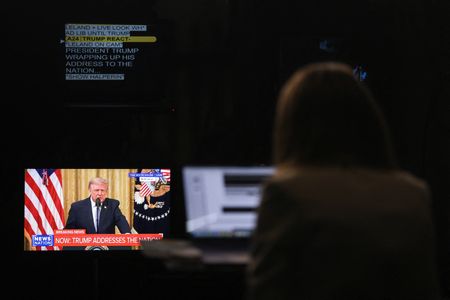

President Donald Trump turned up the heat on his effort to place election security at the heart of the Republican Party’s midterm strategy, claiming during a prime-time White House address that China meddled in the 2020 presidential election — a claim that contradicts an official U.S. intelligence assessment.
The roughly 30-minute Thursday evening speech saw Trump revisit long-held assertions that American elections are fundamentally flawed, pointing to newly declassified documents he described as exposing “shocking vulnerabilities.” However, many of those documents appeared to fall well short of supporting his claims, and Trump offered no evidence that any votes were changed or manipulated in 2020.
Trump used the address to once again urge fellow Republicans in Congress to advance legislation that would impose stricter voter identification and citizenship verification requirements. The bill, called the SAVE America Act, has stalled in the Senate due to strong Democratic opposition, even as research consistently shows that voter fraud is extremely rare.
The speech arrived at a politically difficult time for Trump and his party. Republicans are facing the possibility of losing one or both chambers of Congress in November, with the president’s approval numbers dragged down by the unpopular Iran war and rising energy costs. Some Republican leaders have privately encouraged Trump to focus on kitchen-table concerns like the high cost of living rather than relitigating the 2020 election.
Trump briefly addressed the war, saying the United States was “winning big,” and highlighted domestic achievements including tax cuts and his immigration enforcement efforts before pivoting to election integrity.
The president announced he was releasing classified information showing that China had unlawfully obtained 220 million U.S. voter files containing names, addresses, and other personal data. He also alleged that members of the U.S. intelligence community had intentionally concealed the full scope of China’s actions.
However, a 2021 unclassified U.S. intelligence assessment found no sign that any foreign government attempted to or succeeded in altering “any technical aspect” of the 2020 presidential election — including voter registrations, ballot counts, or final results. That assessment was overseen by John Ratcliffe, who served as Trump’s director of national intelligence at the time and now leads the CIA.
The same report noted that China had been gathering data on U.S. voters, public opinion, candidates, and senior government officials since at least 2008, likely to help forecast election outcomes. Two sources with knowledge of the situation indicated that the voter data China obtained was not classified — voter files are commonly bought by political consultants — and could not be used to alter election results.
Trump’s pointed rhetoric toward China also raised concerns about damaging a relationship that had stabilized following a costly trade war the previous year. Trump is hoping to sit down with Chinese President Xi Jinping in September to discuss improving trade ties.
Before Trump’s speech began, a spokesperson for the Chinese embassy, Liu Chang, pushed back firmly, stating: “China has never and will never interfere in the presidential elections of the U.S.”
Trump has spent years sowing doubt about U.S. election outcomes, repeatedly and falsely claiming that his 2020 defeat to Democrat Joe Biden was the result of a rigged process. He has also promoted other unsubstantiated claims — that mail-in voting is riddled with fraud, that voting machines cannot be trusted, and that non-citizens are casting ballots in large numbers. Courts and election recounts across the country have found no evidence of widespread fraud in the 2020 race.
Despite the lack of evidence, Trump’s messaging has resonated with his political base. A Reuters/Ipsos poll conducted in April found that 63% of Republicans believe Trump’s assertion that the 2020 election was stolen.
During Thursday’s address, Trump claimed his administration had identified more than 275,000 non-citizens registered to vote across just four states — though he offered no evidence that any of them had actually cast a ballot. Past investigations have shown that citizenship verification systems have sometimes incorrectly flagged naturalized citizens as non-citizens, and studies consistently find that non-citizens voting is extremely rare.
Many of the newly declassified documents Trump cited also appeared to undercut rather than support his arguments. One CIA document, prepared just last month, dealt with Venezuela’s election rather than the United States’. A separate document stated that “vote tabulation systems would be difficult to manipulate on a wide enough scale to compromise election results.” A third CIA document described Chinese espionage efforts targeting Biden’s campaign, but also noted that Beijing “does not currently intend to covertly interfere to try to sway the outcome of the election.”
Democratic Senator Mark Warner of Virginia, who serves as vice chair of the Senate Intelligence Committee, issued a sharp response during the speech. “Trump’s shocking ‘bombshells’ about China are totally bogus,” Warner said. “The fact is our intelligence agencies unanimously agreed that China did not even try to change a single vote in the 2020 election.”