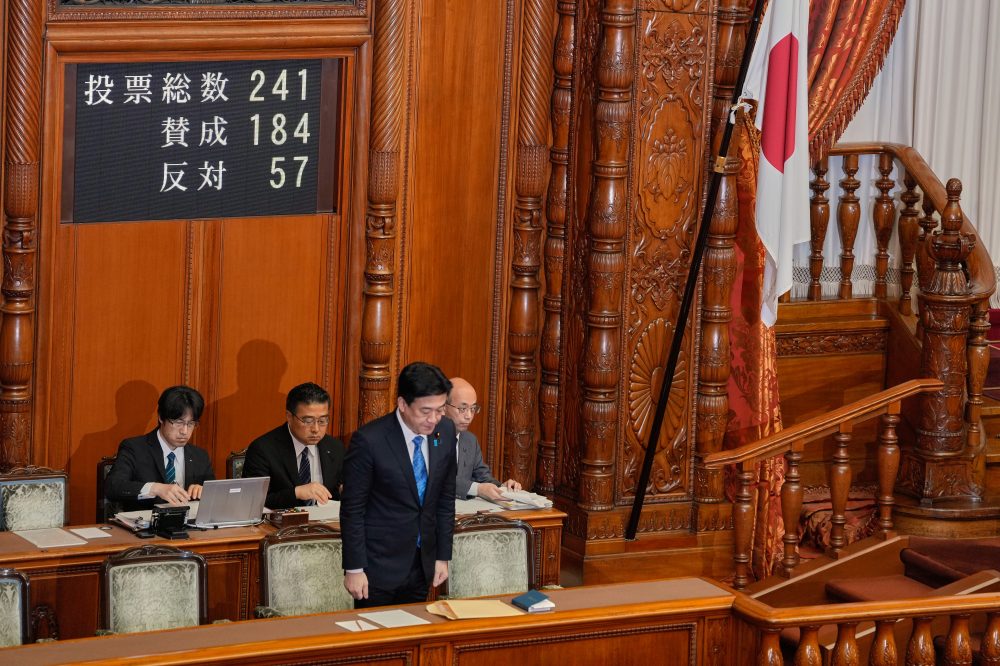

TOKYO (AP) — Japan officially put a new and contentious law on the books Friday, making it a crime to desecrate the country’s national flag. The legislation was a central goal of Prime Minister Sanae Takaichi’s right-wing agenda, but critics are pushing back hard, calling it a tool to intimidate citizens and muzzle dissent against her administration.
Under the new law, it is illegal to publicly damage, remove, or deface Japan’s national flag — known as the “hinomaru” — in any manner that “causes extreme discomfort or sense of disgust to others.” Even livestreaming or uploading video of someone burning or cutting a flag in a private space falls under the law’s reach.
Those found guilty could face a prison sentence of up to two years or a financial penalty of up to 200,000 yen, which is roughly $1,230.
Takaichi has long argued that Japan’s absence of a law protecting its own flag was “wrong,” pointing out that the country already had legislation on the books to prevent damage to foreign national flags — particularly those displayed at embassies and diplomatic sites — in order to prevent international incidents.
Legal scholars have largely pushed back against the new measure. Many argue the law’s wording is too vague, leaving it open to selective enforcement that could target people who criticize the government.
“Punishing national flag vandals means a prohibition of criticism against the government,” said Motohiro Hashimoto, a constitutional law professor at Chuo University, during testimony before parliament this week.
The law has sparked a wave of questions in parliament about what specific actions would actually be punishable. Takaichi’s governing Liberal Democratic Party outlined several examples of violations: pulling down and throwing away a flag displayed at a municipal building; tearing, burning, or cutting a flag in a public space; stepping on or smearing mud on a flag in public; and streaming or posting footage of oneself burning or cutting a flag even while at home.
However, certain uses of the flag are permitted. Digital or illustrated versions of the flag appearing in anime, cartoons, or AI-generated images are exempt because they are not physical objects. Flag imagery that is part of a painting is also not subject to punishment. Additionally, damaging the small decorative hinomaru flags commonly placed on children’s meals is allowed.
Opposition lawmaker Ayaka Shiomura of the Constitutional Democratic Party of Japan raised questions during a parliamentary session about whether crossing out an image of the flag — noting the flag’s complicated historical meaning when used at political rallies — would be a punishable act. LDP lawmaker Akihisa Shiozaki gave a notably vague reply: “It all depends. It is difficult to categorize, standardize or make a hypothetical judgment until it happens.”
Experts note that while other nations, including the United States and countries across Europe, have laws addressing flag vandalism, those laws tend to include clearer standards and stronger safeguards for free expression.
Japan’s national flag — a red circle on a white background — is thought to have roots in ancient sun worship. It was formally recognized as the flag for Japanese commercial ships in 1870. Today, it is a common sight at sporting events, government buildings, and international gatherings. At Imperial Palace events, crowds wave miniature versions of the flag to show support for the emperor and the royal family.
A separate well-known Japanese flag, called the “kyokujitsuki,” features a red disc surrounded by 16 outward-spreading rays. That flag has repeatedly drawn sharp protests from some of Japan’s neighboring countries due to its association with Japan’s imperial navy during the period when Japan colonized the Korean Peninsula and invaded or occupied China and other parts of Asia before its defeat in World War II in 1945.
Despite the hinomaru’s widespread modern use, it did not hold official legal status as a national flag until 1999 because of lingering controversy over its wartime associations. Starting around the 1980s, the Japanese government pushed to have the flag and the national anthem “Kimigayo” — which translates to “the Emperor’s reign” — used in public schools, a move that often drew protests from teachers opposed to patriotic education.
The emotional weight of that debate was underscored in 1999, when a school principal in Hiroshima took his own life the day before a graduation ceremony, caught in the middle of a standoff between teachers protesting the flag and local education officials demanding its display.