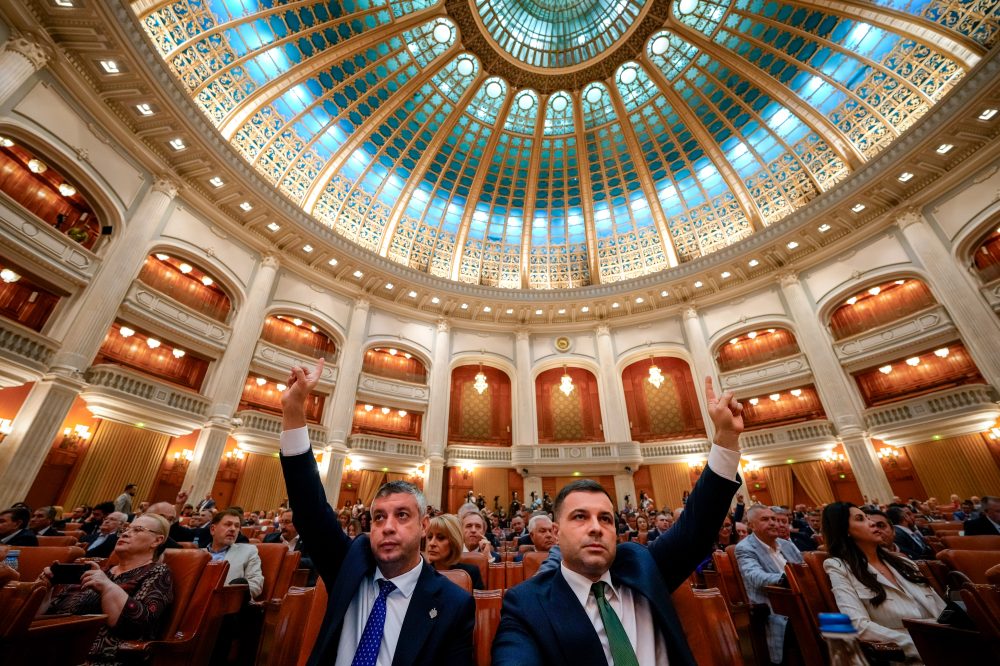

BUCHAREST, Romania — Romania’s ongoing political crisis took a turn for the worse Monday night after Parliament voted down a new government put forward by Prime Minister-designate Adrian Vestea, who had been hoping to finally bring stability to the struggling nation.
The confidence vote fell well short of the required threshold, with 189 lawmakers voting in favor and only 23 opposed — but more than half of Parliament chose to abstain. At least 233 votes were needed for the government to be approved. The failure marks the latest chapter in a political standoff that began when a no-confidence vote brought down the previous government back in May.
Romanian President Nicusor Dan had tapped Vestea, a longtime member of the National Liberal Party, known as PNL, citing his background in public administration. Vestea was actually Dan’s second choice for the position — his first nominee, Eugen Tomac, had failed to put together a cabinet within the required 10-day window.
The collapse of Vestea’s cabinet bid is expected to further destabilize a country already struggling with one of the highest budget deficits among European Union member states.
Speaking to Parliament on Monday, Vestea painted a sobering picture of Romania’s condition, describing it as going through “a complex period” marked by “distrust between the citizen and the state.”
He went on to say the country is confronting “serious economic challenges, social tensions accumulated over years, an international context more unstable and risky than we have known for a long time. But beyond all this, I believe that our real problem is something else — a crisis of trust.”
Vestea had submitted his proposed cabinet lineup and governing agenda to Parliament on Sunday. However, a significant political problem emerged: President Dan had not consulted Vestea’s own party, PNL, before naming him as his pick. While Parliament’s largest party, the Social Democratic Party — or PSD — backed Vestea’s cabinet, his own party refused to support him.
Earlier Monday, Vestea met with the leader of the hard-right nationalist opposition group known as the Alliance for the Unity of Romanians, or AUR, calling it essential to address “an unprecedented crisis.” However, AUR leader George Simion announced after that meeting that his party would not support the proposed cabinet, and AUR lawmakers walked out of Parliament before the vote was held.
Simion delivered a sharp rebuke from the Parliament floor, saying, “For 35 years in Romania, betrayal has been the order of the day and has somehow become commonplace, part of everyday life. Those in this hall who are not traitors are leaving this hall synonymous with betrayal.”
PSD leader Sorin Grindeanu, speaking to reporters before the final tally was in, said his party was unlikely to back a minority government going forward. He offered Vestea a backhanded compliment, congratulating him for “accepting to enter this battle.” He also took a veiled shot at the lawmakers who skipped the vote, saying, “There are others who were not even present at the vote … acting like moralists, but it is not my job to judge them.”
Political consultant Cristian Andrei, based in Bucharest, said the outcome largely benefits AUR by demonstrating that “the mainstream parties are unable to govern.” He warned that the road to forming a stable government remains rocky.
“There is a tough road ahead for finding a majority because the pro-Western parties are in a perpetual conflict,” Andrei told The Associated Press. “Instability and populism win again. Trust in the mainstream politics is the victim again.”
With the vote failed, President Dan must now put forward yet another candidate for prime minister. If that person also fails to assemble a functioning government, the country could be forced into snap elections — something that would be unusual, as Romania’s next general election is not scheduled until 2028.
Romania continues to grapple with one of the EU’s highest budget deficits and widespread inflation. Reducing the deficit had been declared a top priority when the coalition took power in June 2025.