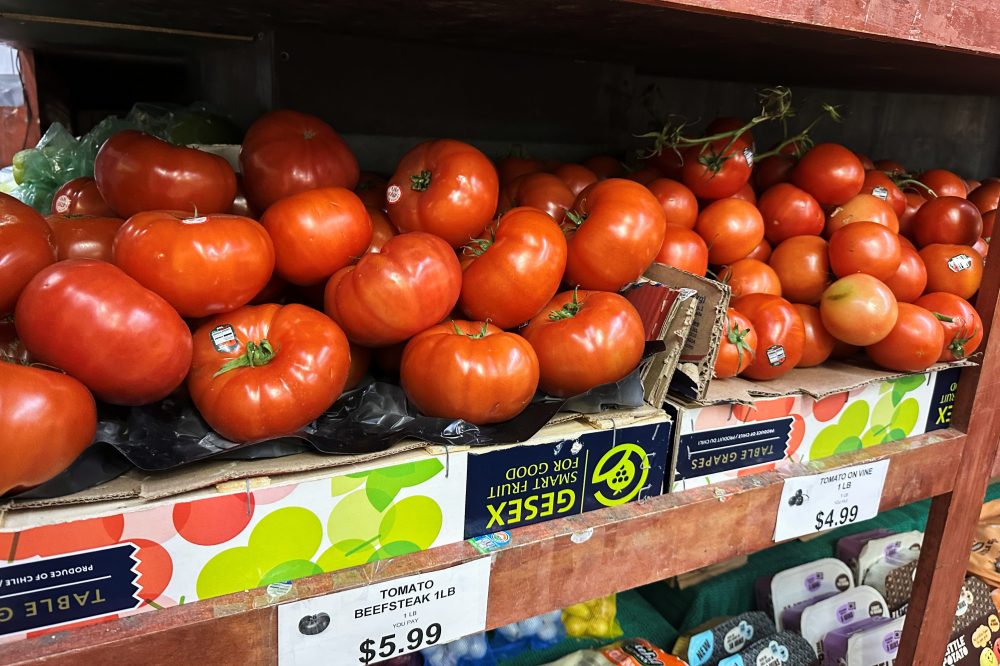

NEW YORK (AP) — The humble tomato, found in countless dishes from casual dining to fine restaurants, has emerged as an unexpected symbol of America’s growing cost-of-living crisis.
These red vegetables have experienced the steepest price increases among all food items in the past year, establishing themselves as a prominent example of today’s consumer financial pressures.
“The tomato has become a symbol of something much deeper,” says Isaac Bernal Carbajo, a New York City chef who lamented life’s “simplest pleasures” falling victim to price increases. “Something as basic as buying fresh vegetables is starting to become a serious financial decision for many families.”
According to the most recent Consumer Price Index data, tomato costs have climbed roughly 40% compared to last year, significantly outpacing price jumps for other grocery items such as coffee (increased 18.5%), beef roasts (up 17.8%) and frozen fish and seafood (rising 12%), all of which have also become emblematic of the nation’s affordability challenges.
A different inflation measurement released Thursday revealed that general prices rose 3.8% in April compared to the previous year, marking the highest level in almost three years.
Beyond agricultural production factors, analysts attribute tomato price surges partly to two key elements of President Donald Trump’s second-term agenda: the Iran war and tariffs. The conflict drove up fuel costs and transportation expenses. Additionally, the U.S. ended an agreement that permitted tariff-free tomato imports from Mexico, the source of most American tomato supplies.
Usha Haley, a Wichita State University economist, says it’s “a perfect storm of trade policy, extreme weather and Mideast policy.”
Domestic tomato producers applauded ending the Mexican tomato agreement last July, arguing it would help revitalize their declining sector. However, consumers have felt significant financial strain. While the U.S. terminated the Mexico tomato arrangement in July, grocery store impacts took months to materialize, with increased imports during late winter and early spring months.
Upon arrival, these tomatoes faced a 17% tariff assessment.
“Tariffs are undeniably a big driver of the price inflation,” says Brett Massimino, a Virginia Commonwealth University business professor. “Because the U.S. relies on Mexico for the majority of its tomato supply, any changes in trade policy can have a large impact.”
Federal records show U.S. tariff collections on tomatoes exploded from merely $16,424 in 2024 to approximately $4.6 million, representing an astronomical 27,879% jump.
As expenses filter down to consumers, frustrated shoppers have documented their grocery store experiences on social media, recording videos expressing dismay over costs they claim have quadrupled, with some promising to start home gardens rather than pay up to $8 per pound. However, the most significant effects have hit businesses that depend heavily on tomatoes in their food preparation.
MarginEdge, a restaurant price tracking service, reports grape tomatoes have seen the largest increases — 65% within just one month — though all tomato varieties have experienced price escalation.
Phillip Coles, a professor of supply chain management at Lehigh University, says prices should drop later in the year when domestically grown tomatoes are harvested. Higher prices, he says, will also “induce farmers to increase planting to meet the demand, but this takes longer because of the lead time.”
Currently, these increases are creating substantial financial challenges for operations like Snarf’s Sandwiches, which includes tomatoes in virtually every sandwich they prepare.
Wayne Humphrey, chief operating officer of Snarf’s, which operates dozens of stores in Colorado, Missouri and Texas, said cases of tomatoes went from costing him $27 to $93 in the space of a year, piled on top of rising expenses for other ingredients including bread and beef, as well as increased labor costs.
“That single ingredient now costs us more than $1.7 million in additional spend annually,” says Humphrey. “The math is getting harder to ignore.”