
Communities in Indonesia’s East Java province gathered on Friday to commemorate two decades since a catastrophic mud volcano disaster that claimed at least 14 lives and buried entire neighborhoods under a sea of boiling sludge.
On May 29, 2006, the Lusi mud volcano began erupting in the Porong subdistrict of Sidoarjo, with scientific studies suggesting the catastrophe resulted from commercial gas exploration activities by a local drilling company. This finding contradicted claims by an Indonesian government minister at the time who maintained the event was a natural occurrence.
During Friday’s memorial, community members placed flowers, offered prayers, and honored victims at the edge of what is now a massive mud lake where their former villages once stood.
Despite years of expert efforts to contain the flowing sludge, including building containment dams, all attempts to halt the disaster have proven unsuccessful. The volcanic activity persists today, continuing to release mud from its underground source.
The fatalities occurred in two separate incidents: one worker died in August 2006 when his excavation equipment toppled from a levee, while 13 others perished in November 2006 during an explosion of an underground gas line beneath a containment structure.
The catastrophe forced tens of thousands of people from their homes, destroying not only their residences and livelihoods but also ancestral burial grounds that held generations of family history.
Among those affected was Sastro, a 55-year-old man who lost both his home and his employment at a factory that became submerged beneath the mud. The facility was among thousands of buildings consumed within the 572-hectare disaster zone.
Two decades later, Sastro now earns his living as a motorcycle taxi operator, transporting tourists who visit the site, which has evolved into an unusual attraction in East Java.
“As far as I can tell, things have been really tough ever since the Lapindo incident,” said Sastro, who like other Indonesians uses a single name.
PT Lapindo Brantas, the local mining company, was conducting gas exploration in the region when the disaster began in May 2006.
The country’s president at that time, Susilo Bambang Yudhoyono, directed the company to provide $420 million in compensation to displaced villagers and contribute to government emergency response funding.
While the government later stepped in with emergency financial support for affected residents, Lapindo Brantas contributed only a small portion of the total compensation needed.
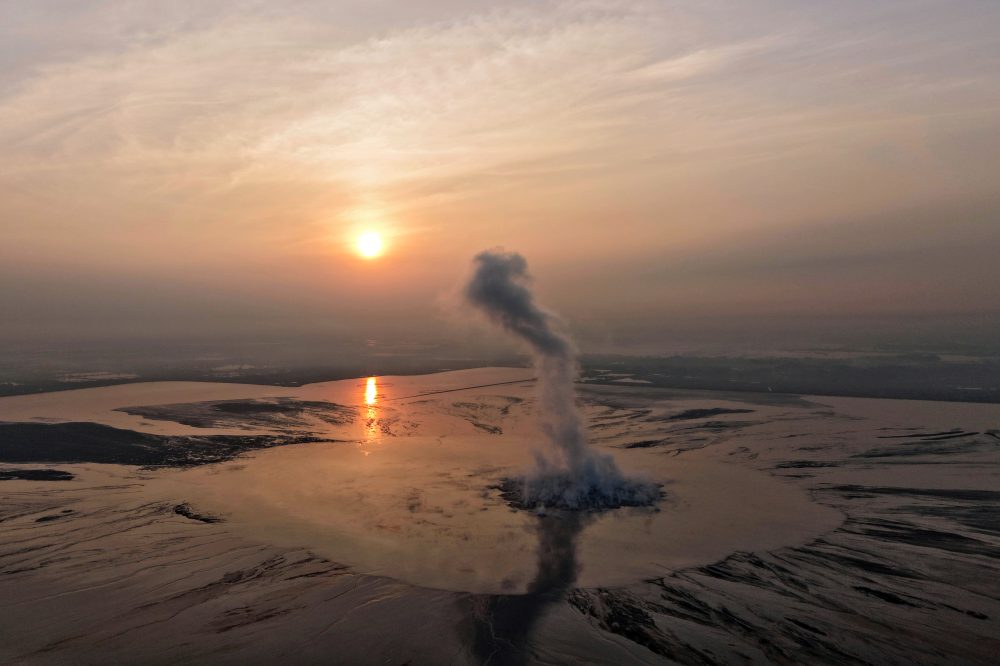
Twenty years after the initial eruption, white smoke continues rising from the mud lake’s center, demonstrating that hot material is still emerging from the underground vent. Excavation equipment regularly works to dredge the mud pond’s bottom.
Overhead images reveal the vent as a tiny spot within the enormous mud lake expanse, marking the source of what became one of Indonesia’s most significant and enduring disasters.
The flowing mud has impacted more than 1,100 hectares as it consumed 19 villages spanning three subdistricts.
Survivors continue facing numerous challenges today, including environmental pollution, health complications, civil documentation issues, and ongoing uncertainty about their futures, according to Lucky Wahyu Wardana from the Indonesian Forum for Living Environment, or WALHI, in East Java.
“The Lapindo tragedy must serve as a lesson for the government to stop relying on extractive industries, as the costs of the impact far outweigh the benefits.
“Not only have lives been lost, but children who once lived in the affected areas have lost their future and face health consequences,” Wardana said. “In addition, many parents have lost their sense of history regarding their origins and hometowns.”