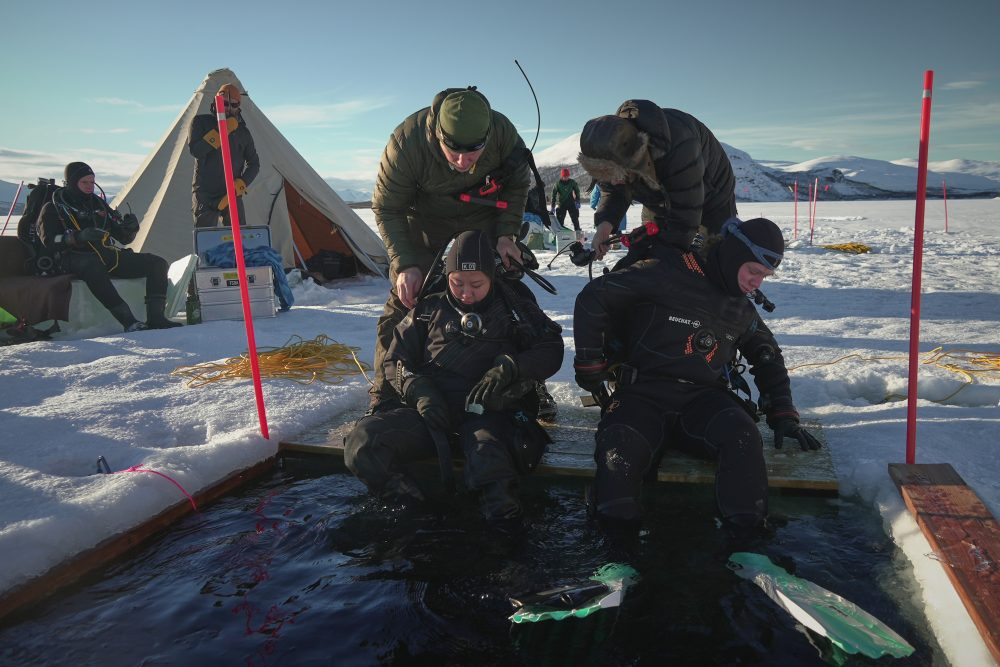

KILPISJÄRVI, Finland — Bubbles broke the surface of an icy Finnish lake as researcher Daan Jacobs surfaced through a carved opening in the frozen water.
His underwater journey had taken him 26 feet below, where Arctic sunlight penetrated the ice above and fish moved around rocky formations. Few people will ever witness this remote underwater world, particularly during winter when snow covers the ice and land temperatures plummet to minus 40 degrees.
Jacobs, who works as a biodiversity consultant in the Netherlands, represents a growing group of specialized underwater researchers.
He participated in the Polar Scientific Diving program in northern Finland this month, an initiative created by the Finnish Scientific Diving Academy to prepare future scientists and researchers for underwater exploration beneath polar ice to examine marine life below.
“The view is beautiful,” Jacobs said, catching his breath after completing his 45-minute underwater expedition.
Arctic regions are experiencing temperature increases four times greater than the global average. From altering worldwide weather systems to reducing polar bear populations that depend on sea ice for hunting, rising temperatures in the far north threaten the entire planet.
In the southern polar region, rising global temperatures are causing ice sheet deterioration, contributing to rising sea levels and disrupting marine environments.
Researchers must therefore examine what exists beneath the remaining polar ice in both regions and assess how environmental changes are impacting organisms that have historically thrived on the ocean floor with minimal sunlight exposure. However, conducting this research demands specialized underwater diving expertise combined with proper scientific training — credentials that authorities say fewer than several hundred individuals worldwide currently possess.
The Finnish Scientific Diving Academy’s program seeks to prepare additional divers while demonstrating that the polar ice emergency demands expanded research efforts.
“Because it is melting so fast, we need to have more people deployed there — more science to be done — to understand better what happens,” said Erik Wurz, a marine biologist and one of the class’s scientific diving instructors. “We have to do more and we need to be fast to save this unique ecosystem in the Arctic, but also the Antarctic.”
While technology increasingly relies on artificial intelligence and automated systems, British Antarctic Survey marine biologist Simon Morley emphasized that human involvement remains essential for this work. Using nets across the ocean floor would damage the environment, and remote-controlled submarines or robotic devices typically can collect only single specimens at a time.
“A diver can go down and pick up 12 urchins, put them in a bag and not affect the rest of the system,” said Morley, who isn’t part of the course.
Throughout each 10-day training period, academy instructors work with twelve experienced divers on a frozen lake at the University of Helsinki’s Kilpisjärvi Biological Station. The program launched in 2024 and high interest has enabled organizers to offer two sessions annually.
Students include marine and freshwater biologists, other scientists, skilled recreational divers, and documentary producers.
Ruari Buijs, studying marine biology and oceanography at the University of Plymouth in England, hopes to eventually work in Antarctica researching large marine animals. He joined this month’s polar diving program to improve his job prospects after graduation.
“I thought this would be a very good stepping stone toward that goal,” he said.
Caroline Chen, a scientific diver and research assistant in Germany, described diving in polar regions as her aspiration. She expects her training experience will help her plan future research projects in such demanding environments.
Students must master more than diving beneath ice nearly three feet thick into water temperatures barely above freezing. They also face harsh air temperatures and strong winds across Lake Kilpisjärvi.
These conditions challenge the surface support crew, which must manage equipment to protect divers while avoiding frostbite themselves. They also train as emergency backup divers in case the primary diver cannot locate the ice opening to return to the surface after 45 minutes underwater.
Once submerged, divers describe the experience as remarkable. During this month’s training, participants dove beneath ice approximately 2½ feet thick. Chen observed fish along the bottom and paused to watch sunlight filtering through the ice above, creating an effect similar to another Arctic spectacle.
“It looks insane from the bottom up,” Chen said. “It changes all the time, like the Northern Lights.”
Buijs noted that cold temperatures don’t impact covered body parts while diving. However, the mouth area remains exposed underwater.
“I think the worst thing is like your lips feel very numb afterward and they like stick out a lot,” he said, laughing. “You kind of get Botox lips a little bit.”