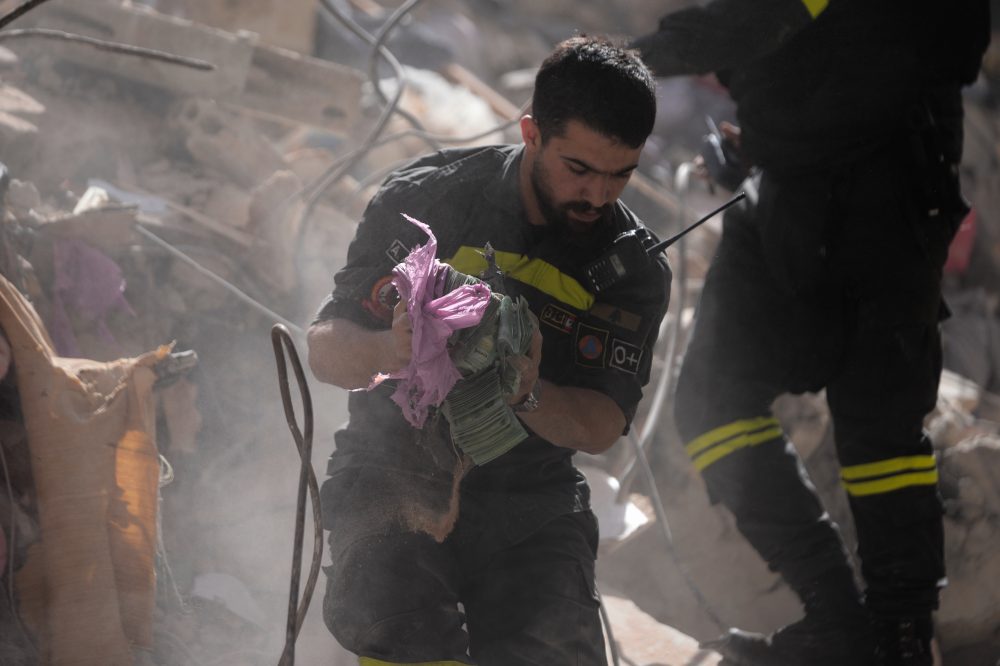

BEIRUT — Emergency crews worked frantically Thursday searching through rubble for survivors and victims following what became the most catastrophic day in more than five weeks of escalating conflict between Israeli forces and Hezbollah militants.
Wednesday’s Israeli airstrikes claimed the lives of at least 203 people while injuring over 1,000 others, according to Lebanon’s health ministry. Israeli military officials stated they focused on locations linked to the Iranian-supported Hezbollah organization, though multiple strikes impacted crowded business districts and residential neighborhoods without advance notice during peak traffic hours, resulting in extensive civilian casualties.
Lebanese President Joseph Aoun condemned the attacks as “barbaric.” Israeli officials stated that the ceasefire agreement regarding the Iran conflict does not extend to their operations against Hezbollah.
Elie Khairallah, spokesperson for Lebanese Civil Defense, informed The Associated Press that rescue teams discovered an injured woman alive beneath debris overnight in Beirut’s coastal Ain Mreisseh district, while another man was pulled alive from his collapsed apartment complex in the capital’s southern outskirts.
Families continued their agonizing wait for news. Mohammad Chehab, a Syrian resident originally from Deir el-Zour, reported that six of his ten family members had been recovered dead from a demolished structure.
“They’ve been searching all day” for the remaining relatives, he explained while observing rescue teams excavate through the debris.
Medical facilities became scenes of trauma as survivors and healthcare workers recounted the devastation.
“I thought I was dead. What happened? A big flash of light struck my face and eyes and I found someone flying over and landing next to me. He was dead,” survivor Rabee Koshok stated from his hospital bed at Makassed medical center in Beirut. He had been in the Corniche al Mazraa business area when an explosion struck a neighboring structure.
Dr. Wael Jarrosh reported that his hospital admitted approximately 70 wounded patients within ten minutes following the explosions. Two individuals died while five remained hospitalized, with three requiring intensive care treatment, according to Jarrosh.
“This has destroyed us psychologically,” the physician explained. “We have to stay prepared so that we can serve our families and the injuries that come in.”
Israeli authorities announced Thursday they eliminated Ali Yusuf Harshi, described as an assistant and relative of Hezbollah leader Naim Kassem, during the bombardment. Hezbollah has not yet responded to this claim.
Israeli Prime Minister Benjamin Netanyahu declared that military operations would continue “with force, precision and determination.” Israel’s armed forces have alleged that Hezbollah operatives are relocating from their traditional strongholds in southern Lebanon and Beirut’s southern suburbs, called Dahiyeh, to blend into civilian populations.
Lebanese Prime Minister Nawaf Salam announced Lebanon would submit an emergency complaint to the U.N. Security Council, characterizing the strikes as a “blatant violation” of international and humanitarian law.
Salam also revealed that Lebanon’s cabinet has directed security agencies to strengthen oversight of the capital by “enhancing the state’s full authority across Beirut and restricting arms to legitimate forces.” Prior to the current conflict’s renewal, Lebanon’s government had already been pursuing Hezbollah’s disarmament.
The ongoing war has forced over one million people from their homes, with many fleeing from southern regions and Dahiyeh. Israeli military forces have issued broad evacuation orders for residents to abandon these areas, subsequently conducting intensive bombing campaigns.
Israeli ground forces have additionally initiated a land offensive along the border region.
The primary border checkpoint connecting Lebanon and Syria resumed operations Thursday, five days after Israeli military officials threatened to target it, claiming Hezbollah was utilizing the crossing to transport military supplies. Both Lebanese and Syrian officials rejected these allegations.
More than 200,000 individuals have escaped from Lebanon into Syria since hostilities resumed.