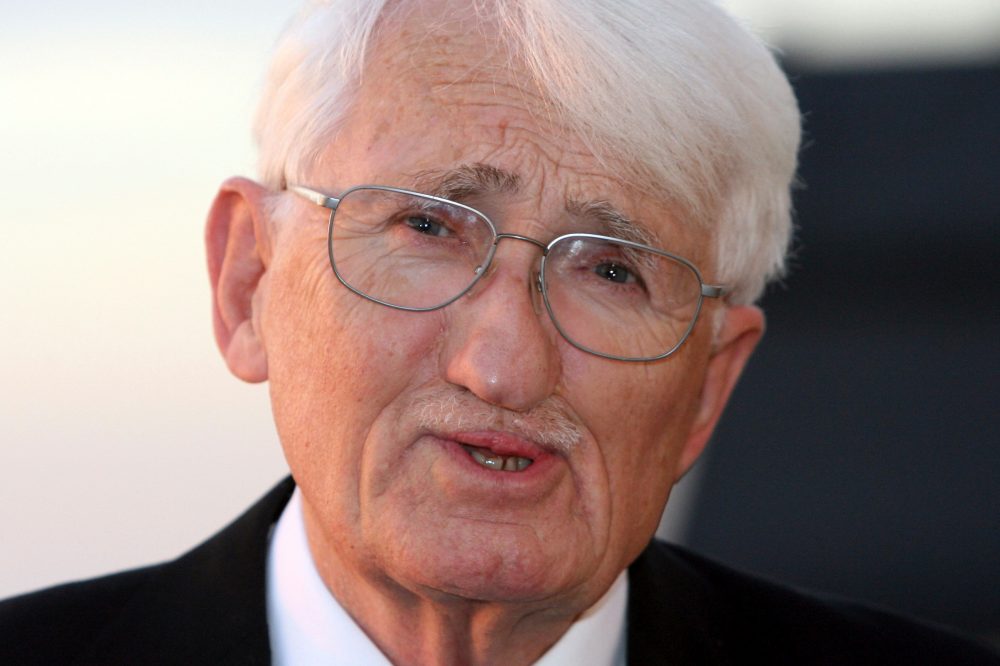

BERLIN — Jürgen Habermas, a towering figure in philosophy whose groundbreaking research on communication and rational thought established him as one of the most important thinkers of our time, passed away at age 96.
The German scholar died Saturday at his home in Starnberg, a town located near Munich, according to his publishing house Suhrkamp.
Throughout his career spanning multiple decades, Habermas regularly offered commentary on major political developments. His scholarly writings spanned multiple academic fields, offering insights into contemporary society and how people interact with one another. Among his most celebrated contributions was his comprehensive two-part work “Theory of Communicative Action.”
The philosopher, who was just 15 when Nazi Germany collapsed, later described how witnessing the beginning of a new chapter in 1945 and confronting the horrific truth about Nazi atrocities shaped his intellectual journey into philosophy and social analysis. He remembered realizing “you saw suddenly that it was a politically criminal system in which you had lived.”
During the turbulent student protests of the late 1960s, Habermas maintained a complex stance toward the left-wing movement in Germany and elsewhere. While he participated in discussions with activists, he also cautioned against what he termed “left-wing fascism” — a response to an inflammatory address by a student organizer that he later acknowledged was “slightly out of place.” Years afterward, he would credit the movement with spurring a “fundamental liberalization” throughout German society.
During the 1980s, Habermas played a central role in what became known as the Historians’ Dispute, where Berlin academic Ernst Nolte and his colleagues advocated for a revised interpretation of the Third Reich and German national identity. These historians sought to draw parallels between Hitler’s regime and brutalities committed by other nations, including Stalin’s mass killings in the Soviet Union. Habermas and his allies argued that these conservative scholars were attempting to diminish the severity of Nazi atrocities through such historical comparisons.
The philosopher endorsed the election of center-left leader Gerhard Schröder as Chancellor in 1998. He later criticized the “technocratic” governing style and apparent absence of political imagination under Schröder’s conservative replacement, Angela Merkel, lamenting in 2016 about the numbing impact on public discourse of “the foam blanket of Merkel’s policy of sending people to sleep.”
He expressed particular frustration with the “limited interest” demonstrated by German political figures, corporate executives and journalists in “shaping a politically effective Europe.” In 2017, he commended newly inaugurated French President Emmanuel Macron for presenting comprehensive European reform proposals, noting that “the way he speaks about Europe makes a difference.”
Born June 18, 1929, in Duesseldorf, Habermas spent his childhood in the neighboring town of Gummersbach, where his father served as director of the local chamber of commerce. At age 10, he joined the Deutsches Jungvolk, the Hitler Youth division for younger children.
A cleft palate condition at birth required multiple surgical procedures during his youth, an experience that significantly influenced his later theoretical work on language and communication.
Habermas described discovering the significance of verbal communication as “a layer of commonality without which we as individuals cannot exist” and remembered his difficulties in making others understand him. He also discussed the “superiority of the written word,” explaining that “the written form conceals the flaws of the oral.”
His spouse, Ute Habermas-Wesselhoeft, passed away last year. The couple raised three children together: Tilmann, Rebekka, who died in 2023, and Judith.