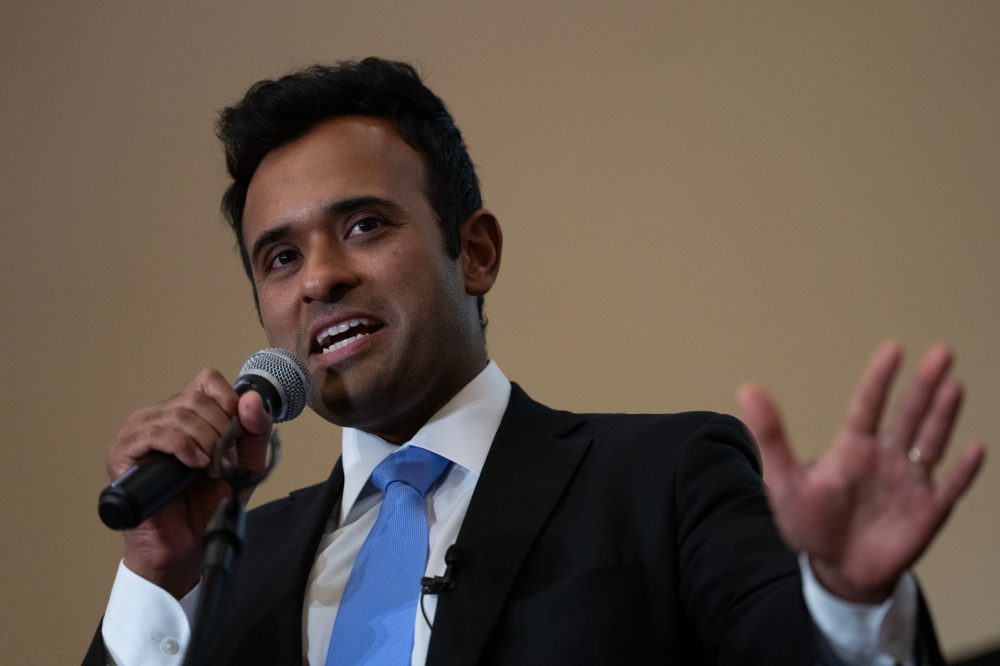

COLUMBUS, Ohio — While Vivek Ramaswamy appears to be cruising toward victory in Ohio’s Republican gubernatorial primary on May 5, the race has revealed some unexpected challenges for the former presidential candidate.
The biotech entrepreneur has leveraged his celebrity status from the 2024 presidential race, technology sector ties, and Trump’s backing to amass unprecedented campaign funds, which he’s now deploying in television advertisements targeting the November general election. Rather than focusing on his primary challenger, Ramaswamy has directed his campaign events and commercials toward attacking Democrat Amy Acton, Ohio’s former health department chief who will likely be his fall opponent.
Ramaswamy appears so confident about securing the Republican nomination that his team has essentially dismissed his primary rival up to this point.
“I believe this year we face the single greatest contrast between two candidates in the history of governor’s races in Ohio,” he told Republicans at a recent party fundraising dinner, referencing the general election. “We face the most consequential election for governor in the history of our state.”
However, the primary campaign has revealed some weak spots for the former White House hopeful.
The Cincinnati native is encountering increasing resistance from Republican voters frustrated by inflation, the chaotic handling of Jeffrey Epstein document releases, expanding data center demands, and Middle East conflicts. Ramaswamy has also drawn fire for policy proposals including merging Ohio’s university systems and increasing the minimum voting age to 25. Detractors argue these positions show the Harvard and Yale-educated tech mogul has lost touch with ordinary Ohio residents.
The attacks have turned personal, with some criticism rooted in ethnic and racial hostility toward Ramaswamy, whose parents immigrated from India.
Should Ramaswamy secure the nomination, his allies are less concerned about Republicans crossing party lines than about factors that might suppress conservative voter participation. Low turnout in November could potentially give Ohio its first Democratic governor in two decades.
“We have three opponents right now in this race,” Ramaswamy’s running mate, state Senate President Rob McColley, said in remarks to Republicans in rural Marion County that were shared by WGH Talk. “We have Amy Acton, we have the national political environment and then we have complacency. I would argue the third opponent is the most dangerous opponent we possibly have.”
Frustration among certain Ohio conservative voters has generated interest in Casey Putsch’s long-shot campaign.
Putsch, an engineer and car designer who brands himself “The Car Guy,” has gained followers through controversial YouTube content that mocks Ramaswamy and attacks national Republican leaders over Epstein file management, positions on power-hungry data facilities, and Middle East policy.
While his rallies draw small crowds and his campaign has collected just $123,000, Putsch has won support from some right-wing voters. Tyler Morris, who works in ambulance manufacturing in central Ohio, represents this constituency.
“When I hear people like Casey speak, he’s a guy like me,” Morris, 32, said as he was on his way to see Putsch speak at a Columbus park. “He’s just a guy that got pissed off one day. He’s not a politician. He’s like, do you know what — I want to speak for the average, everyday Ohioan.”
Morris explained he previously backed Trump but has since turned against the former president and refuses to support any Trump-endorsed candidate like Ramaswamy.
“I say I’m politically cynical, because it’s just like regardless of who I vote for, I feel like as an average Ohioan, it seems like things are just getting worse and worse for everyone,” he said.
Putsch’s campaign rhetoric has extended beyond appeals to working-class Ohioans. He has been criticized for promoting ethnic animosity toward Ramaswamy, frequently questioning the candidate’s Indian background and Hindu religious beliefs.
During his campaign launch, Putsch claimed Ramaswamy showed disdain for “American cultural values.” In one internet video, he demanded Ramaswamy “be destroyed.”
Following Putsch’s campaign announcement, Ramaswamy published an opinion column in The New York Times urging Republicans to reject white nationalist extremists within the party in favor of an American identity “based on ideals.”
“No matter your ancestry, if you wait your turn and obtain citizenship, you are every bit as American as a Mayflower descendant as long as you subscribe to the creed of the American founding and the culture that was born of it,” he wrote. “This is what makes American exceptionalism possible.”
The Cincinnati-born candidate later condemned racism and antisemitism within Trump’s “Make America Great Again” coalition during remarks at Turning Point USA’s AmericaFest, which angered some party members.
Following that speech, Ramaswamy’s social media accounts attracted increasingly vicious and racist comments. Putsch has also promoted racial slurs, including imagery showing Ramaswamy as an insect being exterminated and challenging him to “cowboys and Indians.”
In January, Ramaswamy withdrew from Instagram and X social media platforms.
“Leaders who depend on social media to gauge public opinion are looking through a broken mirror,” he wrote in a Wall Street Journal column.
Putsch ridiculed Ramaswamy’s withdrawal, writing on X that his opponent “can’t take the heat.”
Ohio Republican Party chairman Alex Triantafilou brushes off Putsch’s attacks as standard primary season tactics.
“The online right these days, it’s meaningless to the message of where we are as a party on the ground,” Triantafilou said.
He pointed to Ramaswamy’s national recognition, political abilities, and fundraising success — a record $50 million in total donations, though approximately half comes from Ramaswamy’s personal wealth.
“In every possible category of what we want in a candidate, he has it,” Triantafilou said.
Aaron Baer, who leads the Columbus-based Center for Christian Virtue, also dismisses Putsch’s criticism of Ramaswamy’s heritage, including challenges to Ramaswamy’s capacity to govern “a Christian state.”
“The bottom line is Vivek Ramaswamy, while he doesn’t share the Christian faith with me and millions of other Ohioans, he very much shares our values,” Baer said.
Ramaswamy has conducted what resembles a general election effort, attracting large audiences during stops in all 88 Ohio counties. His approach seems effective with voters like Pam Koch, a 70-year-old pharmacy employee who attended a Lincoln Reagan Day dinner featuring Ramaswamy as keynote speaker.
Koch identified herself as an anti-abortion Christian and said she attended “just to see where he stands, you know, spiritually and (on) everything that we value.” She left the event pleased with his presentation.
“I think he lines up with all of our values, so I’m excited about that,” she said.
Ron Eckles, a retired telecommunications worker, remains committed to Putsch, partially because of characteristics the candidate shares with Ramaswamy, including Ohio roots and entrepreneurial success. However, he views Putsch as superior on Second Amendment issues and appreciates that Putsch graduated from Ohio State University, while Ramaswamy attended Ivy League schools.
Putsch’s massive financial disadvantage doesn’t concern Eckles.
“I believe in miracles,” Eckles said.