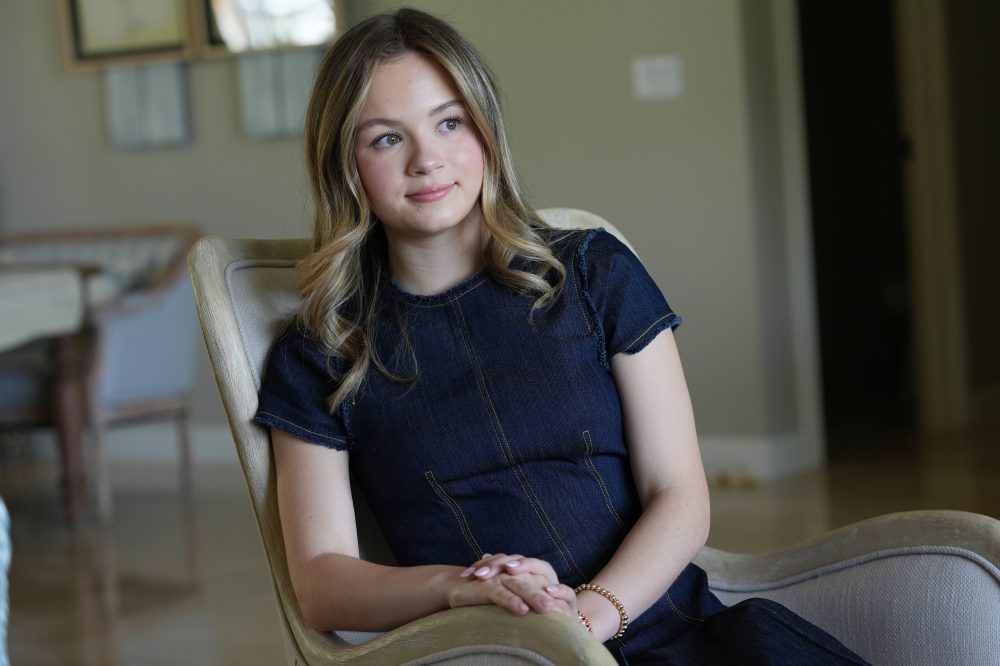

WASHINGTON — When 18-year-old Lauryn Muller came across a social media video showing President Donald Trump mocking California Governor Gavin Newsom’s dyslexia, painful memories from her childhood came flooding back. The incoming Auburn University student remembered her own reading struggles and moments when she questioned her abilities.
During recent remarks, Trump described Newsom as “stupid,” having a “low IQ,” being “mentally disabled,” and unsuitable for presidential office. While Muller understood this was political theater between a Republican president and a Democratic governor eyeing a 2028 White House bid, the words felt deeply personal.
“We’ve had to overcome so many deficits, and for someone to, on a national stage, say, yeah, they will never be like us — that definitely came as an emotional sting to me,” Muller explained, noting her dyslexia diagnosis came during childhood.
The president’s latest verbal attack adds to his pattern of questioning opponents’ intelligence and ridiculing people with disabilities. However, this instance targeted millions of Americans while contradicting decades of advocacy work aimed at reducing dyslexia-related stigma.
The response from the dyslexia community ranged from heartbreak to fury, transcending political boundaries and drawing criticism from both Trump supporters and opponents.
Marilyn Muller, Lauryn’s mother and a Florida-based literacy advocate, has supported Trump in three elections and continues backing his policies. Still, she felt wounded when the president connected dyslexia with reduced intelligence — an outdated misconception she fights daily.
“It works against everything I do on a daily basis,” Marilyn Muller stated. “It was probably one of the more ignorant comments I have ever heard come from his mouth.”
The president’s statements directly contradict extensive scientific evidence showing dyslexia has no relationship to intelligence levels. His remarks also stand in sharp contrast to proclamations he signed during his first presidency celebrating dyslexia awareness months, where he praised the “extraordinary contributions” of individuals with the condition and highlighted successful executives and innovators among their ranks.
Dyslexia, frequently misunderstood by the public, disrupts the connection between brain function and written text, creating reading challenges. The condition typically becomes apparent when children begin developing literacy skills and is believed to impact as much as 20% of the global population.
“All of a sudden, you’re not doing so well in school and then people will tell you, oh, you’re not trying, you’re not smart or whatever, and none of that’s accurate. You just have this difference in that bridge from language to print,” explained John Gabrieli, a Massachusetts Institute of Technology neuroscientist.
Newsom has openly shared his dyslexia experience for years, including in a 2021 children’s book and his recent memoir. During promotional events for his latest publication, he explained how he memorizes speeches since reading them aloud proves difficult. The governor characterizes his condition as both challenging and beneficial, crediting it with helping him develop alternative abilities.
Trump seized on portions of Newsom’s public statements about his learning difference. “He can’t read a speech, he can’t do almost anything,” Trump declared during a March Cabinet meeting. “He’s actually a very stupid person.”
The president added: “I think a president should not have learning disabilities.”
Trump recognized he was breaking protocol, calling his statement “highly controversial to say such a horrible thing.” Despite this acknowledgment, he repeated similar remarks at least four additional times.
Newsom’s representatives declined interview requests and directed inquiries to the governor’s social media responses. “Learning differences don’t define your limits, they shape your strengths,” Newsom posted online. “And no one, not even the President of the United States, gets to decide your worth.”
Utah resident Lia Beatty, 27, says she’s grown accustomed to Trump’s confrontational style, but she recognizes the potential harm in his recent statements. The university neurology lab director, who has dyslexia herself, worries that young people with the condition might internalize the president’s words and feel diminished.
“The harm isn’t necessarily in the headline. It’s what happens quietly,” Beatty observed. “It’s the student in the classroom who stops raising their hand, the college applicant who hides how they learn, the employee who doesn’t pursue a promotion that they’re more than qualified for.”
After encountering Trump’s comments online, Beatty decided to publicly announce her acceptance into Dartmouth College’s doctoral neurology program — news she had previously kept private. Her social media revelation aimed to counter the president’s narrative.
“I think it’s important to acknowledge that, yeah, the rooms — they weren’t made for us, but we’re still getting in them,” Beatty said.
Congress has traditionally shown bipartisan commitment to supporting individuals with dyslexia through a dedicated House caucus featuring advocates from both major parties. However, Republican lawmakers have largely remained silent regarding Trump’s recent comments.
The president’s statements weren’t addressed during Wednesday’s congressional dyslexia roundtable, hosted by Senator Bill Cassidy, a Louisiana Republican whose daughter has the condition and whose spouse operates a school for dyslexic children. Following the event, Cassidy avoided directly responding to Trump’s remarks.
“All I can say is that a child with dyslexia will grow to be, often times, a very talented adult,” Cassidy, who faces reelection without Trump’s endorsement, told The Associated Press. “There’s people who have self-identified as dyslexic who have become CEOs of hospitals and of great businesses.”
Arkansas Representative Bruce Westerman, who co-chairs the dyslexia caucus, has not issued any public response.
Historical experts point out that several former presidents likely experienced dyslexia themselves.
Woodrow Wilson documented his reading difficulties and became an early typewriter user as part of various coping strategies, according to presidential historian and Wilson biographer John M. Cooper.
Even within Trump’s inner circle, some figures have discussed their dyslexia challenges.
Gary Cohn, who designed Trump’s major first-term tax legislation, has spoken extensively about his childhood dyslexia struggles before becoming a business leader and Goldman Sachs president.
Advocacy groups warn that Trump’s rhetoric could undo years of progress in dismantling harmful stereotypes. His statements also raise concerns about his administration’s disability protection commitments, particularly as Trump plans to eliminate the Department of Education, which administers the Individuals with Disabilities Education Act.
Jacqueline Rodriguez, who leads the National Center for Learning Disabilities, said families will struggle to trust Trump’s education appointees “when their boss is making these really stigmatizing and really inaccurate statements.”
In Decatur, Georgia, Meagan Swingle felt physically ill upon hearing Trump’s comments. She discussed the situation with her 15-year-old son Enrique, who has dyslexia, anticipating he might encounter the remarks at school. While Enrique, who excels in mathematics and science, dismissed the president’s words, they continued troubling his mother.
“I don’t know that he remembers a time like I do when, whether you were a Democrat or a Republican or an independent, you could expect a higher standard from the president of the United States,” she reflected. “We build people up, we don’t tear them down.”