
WEST LAFAYETTE, Ind. — Former President Donald Trump faces a crucial test of his Republican Party influence as Indiana voters prepare to decide the fate of state senators who refused his redistricting demands.
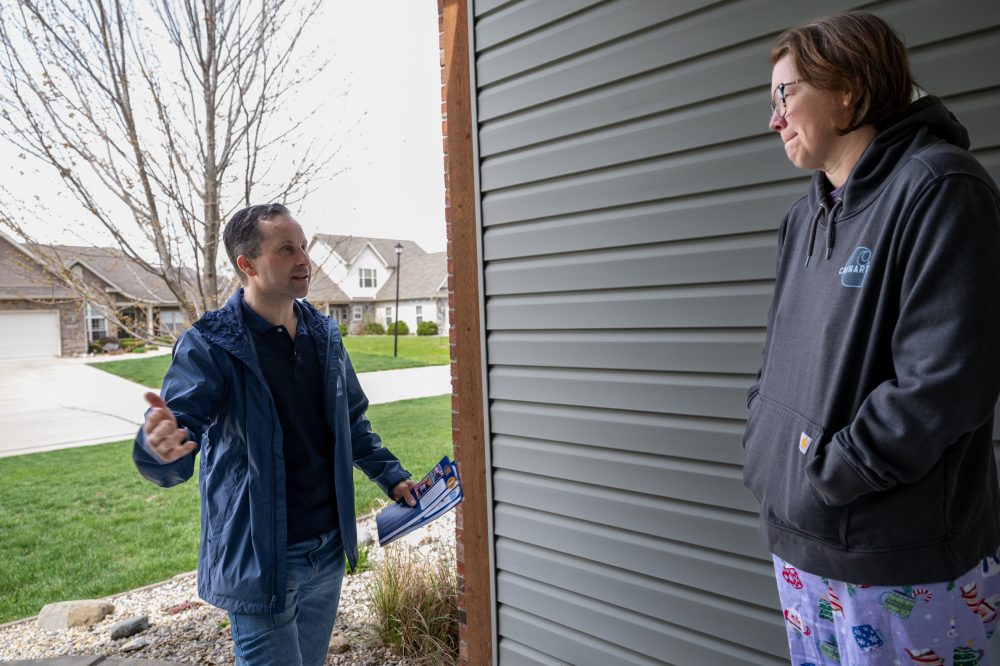
Julie Wise, a 48-year-old hospital employee from West Lafayette, represents the challenge Trump confronts. Despite describing herself as conservative and supporting Trump in the previous election, she won’t automatically vote against her state senator simply because he opposed the former president.
“I’m not going to say that ‘because this is what the president wants, this is how I’m going to vote,’” Wise explained while speaking from her doorstep on a bright spring day.
The May 5 Indiana primary has emerged as an unexpected measure of Trump’s Republican Party control. Following state senators’ resistance to White House pressure on redistricting, Trump backed seven primary opponents in contests that typically receive little national notice.
This unprecedented campaign involves national groups like Turning Point Action and Trump-supporting organizations that have invested over $4.2 million in advertisements. Republican Governor Mike Braun and U.S. Senator Jim Banks are also opposing sitting state senators, demonstrating their loyalty to Trump.
Among those being challenged is Spencer Deery, a freshman state senator who campaigned door-to-door through Wise’s West Lafayette community using an electric scooter.
“This is about one thing only,” Deery explained to The Associated Press. “And that’s control.”
Deery serves the 23rd Senate District, covering seven rural counties that extend from the Illinois border through West Lafayette and near Terre Haute’s outskirts.
When Deery first won his position four years ago, his campaign invested $142,000 in a contest with fewer than 11,000 voters. Among his defeated opponents was Paula Copenhaver, an experienced Republican organizer and local party leader.
Trump has now backed Copenhaver, who works as an aide to Lieutenant Governor Micah Beckwith, while Deery confronts nearly $1 million in opposition spending. Television commercials have claimed that “State Sen. Spencer Deary voted against President Trump’s agenda.”
“It’s about sending a message that any state that does not get in line or any lawmakers that do not get in line with the political forces in D.C. should be on the lookout,” Deery warned. “That should concern you in a constitutional democracy.”
Deery has invested $167,000 in his campaign without assistance from external organizations.
Copenhaver refused to respond to phone calls and messages from The Associated Press despite initially agreeing to discuss her campaign. Trump supported her in January, calling her a “MAGA Warrior” and “a terrific Candidate for Indiana’s 23rd State Senate District.”
On social media, he wrote that Copenhaver was “running against an incompetent and ineffective RINO incumbent named Spencer Deery who, for whatever reason, betrayed his voters by voting against Redistricting in Indiana.” The term RINO stands for “Republican in name only.”
The White House pressured Indiana legislators extensively last year to abandon tradition and implement new congressional boundaries, part of a broader national redistricting effort Trump believed would help Republicans maintain their narrow U.S. House control in November’s elections. Vice President JD Vance conducted meetings with Indiana officials in both Washington and Indianapolis, while Trump participated through conference calls.
Several proposal opponents received threats. Deery became the victim of a fraudulent police report designed to create a dangerous scenario by dispatching a SWAT team to his residence.
However, the Republican-majority state Senate rejected redistricting in December, delivering a setback to the president.
Trump later downplayed the defeat, telling Oval Office reporters that “I wasn’t working on it very hard.”
While Deery canvassed the well-maintained suburban neighborhood bordering a clover field in northwest West Lafayette, two motorcyclists on a Saturday ride paused to support him.
“I wanted to thank you for having the courage to vote against the redistricting,” one rider stated.
Annette and Curtis Williams conversed politely with Deery at their entrance. Curtis described Trump’s attempt to remove Deery as “inappropriate,” though neither he nor his spouse revealed their voting intentions.
Beckie Eikenberg, a quality assurance worker at an Indiana pharmaceutical facility, has observed the advertisements attacking Deery but remains skeptical of their claims. The 47-year-old, who identifies as “libertarian on the conservative side,” spoke with the state senator near her cul-de-sac’s end.
Though she supported Trump, Eikenberg questioned whether the president should influence Indiana’s congressional boundaries.
“He doesn’t necessarily know what’s going on within our state. He’s not here. He doesn’t see the day to day,” she observed.
The effort to remove incumbents also aims to eliminate Indiana Senate President Pro Tem Rodrick Bray, who helped prevent redistricting and faced Trump’s criticism.
While Bray isn’t seeking reelection this year, Braun reportedly demanded that primary challengers pledge to oppose him as Senate leader, according to three sources familiar with this requirement. These individuals requested anonymity because they weren’t authorized to discuss private conversations publicly.
Trump political advisors confirmed they were monitoring these campaigns. Representatives for Banks, the U.S. senator aligned with the White House, didn’t respond to requests for comment.
Governor Braun stated he’s supporting primary challengers not due to redistricting but because he requires assistance advancing his priorities. He previously disagreed with Bray regarding property taxes during his term.
Braun is contributing $500,000 from his political action committee to state senate contests.
“Whether you supported this or that, my goal is to get enterprising senators and representatives,” Braun explained Monday. “So when it comes to what you do to either support or not support certain legislators, for me, it’s going to mostly based on, ‘Are you willing to help me take Indiana into places that all states would want to be?’”
A former governor is opposing Braun in the primary. Ex-Governor Mitch Daniels, a Republican who withdrew from politics after leaving office in 2015, has quietly worked to defend incumbents targeted by Trump.
Daniels created a video and helped fundraise for Deery, who served as the former governor’s chief of staff when he became Purdue University president.
Deery emphasized that his redistricting vote wasn’t about opposing Trump or the president’s supporters.
“I don’t work for them,” Deery declared. “I work for my voters, my constituents.”