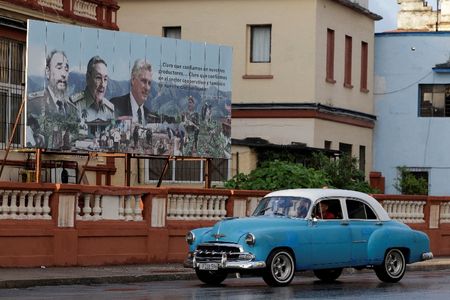

HAVANA, May 15 – Washington’s intention to bring criminal charges against Cuba’s former leader Raul Castro regarding the destruction of civilian aircraft two decades ago has heightened anxieties across the Caribbean island nation on Friday, as Cuba grapples with its most severe economic crisis in recent memory while facing critical fuel supply problems.
Criminal charges against the 94-year-old revolutionary figure would represent a significant intensification of the pressure tactics employed against Cuba by the Trump administration, which has characterized the island’s communist leadership as both corrupt and incompetent while demanding political transformation.
Cuban officials have not yet issued a direct response to the indictment threat, though Foreign Minister Bruno Rodriguez demonstrated resistance on Friday.
“Despite the (U.S.) embargo, sanctions and threats of the use of force, Cuba continues on a path of sovereignty towards its socialist development,” Rodriguez said in a meeting of BRICS foreign ministers.
Reuters spoke with Cuban citizens in Havana who believe criminal charges would only reverse progress in U.S.-Cuba relations, worsening the diplomatic standoff between the neighboring countries.
Sonia Torres, 59, a Havana schoolteacher, viewed potential prosecution of Raul Castro, who spent decades leading the nation’s armed forces before serving as president from 2008 to 2018, as an insult to Cuban national dignity during a period of hardship.
“Cubans must always keep moving forward,” she said. “If they try to process Raul, we’ll defend Cuba with sticks and rocks if we have to.”
Strained diplomatic ties between the two neighboring nations trace back to Fidel Castro’s 1959 communist revolution. Castro formed an alliance with the Soviet Union, then confiscated U.S.-citizen owned businesses and properties, fueling decades of tensions between the two nations.
The Trump administration has besieged Cuba since January, implementing a de facto fuel blockade, issuing threats of military action and intensifying sanctions that have compelled foreign businesses – including Canadian miner Sherritt International – to flee.
However, criminal charges against Castro would represent a pivotal moment, according to Peter Kornbluh, an author of a history of secret negotiations between Cuba and the United States, who said an indictment would likely represent “the diplomatic endpoint” to negotiations.
“This was an ultimatum: It’s do or die time,” Kornbluh said. “(The indictment) has created a fig leaf of legality for any military operations to seize or assassinate Raul Castro.”
The United States has previously used criminal cases against foreign political figures to justify military actions, and Trump has threatened that Cuba “is next” after his administration in January captured Venezuela leader Nicolas Maduro.
His government called the military raid a “law enforcement operation” to bring Maduro to New York to face criminal charges.
The younger Castro remains considered the island’s most powerful living leader and emblem of the Cuban revolution, despite no longer maintaining an official government position.
BROTHERS TO THE RESCUE
A potential Castro indictment, the U.S. Department of Justice sources said, ties back to Cuba’s 1996 shootdown of two planes operated by humanitarian group Brothers to the Rescue.
Cuba at the time defended the attack as a legitimate defense of its airspace but the U.S. position was later backed up by the International Civil Aviation Organization, which concluded the shootdown took place over international waters.
Fidel Castro said Cuba’s military had acted on “standing orders” to down planes entering Cuban airspace. He said brother Raul, then defense minister, did not give a specific order to shoot the planes.
Havana resident Eliecer Diaz, 45, said then, as now, Cuba had to defend itself in the face of U.S. aggression.
“That’s an invasion … and you have to defend yourself,” said Havana resident Eliecer Diaz, 45. “If they are now thinking of prosecuting (Raul Castro), I think that is wrong.”