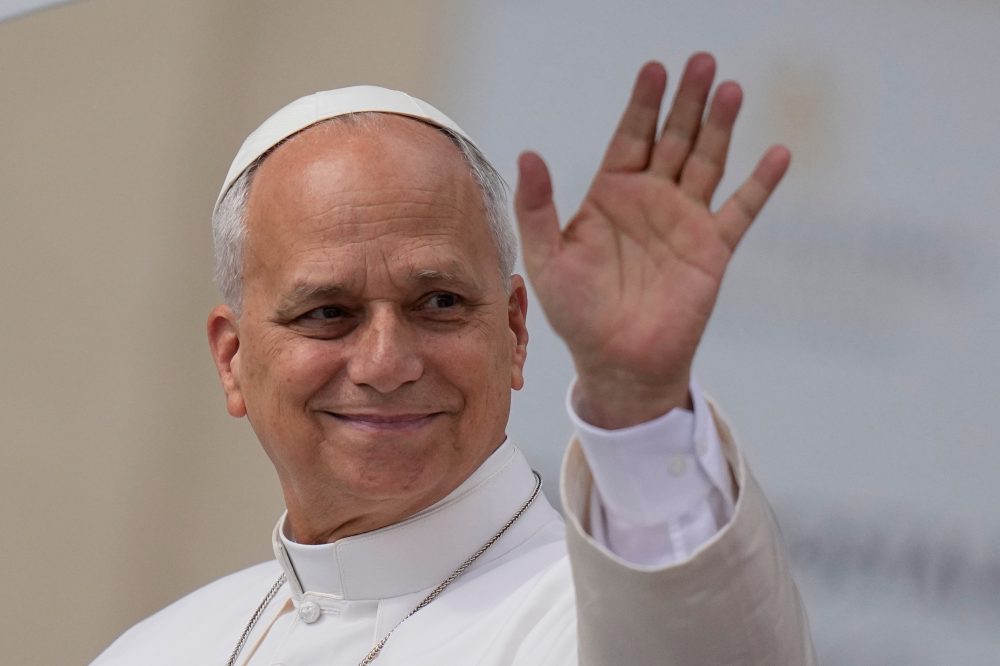

VATICAN CITY — Church officials are preparing for the publication of Pope Leo XIV’s inaugural encyclical, a major document anticipated to focus on artificial intelligence while demanding an ethics-centered approach to technology that puts human dignity, social connections and peace first.
Church leaders revealed that Leo signed the document on Friday, marking exactly 135 years since his predecessor, Pope Leo XIII, signed his groundbreaking encyclical “Rerum Novarum,” which means “Of New Things.” That historic document tackled worker rights, capitalism’s boundaries and the duties that governments and employers had toward workers during the Industrial Revolution.
That earlier encyclical established the foundation for contemporary Catholic social doctrine, and the current pope has already referenced it regarding the AI transformation, which he views as presenting the same fundamental challenges that the Industrial Revolution created more than a century ago. The upcoming encyclical is anticipated to frame the AI issue within the church’s social teachings, which encompass topics like employment, justice and peace.
“I think that the Catholic Church in many ways is going to be the adult in the room on some of these debates about how we are going to integrate AI into the rest of our society,” said Meghan Sullivan, a philosophy professor at the University of Notre Dame who directs its ethics institute. “For sure, the pope is going to be one of the most forceful advocates for human dignity in these discussions.”
Within days of his 2025 election, Leo informed the cardinals who elected him that the Catholic Church had an obligation to provide the world with the “treasury of her social teaching” to address AI’s challenges to “human dignity, justice and labor.”
The American pope, who studied mathematics and is known for spending time on his phone, will probably address the topic this weekend, as the Vatican observes its social communications day on Sunday with a message focused on the human costs of the AI competition. In that message, published earlier this year, Leo cautioned about maintaining genuine human connections despite chatbot “friends,” protecting human creativity against AI-generated music and videos, and preserving human authenticity in the face of generative AI deepfakes.
The public unveiling of the encyclical, anticipated in the coming weeks, will probably create new tensions between the Chicago-born Leo and the Trump administration, which has prioritized rapid AI advancement as crucial to national economic and security interests. The United States has firmly opposed international regulatory attempts to control AI development, and domestically, the Trump administration has eliminated bureaucratic barriers that were slowing progress.
The document received the pope’s signature as President Donald Trump concluded a China visit that involved AI business matters. Among those traveling with Trump on Air Force One were Elon Musk, whose social media platform X includes his AI chatbot Grok, and Nvidia CEO Jensen Huang, who recently obtained federal permission to sell H200 AI chips to Chinese customers.
Following the AI surge that began with ChatGPT’s launch, the technology’s remarkable abilities have fascinated the globe. Technology corporations have competed to create superior AI systems while experts caution about risks, ranging from distant existential dangers like uncontrolled rogue AIs to immediate issues like bias in automated hiring processes.
The United Nations adopted new governance structures last year to control AI after earlier international efforts, including AI conferences hosted by Britain, South Korea and France, produced only voluntary commitments. The European Union implemented its own Artificial Intelligence Act in 2024, using a risk-based framework for AI regulations.
The Vatican has attempted to contribute to the discussion, providing ethical guidance for AI implementation in areas from military operations to education and healthcare. The central message has been that technology should serve as a tool to enhance, rather than substitute for, human intelligence.
The Vatican has additionally cautioned about AI development’s environmental consequences, highlighting the “vast amounts of energy and water” required for AI data centers and computing power.
“There are almost a billion and a half Catholics in the world, so that alone is reason to pay attention,” said Thomas Harmon, theology professor at the University of St. Thomas in Houston. “But beyond the numbers, the Catholic Church has a deep and sophisticated tradition of thinking through what it means to be human.”
In 2020, the Vatican persuaded technology companies to endorse an AI commitment called the Rome Call for AI Ethics, which established fundamental principles for AI oversight, including inclusiveness, accountability, impartiality and privacy. Microsoft, IBM and Cisco were among the private companies that participated.
During his later years, Pope Francis advocated for an international agreement to govern AI, arguing that the dangers of technology without human values like compassion, mercy, morality and forgiveness were too significant to rely solely on the ethics of AI researchers and developers.
He also used his influence within the Group of Seven, speaking at a special session about AI’s dangers and potential in 2024. There, Francis stated that political leaders must ensure AI stays human-centered, so that choices about weapon use or other tools always remain with humans. He ultimately advocated for prohibiting lethal autonomous weapons, commonly called “killer robots.”
Internally, Leo has cautioned priests against using AI for sermon writing, but he has also spoken out about AI’s broader effects on global peace, employment and the fundamental nature of reality.
For the Augustinian pope, generative AI’s capacity to mislead and deceive through deepfake images is especially concerning, since truth-seeking is a core component of his religious order’s spirituality.
During a June 2025 address to an AI conference, Leo recognized generative AI’s contributions to medical care and scientific research. However, he questioned “its possible repercussions on humanity’s openness to truth and beauty, on our distinctive ability to grasp reality.”
Leo, who has consistently advocated for peace, has also demanded oversight of AI use and development in Middle Eastern and Ukrainian conflicts, where automated weapon systems employ aerial drones and maritime and ground platforms.
“What is happening in Ukraine, in Gaza and the Palestinian territories, in Lebanon and in Iran illustrates the inhuman evolution of the relationship between war and new technologies in a spiral of annihilation,” he stated this past week at La Sapienza, Europe’s largest university.