
VIENNA (AP) — Saturday brings the climactic finale of the Eurovision Song Contest, where heightened security measures and soggy conditions haven’t dampened fan excitement or silenced protesters demanding Israel’s removal from the competition.
Following a week of anticipation, performers representing 25 nations will compete on the Wiener Stadthalle stage for Europe’s most coveted musical prize. Global audiences numbering in the millions will evaluate diverse acts including a passionate Finnish violin player, a folk-rap artist from Moldova, and a heavy metal group from Serbia during this milestone 70th anniversary celebration.
This flamboyant, vibrant competition has drawn comparisons to soccer’s World Cup, substituting melodies for matches. Similar to international sporting events, political tensions frequently surface. For the third consecutive year, controversy surrounds demands to bar Israel due to Gaza-related conflicts and other disputes, prompting five regular participants — Spain, the Netherlands, Ireland, Iceland and Slovenia — to withdraw in protest.
Those unfamiliar with Eurovision’s blend of entertainment and political undercurrents need only examine two crowd-pleasing acts that emerged during the week’s preliminary rounds before Saturday’s championship event.
Rapper Satoshi’s “Viva, Moldova” combines “a stunning high energy performance with a subtle pro-European political message,” from a country moving toward the European Union after decades in Moscow’s orbit, said Eurovision historian Dean Vuletic. Greek artist Akylas’ song “Ferto,” or “Bring It,” provides a playful take on conspicuous consumption in a country still scarred by the economic wounds of the 2008 financial crisis.
Television audiences will likely award both acts high scores, though professional judging panels, who typically favor technical skill, may respond differently. Victory depends on combined voting from both groups, converted through a point system that puzzles even devoted Eurovision followers. The highest-scoring performer claims victory, earning their nation hosting rights for next year’s contest.
Finland leads wagering predictions with “Liekinheitin,” or “Flamethrower,” a passionate collaboration featuring pop vocalist Pete Parkkonen and classical violinist Linda Lampenius.
However, Eurovision frequently delivers unexpected outcomes.
“Eurovision has never really been a contest for big stars. It’s largely been a contest for underdogs,” Vuletic said. “People like to see the underdog on stage. They like to the artist-in-the-making on stage or an artist from a smaller, poorer country on stage.”
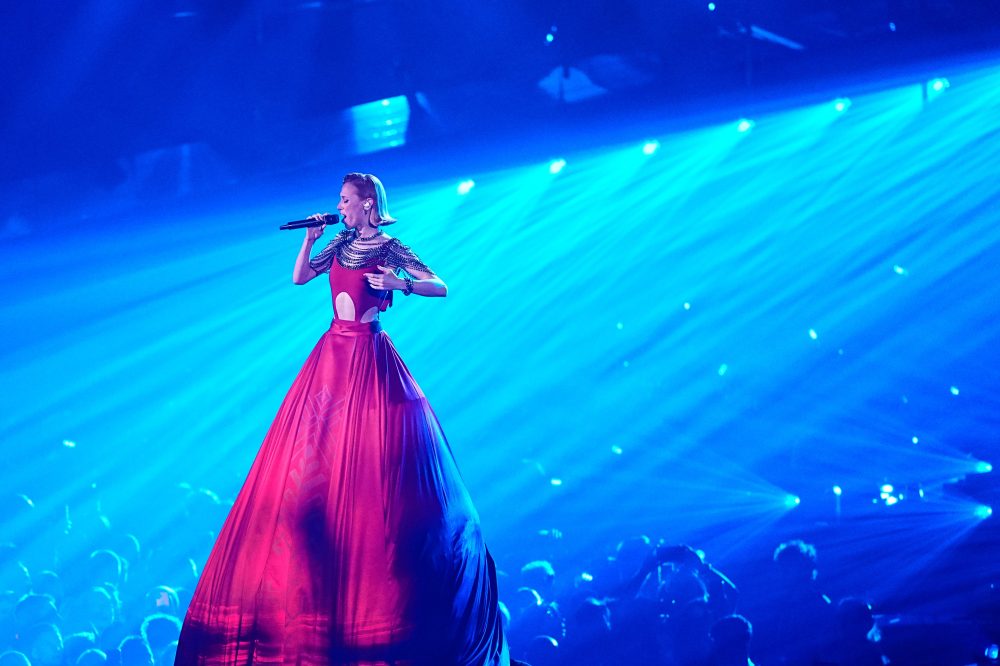
Australia presents an intriguing possibility, having participated since 2015 by sending established performer Delta Goodrem. Her polished moderate-tempo ballad “Eclipse” — featuring a dramatic performance where she’s lifted above a sparkling piano — has gained momentum in betting markets. Should she triumph, a European nation would likely serve as Australia’s proxy host next year.
Israeli representative Noam Bettan has received positive audience reactions inside the venue, despite four demonstrators being removed after attempting to disrupt his Tuesday semifinal appearance.
Public demonstrations condemning Israel’s participation due to its military actions against Hamas in Gaza have been more subdued in Vienna compared to the 2024 competition in Malmo, Sweden and last year’s event in Basel, Switzerland.
Organizers have scheduled a protest against Israel’s involvement before Saturday’s finale, while pro-Palestinian organizations held an outdoor performance Friday titled “No stage for genocide.”
“Inviting Israel on such a beautiful stage as the Eurovision Song Contest stage is an affront to all the people who believe in humanity, who believe in love and togetherness,” said Congolese-Austrian artist Patrick Bongola, one of the organizers. He said the concert aimed to “show the world that not all Austrians are happy with this decision.”
The five-country withdrawal represents a significant financial and audience setback for an event that organizers report attracted 166 million global viewers last year. This year’s 35-competitor lineup marks the smallest field since 2003.
Nevertheless, Eurovision plans continued growth, with a new Eurovision Song Contest Asia scheduled for Bangkok in November.
Vuletic notes that political disputes aren’t unprecedented. The inaugural Eurovision boycott occurred in 1969 — ironically by Austria, which declined to participate in Spain under dictator Francisco Franco.
“We’ve seen very politicized editions of the contest in the recent past,” Vuletic said, including the 2009 contest in Russia, Azerbaijan’s turn as host in 2012 and the 2024 competition in Sweden, marred by protests and the expulsion of a competitor for allegedly threatening a female camera operator.
“All of them were very much mired in political controversy, yet Eurovision continues,” he said.