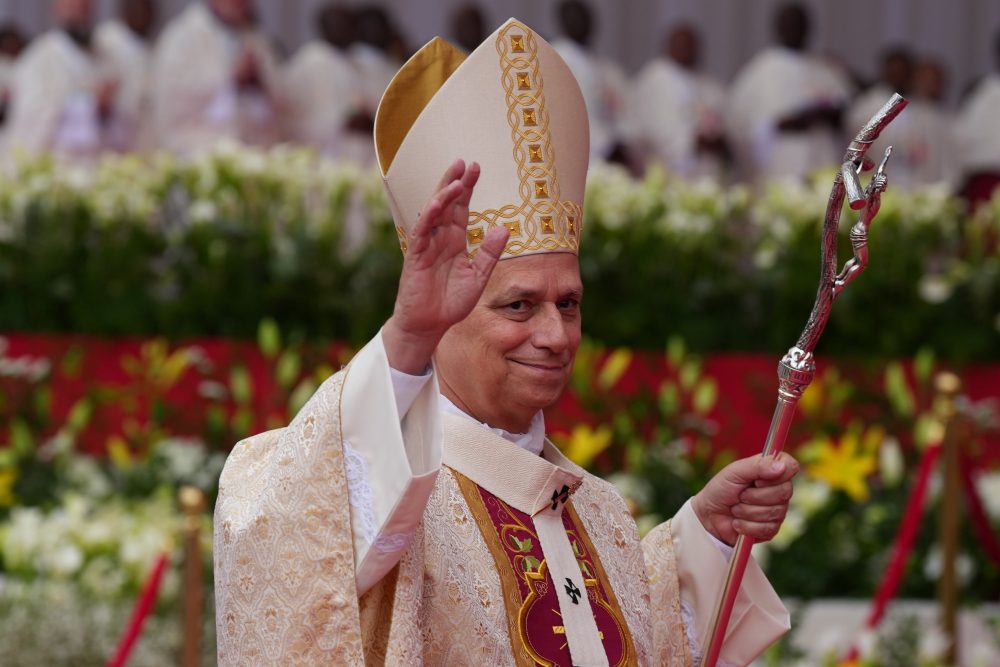

MALABO, Equatorial Guinea — Pope Leo XIV concluded his historic African journey Thursday with a final religious service in Equatorial Guinea, ending what many consider one of the most headline-grabbing papal visits ever due to his remarkable public dispute with President Donald Trump.
Heavy rains soaked the Malabo sports stadium and approximately 30,000 worshippers who had assembled before sunrise for Leo’s closing ceremony. However, the downpour subsided before Leo’s arrival in his enclosed papal vehicle for his procession through the enthusiastic crowd.
The pontiff departed following an extensive 11-day journey across four African nations, traveling from Algeria in northern Africa down to Angola in the south, with Cameroon included in his itinerary.
During this period, Leo traveled more than 17,700 kilometers (approximately 11,000 miles) across 18 separate flights, including three flights on Wednesday alone that had him traveling across Equatorial Guinea from the western coastline to the eastern border with Gabon and returning.
Throughout his journey, Leo, who became history’s first American pope, was greeted with enthusiastic receptions, particularly in remote locations that had never before hosted a papal visit.
While papal international travel began with Pope Paul VI’s inaugural modern foreign journey in 1964 to Jordan and Israel, it was St. John Paul II who transformed the papacy through his extensive worldwide travels, completing 104 international trips spanning 25 years, establishing the multi-country format that Leo’s recent journey appeared to follow.
During Leo’s closing Mass Thursday, sisters Michaela Mecha and Encarnacion arrived at the Malabo stadium during the heavy rainfall at 4 a.m. Both wore complete pope-themed clothing, including yellow umbrellas featuring Leo’s image.
“We feel very special and blessed that the pope has chosen our country,” said Michaela, who works as a nurse and brought her two young daughters with her. “This visit is bringing young people closer to God.”
During his sermon, Leo mentioned the April 17 death of Rev. Fr. Fortunato Nsue Esono Ayíambeng, who served on the trip’s organizing committee and held the position of vicar general of Malabo.
“May full light be shed on the circumstances of his death,” Leo said, in apparent reference to rumors that foul play might have been involved.
Nobody anticipated that Leo’s inaugural African papal visit would unfold amid Trump’s unprecedented criticism regarding the Iran conflict. However, the timing placed Leo in the media spotlight from the beginning, with the confrontation continuing for several days.
On the first day, Leo maintained he was simply sharing the Gospel of peace and expressed no fear of the Trump administration after Trump criticized him for being lenient on crime and aligned with liberal politics. As the criticism persisted and Vice President JD Vance entered the dispute, advising Leo to “be careful” when discussing theology, Leo attempted to calm tensions by blaming media misinterpretation of his statements.
This approach appeared successful, as both Leo and the Trump administration moved forward, allowing the pope to focus on his African mission. His agenda centered on encouraging Catholics with messages of hope while condemning what he termed the “colonization” of the continent’s natural resources by foreign powers.
The journey included emotionally charged moments, including when Leo departed from a planned visit to a psychiatric facility in Sampaka, Equatorial Guinea, to personally meet each patient and take photographs with them.
Another significant moment occurred when Leo, whose family history includes both enslaved individuals and slave owners, prayed the rosary in Muxima, Angola. This location, once a major center of the African slave trade, has become Angola’s primary pilgrimage destination following a reported Virgin Mary apparition around 1833.
Personal visits also occurred, such as when Leo met with nuns from his Augustinian religious community in Bab El Oued, Algeria, and examined jewelry crafted by local women. He selected a necklace with a tree of life pattern and told the superior, “It’s not for me, it’s for my niece.”
In Bamenda, Cameroon, he visited the center of a conflict that has lasted nearly ten years and pleaded for peace while criticizing the “handful of tyrants” destroying the planet. These comments prompted Leo to approach reporters on his plane days later to clarify he wasn’t referring to Trump.
One particularly concerning incident occurred in Bata, Equatorial Guinea, during Leo’s prison visit. All prisoners, with shaved heads, wore new bright orange or beige uniforms and new rubber shoes resembling Crocs. The facility had received fresh salmon pink paint with newly planted trees around its borders.
The prisoners stood quietly in apparently designated positions in the open yard awaiting Leo’s arrival. Upon his entrance, they performed a song about their wrongdoings. As Leo spoke about God’s love and their worth, they danced and waved Holy See flags in coordinated movements while heavy rain began falling on everyone.
Immediately after Leo’s departure, while the country’s justice minister remained in the courtyard, the prisoners abandoned their positions and began an energetic, dancing chant of “Libertad! Libertad! Libertad!” (Freedom! Freedom! Freedom!)
The extended journey allowed for several notable moments: Leo commemorated the first anniversary of Pope Francis’ death with an impromptu tribute from the papal aircraft, remembering Francis’ compassion and symbolic actions.
Leo also congratulated the few journalists who had birthdays during the trip, with each celebration including birthday cake distributed by the ITA Airways crew.
Leo’s informal comments to journalists while traveling between nations provided opportunities for local Vatican press pool members to ask questions relevant to their home audiences. One revelation that particularly pleased Angolans was Leo’s disclosure that Angola might receive its first cardinal, though not immediately but “a bit further on.”