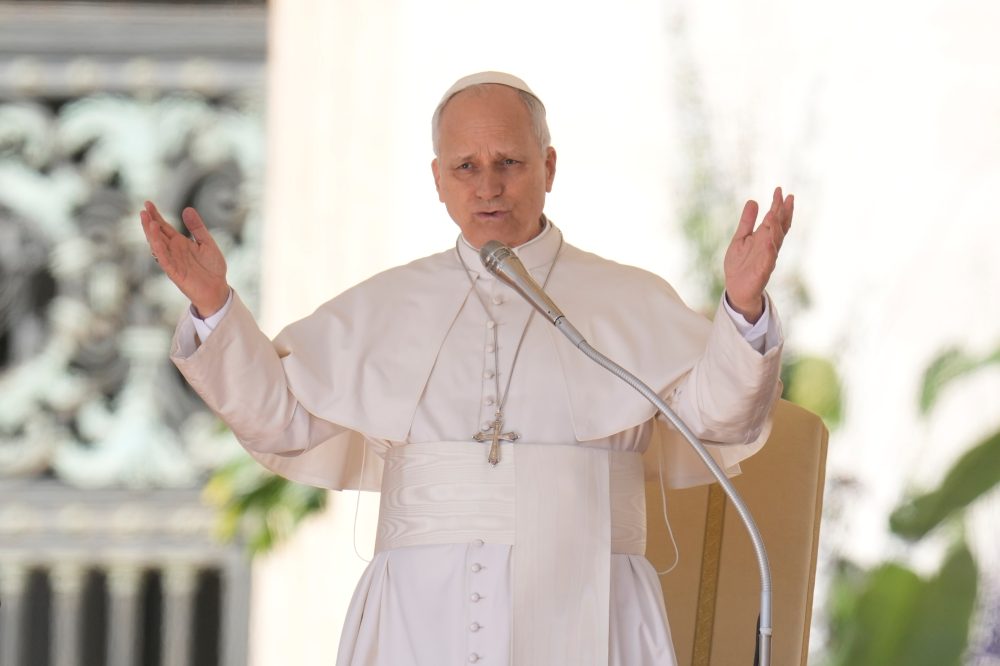

ROME (AP) — Pope Leo XIV intensified his opposition to the ongoing U.S.-Israeli conflict with Iran during remarks Friday, declaring that divine blessing never accompanies warfare and certainly doesn’t favor nations that engage in bombing campaigns.
The pontiff delivered these comments while addressing senior bishops from the Chaldean Catholic Church of Iraq, an Eastern Rite Catholic denomination whose leadership has gathered in Rome to select a new patriarch.
Leo described the bishops as beacons of hope “in a world marked by senseless and inhuman violence,” particularly in regions where early Christianity flourished that have been “desecrated by the blasphemy of war and the brutality of business, with no regard for people’s lives.”
The pope emphasized that no justification exists for shedding innocent blood, encouraging the bishops “to proclaim clearly that God does not bless any conflict; to cry out to the world that whoever is a disciple of Christ, the Prince of Peace, never stands on the side of those who yesterday wielded the sword and today drop bombs.”
The Vatican amplified this message by sharing the pope’s statement on his official @Pontifex account on X.
Political figures have invoked religious justifications throughout the war. American leadership, particularly Defense Secretary Pete Hegseth, has referenced Christian beliefs to defend the conflict and portray the United States as a Christian nation battling its enemies.
Following initially restrained calls for peace and negotiation during the conflict’s early stages, Leo escalated his criticism of the Trump administration beginning on Palm Sunday, when he declared that God ignores the prayers of warmakers.
Earlier this week, the pope condemned President Donald Trump’s threat to destroy Iranian civilization as “truly unacceptable” while advocating for diplomatic solutions.
The Vatican expresses particular alarm about the expansion of Israel’s conflict with Hezbollah into Lebanon, citing concerns for Christian populations in the region’s southern areas.
Leo will lead a special peace vigil Saturday evening at St. Peter’s Basilica. Officials scheduled this prayer service before announcing high-level negotiations between the United States and Iran, set to begin Saturday in Pakistan.
Despite the pope’s increasingly sharp rhetoric, both Vatican officials and the U.S. government worked Friday to dismiss speculation about deteriorating diplomatic relations. These concerns emerged from news reports describing a reportedly tense January meeting between Pentagon officials and Cardinal Christophe Pierre, the Vatican’s departing ambassador to Washington.
The January 22nd encounter occurred months before the war began, but followed the Chicago-born pope’s pointed yet indirect critique of American military intervention during a significant foreign policy address to diplomatic representatives at the Holy See.
In an unusual official response to media coverage, the Vatican stated Friday that Pierre’s Pentagon visit represented part of his “regular duties and provided an opportunity to exchange views on matters of mutual interest.” Officials firmly rejected suggestions of hostility, saying such characterizations “do not correspond to the truth in any way.”
The U.S. Embassy to the Holy See promptly expressed gratitude for the Vatican’s clarification.
The Chaldean Catholic Church serves over one million Aramaic-speaking Christians, predominantly from Iraq. Church leadership is currently selecting a patriarch to succeed Iraqi Cardinal Louis Sako, 76, who has guided the denomination since 2013.
Leo announced Sako’s retirement on March 11th, simultaneously accepting the resignation of U.S.-based Chaldean Bishop Emanuel Shaleta. Shaleta had entered a not guilty plea one day prior to 16 felony charges alleging he stole $270,000 from his California parish.
During Friday’s address to the Chaldean bishops, Leo referenced multiple challenges the church has encountered in recent years.
He acknowledged Sako’s “significant contributions” while declaring this a period for “spiritual renewal,” emphasizing renewed commitment to faith, traditional preservation, and adherence to obedience and chastity.
“I urge you to be attentive and transparent in the administration of goods, sober, measured, and responsible in the use of mass media, and prudent in public statements, so that every word and action may contribute to building up — and not to harming — ecclesial communion and the church’s witness,” he said.