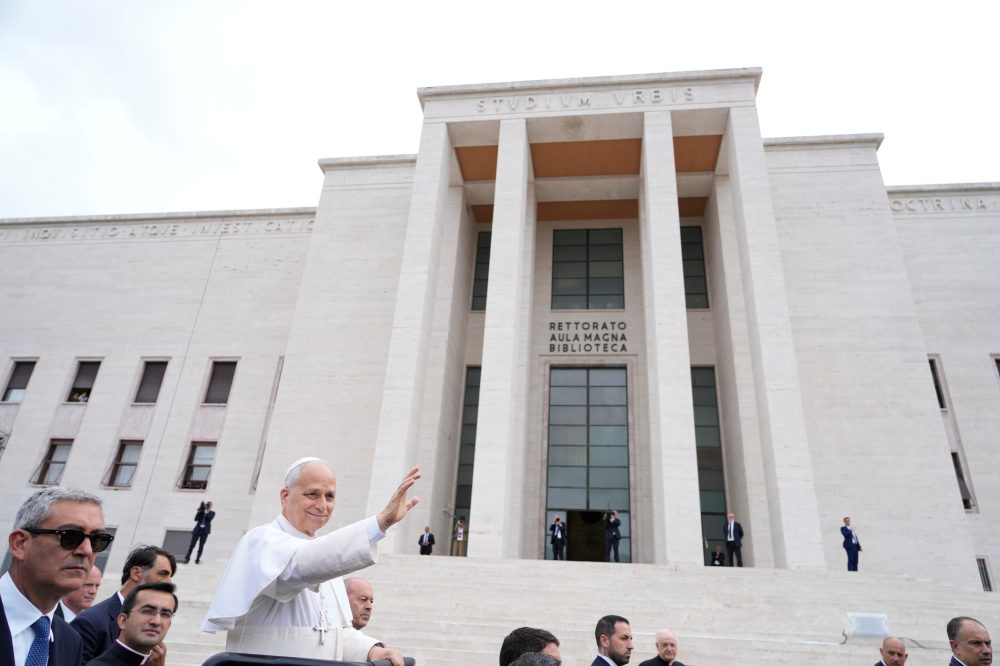

ROME — During a groundbreaking visit to Rome’s La Sapienza University on Thursday, Pope Leo XIV delivered strong criticism against the growing use of artificial intelligence in warfare, warning that such technology is pushing humanity toward a “spiral of annihilation.”
The papal address marked a historic moment as it was the first time a pope had spoken at the campus since Pope Benedict XVI canceled a planned appearance in 2008 due to faculty and student opposition.
The American pontiff received an enthusiastic reception, particularly from a group of Palestinian students who had just arrived in Italy this week through a “humanitarian corridor” from Gaza to pursue their education. Since the Israeli war against Hamas in Gaza started in 2023, the Italian government has collaborated with Catholic organizations to bring hundreds of Palestinians to Italy for educational opportunities and medical treatment.
Pope Leo XIV had the opportunity to meet with some of these Gaza students both at the campus chapel during an initial greeting and following his main address in the university’s primary lecture hall. The institution itself dates back to 1303 when it was established by Pope Boniface VIII.
During his remarks, the pope criticized the sharp rise in military expenditures this year, particularly across Europe, arguing that such spending comes at the cost of educational and healthcare funding while “enriching elites who care nothing for the common good.”
He advocated for enhanced oversight of artificial intelligence development and implementation in both military and civilian applications “so that it does not absolve humans of responsibility for their choices and does not exacerbate the tragedy of conflicts.”
“What is happening in Ukraine, in Gaza and the Palestinian territories, in Lebanon, and in Iran illustrates the inhuman evolution of the relationship between war and new technologies in a spiral of annihilation,” he said.
The pontiff emphasized that educational institutions and research efforts should pursue the opposite path, one that prioritizes human life “the lives of peoples who cry out for peace and justice!”
Pope Leo XIV has made artificial intelligence a central focus of his papacy, particularly its role in warfare and daily life. These topics are anticipated to feature prominently in his upcoming first encyclical, scheduled for publication in the coming weeks.
Among the Gaza students who met the pope was Nada Rahim Jouda, 19, who had arrived in Italy just two days earlier. She expressed amazement at her new circumstances studying business science in Rome, describing the city as “like heaven for me.”
“Everything here is green and it’s not gray and troubles everywhere and miserable people in the streets,” she said.
However, Jouda continues to worry about her family members still in Gaza: her mother, who is recovering from leukemia, and her younger sisters, ages 17 and 13. Throughout the Gaza conflict, her family was displaced four times, and her mother was unable to access cancer treatment or medical monitoring.
“They all rely on me. I’m the only hope that they have,” she said.