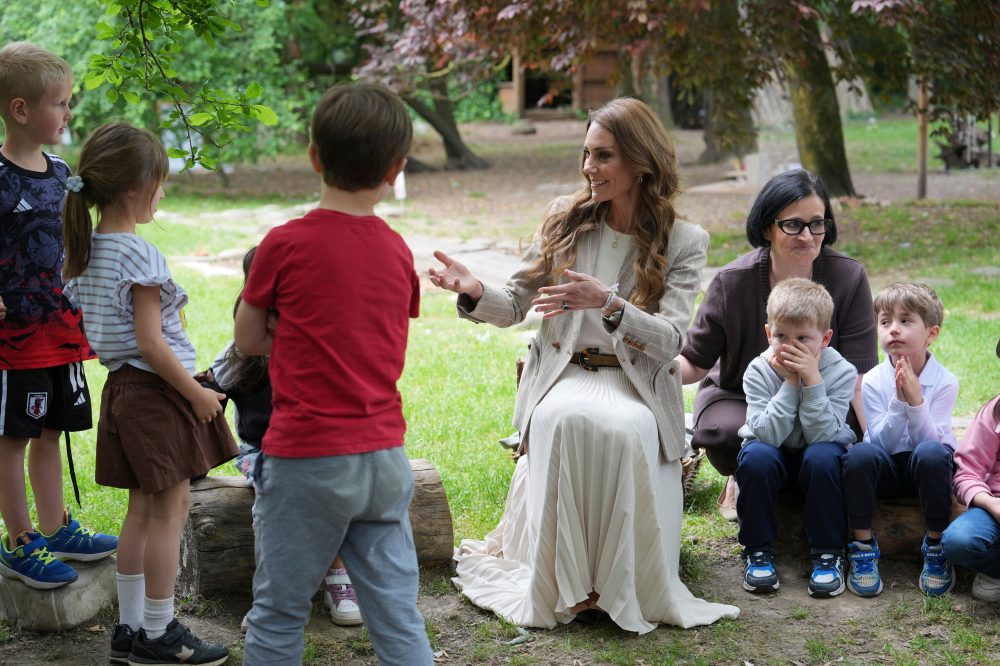

REGGIO EMILIA, Italy (AP) — A two-day visit by the Princess of Wales to Italy has brought international attention to an innovative early childhood education philosophy that has transformed how young children experience learning.
The educational method known as the Reggio Approach operates in public childcare facilities and early learning centers throughout the northern Italian city of Reggio Emilia. This philosophy celebrates children’s natural inquisitiveness and capabilities, positioning educators as guides rather than traditional teachers while encouraging active participation from families and the broader community. Princess Catherine, who has championed early childhood development as a key initiative, dedicated two days to observing this approach firsthand.
“I love that you put children and childhood at the heart of the community, and I’m really fascinated to learn more about it,” she commented upon arriving at one of the city’s preschools on Wednesday.
This Italian educational philosophy emerged from Montessori principles, and both methodologies have gained international recognition as alternatives to educational systems in countries like the United States and Britain that prioritize standardized assessments and testing for children who have not yet begun reading.
While the Reggio method attracts Italian families who experienced traditional rote learning themselves, their enthusiasm has limits, according to Kathryn Ramsay, an experienced early childhood educator who operates a Reggio-influenced program north of Rome.
“When the children are 3 or 4, they’re totally fine with it,” Ramsay explained. “And then when they hit 5, they (the parents) start getting a little twitchy because they’re thinking about Grade 1,” when children must remain seated for extended periods and master reading and writing skills.
The Reggio philosophy emerged during Italy’s post-World War II reconstruction period when a group of mothers in the war-torn city of Reggio Emilia, a stronghold of anti-Fascist resistance, joined forces to create something new.
“They sold the metal from a German tank for funds and they hand-carried stones from the river to reconstruct a place for the children to be cared for while the rest of the village went about the business of putting life back together,” explained Margie Cooper of the North America Reggio Emilia Alliance.
Educational innovator Loris Malaguzzi drew from Montessori and other progressive educational movements to develop Reggio’s child-focused methodology, which serves children from birth through age six.
His written work exploring how young children express themselves and understand their environment through art, movement, and music became a foundational document. Recognizing children’s abilities and experiences represented a revolutionary concept at that time.
“The child was only an adult in formation and didn’t have things to say or competencies already realized,” noted Roberta Cardarello, senior professor of didactical and special pedagogy at the University of Modena and Reggio Emilia.
The methodology expanded to additional communities, particularly in northern Italy’s progressive municipalities. However, Italy’s national government in Rome — controlled by conservative Christian Democrats through the 1990s — avoided widespread promotion of the approach, possibly due to its connection with Reggio Emilia’s communist background.
While those political concerns have faded, implementation today often depends on whether financially constrained local governments fund training programs or individual educators pursue independent preparation, according to Elisabetta Nigris, professor of didactic programs and evaluation at the University of Studies Milan-Bicocca.
The Reggio method incorporates elements found in quality early childhood programs, including emphasis on adult-child relationships that support social and emotional development, according to Sylvi Kuperman, senior researcher at the Center for the Economics of Human Development at the University of Chicago. Her 2017 research on Reggio programs in Italy showed improved high school completion rates and employment prospects compared to children who did not receive formal early care.
Students typically remain with the same educator for multiple years, she noted. They help prepare meals. Learning environments feature natural lighting and organic materials like wood. Outdoor spaces and artistic expression are fundamental components.
During Thursday’s visit, Catherine toured the “Salvatore Allende” daycare and preschool in Reggio Emilia, engaging with children in the outdoor learning area, examining grass and plants through a magnifying glass, and at one point allowing a slippery newt to crawl across her palm.
“In London, we have newts like this too,” she observed.
Catherine’s visit carries special significance for Britain, since the Reggio philosophy lacks recognition in national education policy, and most early childhood programs operate under private, profit-driven organizations, said Peter Moss, emeritus professor at the University College London’s Institute of Education.
However, he emphasized that Reggio developed under unique historical circumstances that are difficult to recreate elsewhere.
“Reggio Emilia is a reaction to 20 years of authoritarian rule under Mussolini and, after that fell, of course a lot of places in Italy were asking the question ‘How do we make sure that never happens again?’”
At Ramsay’s Reggio-influenced, bilingual program north of Rome, children learn in an expansive grassy area without traditional playground structures or colorful educational posters covering classroom walls. Instead, the small wooden building with its covered entrance features minimal, earth-toned design. Most educational activities occur outdoors: the “mud kitchen” where children experiment with dishes and utensils, a designated digging area, and a large stone for climbing and sliding. The program, named “Wild Gioia” (Wild Joy), currently serves five children between ages 3-6.
Ramsay references research indicating that play provides the most effective foundation for literacy skills because it develops children’s ability to focus.
“They don’t learn to concentrate by being told what to concentrate on,” she explained. “They’re learning to concentrate by having the freedom to be able to follow their own interests.”