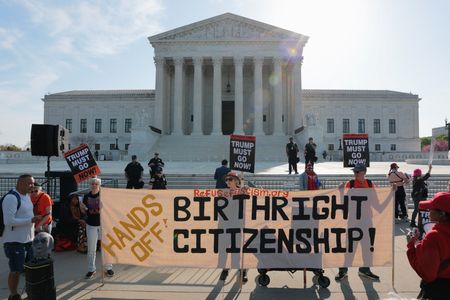

Most Americans want to preserve automatic citizenship for all children born on U.S. soil, new polling data reveals, while the nation’s highest court prepares to decide whether President Donald Trump can eliminate this constitutional right.
The nationwide Reuters/Ipsos survey, conducted between April 15-20, shows 64% of respondents want to maintain birthright citizenship, while 32% back Trump’s January 2025 executive order to end the longstanding practice.
The Supreme Court faces several high-stakes decisions in the coming weeks that could significantly impact Trump’s policy agenda and establish important precedents for the November 3 midterm elections. These cases span immigration law, transgender rights, and election procedures.
Trump’s directive to end birthright citizenship immediately faced legal challenges, and Supreme Court justices will likely announce their decision before June ends in what represents a major civil rights case and crucial test of the president’s strict immigration policies. During April 1 oral arguments, the court’s 6-3 conservative majority seemed hesitant to support Trump’s position.
Political party affiliation strongly influences opinions on birthright citizenship, the polling data indicates. Just 9% of Democratic voters want to eliminate the policy, while Republicans remain split with 62% favoring its removal and 36% supporting its continuation.
The Supreme Court typically releases major decisions during May and June as its yearly session concludes.
SPORTS PARTICIPATION RULES
Regarding cases from Idaho and West Virginia, the court appears ready to permit states to enact legislation limiting transgender athlete participation in women’s athletic competitions.
The polling found widespread approval for restricting transgender girls and women from participating in female school and collegiate sports, an issue that has become a significant political controversy.
Approximately 67% of those surveyed endorsed prohibiting transgender individuals from competing in women’s scholastic athletics. Republican support reached 92%, while Democratic backing stood at 44%.
The justices will also determine whether states may count mail-in ballots bearing Election Day postmarks but arriving several days afterward. Around 65% of poll participants endorsed counting such ballots when postmarked by the deadline despite late arrival.
Democratic support for this mail-in ballot approach reached 85%, compared to 51% among Republicans.
CONGRESSIONAL DISTRICT BOUNDARIES
An additional case will establish whether Louisiana’s congressional district map meets constitutional standards after being redrawn to increase Black-majority districts from one to two, enhancing African American voter representation.
A coalition of white voters seeks Supreme Court intervention to halt the map, claiming racial considerations played an excessive role in its creation.
Public opinion on this issue shows complexity. Roughly 75% of poll participants, including 65% of Black respondents, believe race shouldn’t influence congressional map drawing. However, about half of all respondents and six out of ten Black respondents think communities sharing common characteristics, including race, deserve representation within the same congressional district.
Recent years have seen the court deliver landmark rulings expanding firearm rights, eliminating race-based college admissions, and limiting federal agency authority. The conservative majority includes three justices Trump nominated during his initial presidency.
Supreme Court public perception has grown increasingly partisan over five years. March polling by Reuters/Ipsos found 70% of Republicans view the court positively, versus 27% of Democrats. December 2021 polling, conducted months before the court eliminated nationwide abortion rights in 2022, showed 66% Republican approval compared to 55% Democratic support.
The latest Reuters/Ipsos Supreme Court poll was conducted online with 4,557 U.S. adult participants and carries approximately a 2 percentage point margin of error.