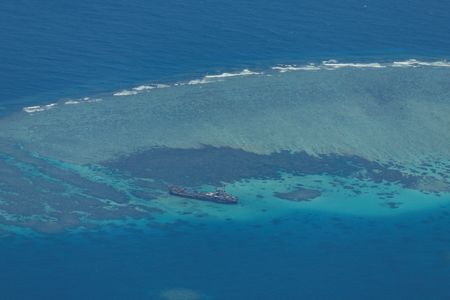

Philippine security officials announced Monday that they detected deadly cyanide aboard Chinese vessels near a contested reef in the South China Sea.
Laboratory analysis verified the toxic chemical was present in containers confiscated by Philippine naval forces during operations at Second Thomas Shoal in the previous year, according to government authorities.
Security leaders cautioned that the dangerous substance posed significant threats to ocean ecosystems and could weaken the coral formation that supports a Philippine warship intentionally run aground at the site to strengthen territorial claims.
“We wish to underscore that the use of cyanide in Ayungin Shoal is a form of sabotage that seeks to kill local fish populations, depriving Navy personnel of a vital food source,” National Security Council spokesperson Cornelio Valencia stated during a news briefing, using the Philippine designation for the reef. Valencia further explained that the toxic chemical could harm the coral structure and “ultimately compromise” the vessel’s foundation.
Chinese Embassy representatives in Manila have not yet provided a response to requests for comment on the allegations.
Manila has previously criticized Beijing for interfering with supply operations to military personnel aboard the grounded vessel, including a June 17, 2024, clash that escalated to violence and left one Filipino serviceman with a severed finger. Chinese officials have rejected claims of hostile behavior during such encounters and maintain that Philippine forces are illegally entering Chinese territorial waters.
Following the June altercation, both nations reached a temporary agreement regarding supply missions to the stationed vessel.
Last month, Beijing and Manila conducted senior-level discussions about South China Sea issues, examining initial steps toward energy sector collaboration and trust-building initiatives at sea, including communication protocols between their maritime enforcement agencies.
The Philippine foreign ministry clarified Monday that coast guard cooperation would have restricted parameters and “does not contemplate cooperation in sensitive operational areas,” noting that joint patrol operations were never discussed.
Beijing asserts sovereignty over virtually the entire South China Sea, including territories also claimed by Brunei, Malaysia, the Philippines and Vietnam.
An international arbitration court determined in 2016 that China’s extensive territorial assertions lacked legal foundation under international maritime law, though Beijing dismisses this ruling. The strategic waterway facilitates over $3 trillion worth of maritime trade annually.