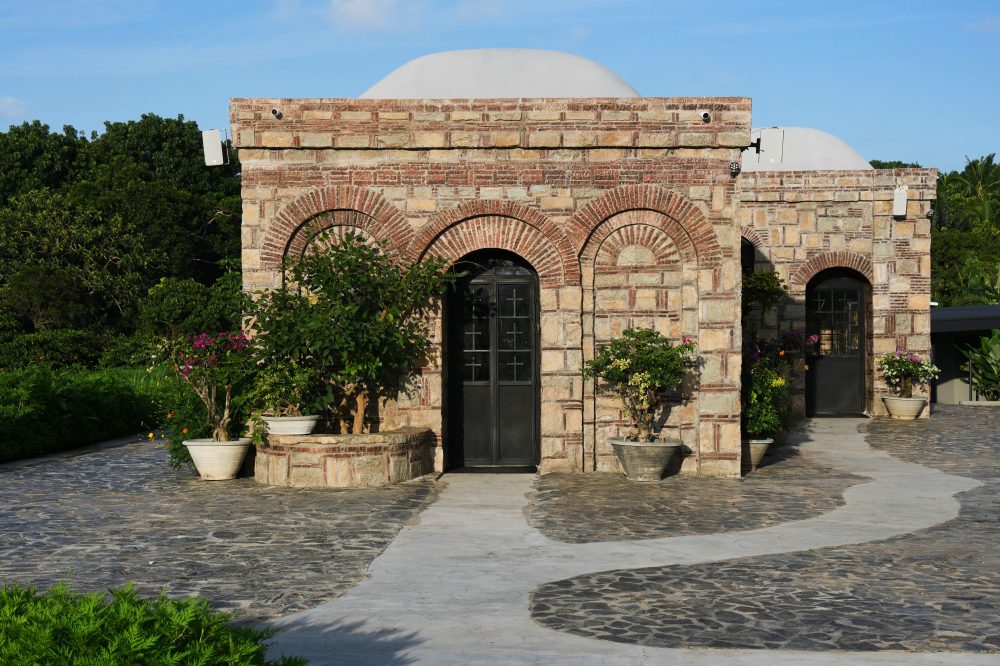

ALFONSO, Philippines — In Ephesus, Turkey, stands the House of the Virgin Mary — a revered shrine where the mother of Jesus is believed to have lived out her final years. Now, thousands of miles away in a field outside the Philippine capital of Manila, a faithful reproduction of that sacred structure is drawing Catholic pilgrims to Asia’s largest Catholic nation.
“The idea began as a place of refuge,” said Dennis Paez, the priest who spearheaded the project. “This is a place where no questions (are) asked.”
The replica opened in 2024 in the town of Alfonso, located in Cavite province roughly 70 kilometers — about 45 miles — south of Manila. Since its inauguration, the site has welcomed Catholic pilgrims, including those who came to celebrate the Feast of Our Lady of Mount Carmel in mid-July. The structure measures 67 square meters, or about 720 square feet, and was built to match the exact dimensions, shape, and appearance of every stone found at the original site in Turkey.
Catholic tradition holds that after Jesus’ crucifixion, Mary lived in the Ephesus house until her assumption into heaven. The apostle John is believed to have escorted her there to protect her from persecution in Jerusalem.
According to Paez, construction of the replica took roughly 10 months. Workers of varying faiths participated in building it — something Paez interpreted as the Virgin Mary uniting all of her children under one purpose.
“The apostolate of this place is to accept people with unconditional positive regard,” said Paez, who also works as a psychologist with a focus on supporting young people. “There is no therapy here. The therapist is our Mother.”
The Philippines is home to approximately 113 million people, with nearly 80% identifying as Catholic. Filipinos commonly refer to the Virgin Mary as the Blessed Mother, and processions held in her honor are a regular part of life throughout the country.
“We are a long-suffering people,” Paez said. “Our wealth is really our faith and our faith is such like that because of the Blessed Mother.”
Religious historian Michael Delos Reyes explained that Filipino devotion to the Virgin Mary traces its roots to the 16th century, when Spanish colonizers first brought Christianity to the islands. That devotion has continued to shape the country’s history in more recent times as well.
Delos Reyes noted that some credited the Virgin’s intercession for the 1986 People Power Revolution, which resulted in the removal of then-President Ferdinand Marcos from power. And when Typhoon Haiyan devastated Tacloban in 2013, many faithful turned to the Blessed Mother for hope and comfort.
The phrase “To Jesus through Mary” reflects just how central Mary is to Catholic life in the Philippines.
“Her maternal dimension is what Filipinos find meaningful, as well as her power to intercede on believers’ behalf,” said Deirdre de la Cruz, a professor of history and Southeast Asian studies at the University of Michigan.
De la Cruz also noted that images of Mary and rosaries are a common sight on Filipino vehicles, public transportation, home altars, and roadside shrines across both cities and rural areas.
“As someone who is known to provide comfort, Mary is a very familiar figure and someone to whom one can appeal in difficult times,” she said.
Daphne Oseña Paez, who paid a recent visit to the replica, shared that although she was raised Catholic, her devotion to Mary didn’t truly deepen until adulthood. It began during a trip to Mexico, where she encountered the image of Our Lady of Guadalupe, and grew stronger after she faced a difficult pregnancy that led her deeper into her faith.
“We don’t pray to Mary herself, but Mary intercedes for us,” Oseña Paez said. “In my times of trouble, and I’ve had a lot, I really clung on to the love and comfort of her as a mother.”
Inside the replica, donated Marian icons line the walls. At the center stands a statue of Mary modeled after the one in Turkey, alongside a relic believed to be from her veil. Most of the displayed images were contributed by art collector and Philippine culture advocate Maritess Pineda, whose devotion to Mary inspired her to build a collection that has now found a permanent home.
Others felt called to contribute in different ways. Rupert Suarez and his wife had previously visited the original House of the Virgin Mary in Ephesus. When he heard about the plan to build a replica in the Philippines, he became part of the effort.
“I usually pray to the Mother,” Suarez said. “It’s so very blessed that we already have this replica built.”
The site has received little formal promotion since it opened, yet Father Paez said pilgrims have continued to arrive.
“I don’t at all think that it is me bringing them,” Paez said. “It’s The Blessed Mother asking them, inviting them to come.”