
DEIR AL-BALAH, Gaza Strip (AP) — The global authority on food insecurity announced Thursday that conditions in Gaza have improved since famine was declared in parts of the Palestinian territory last year — but cautioned that the situation remains at crisis levels and could deteriorate rapidly.
The Integrated Food Security Phase Classification, known as the IPC, credited a reduction in fighting and Israel’s decision to allow more humanitarian aid into Gaza with having a “significant impact, albeit unevenly across areas.” Despite those improvements, the agency noted that most families in the war-torn territory are still not receiving adequate food.
“Even small disruptions to humanitarian access could rapidly reverse recent gains,” the IPC report warned.
The report, covering April through June, shows that while conditions are markedly better than last year, there is no clear path to pulling Gaza’s 2.1 million Palestinians out of this ongoing crisis anytime soon.
Israel’s military currently controls more than half of Gaza, forcing Palestinians into crowded tent camps and heavily damaged neighborhoods. Broken sewage infrastructure has led to frequent disease outbreaks and left residents without reliable access to basic services.
Long lines at charity kitchens and sky-high prices continue to define daily life in Gaza, according to residents and data from the Gaza Chamber of Commerce.
“The situation is very tragic,” said Rana Abu Bakr, a displaced mother who says her family depends on a charity kitchen in Khan Younis every day. Beyond that, she said, “There’s no water, no food, nothing to drink. Prices are exorbitant.”
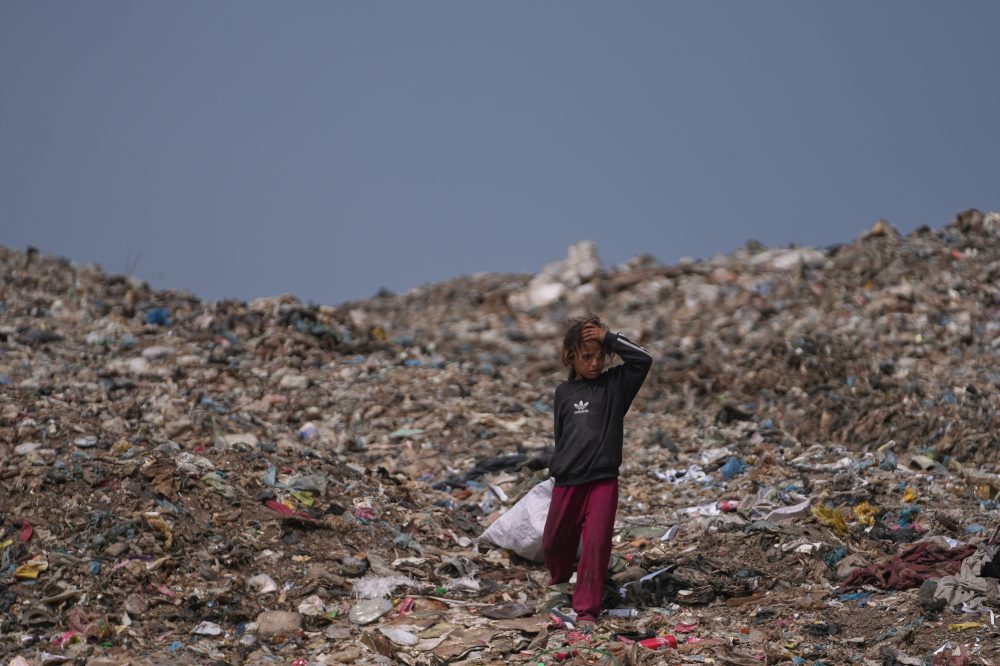
The prolonged food shortage has taken a particular toll on children, with the IPC reporting a rise in cases of “stunting” — a condition in which poor nutrition impairs physical growth and can lead to lifelong health consequences.
“Many children are still going hungry, and some children may never fully recover from prolonged lack of proper nutrition,” UNICEF Executive Director Catherine Russell said in a statement.
Israeli strikes and shelling have also killed more than 1,185 people since last October’s ceasefire agreement, according to the territory’s health ministry.
The IPC is a panel of food security specialists that the United Nations and humanitarian organizations rely on to assess hunger crises. It tracks indicators such as the proportion of households facing extreme food shortages, signs of malnutrition in young children, and starvation-related deaths.
The panel has declared famines in other regions, including parts of Sudan and Somalia, but its declaration last August in parts of Gaza marked the first such designation in the Middle East.
The IPC uses a five-phase scale to measure food insecurity. Last summer, it confirmed the most severe level — famine — in Gaza Governorate, which includes Gaza City. Thursday’s report placed all five of Gaza’s governorates at Phase 3 “crisis” status, while estimating that more than 200,000 residents remain in the higher Phase 4 “emergency” category.
While acute food insecurity — meaning households cannot obtain enough food to survive — remains at crisis levels, the IPC said acute malnutrition, which refers to the physical toll of insufficient food intake, has dropped to levels now classified as acceptable, despite dire warnings issued last year.
Israel has firmly denied allegations of widespread hunger and a manmade famine in Gaza, calling such claims false. However, after imposing a near-complete blockade on humanitarian aid from early March to mid-May last year, Israel began permitting more aid into the territory. Israel controls all food entering Gaza, including both aid shipments and commercial goods sold in local markets.
The Israeli military body overseeing humanitarian affairs in Gaza, known as COGAT, rejected the IPC’s latest findings. It claimed the report ignored Israeli data showing that the number of trucks entering Gaza was nearly three times the amount Israel independently calculated as necessary, using World Food Program benchmarks.
Israel contended that the more significant problem was how food was being distributed in Hamas-controlled areas, not the quantity entering the territory.
Aid organizations, however, say Israel has increasingly relied on commercial traders rather than humanitarian groups to deliver supplies. Medical workers in Gaza report that this shift has left many residents consuming less nutritious food.
“A lot of these things coming in on these trucks are harmful,” said Tanya Haj-Hassan, an American pediatrician who has worked in Gaza, speaking earlier this year. She explained that sugary drinks and packaged foods could shock children’s bodies after months of severe malnutrition.
COGAT acknowledges that commercial goods have made up roughly half of everything entering the territory since the October ceasefire, but denies prioritizing them over humanitarian aid.
With global attention increasingly focused on Iran, efforts to advance reconstruction, demilitarize Gaza, or shift governance to a U.S.-led Board of Peace have largely stalled.
The IPC cautioned that the fragile improvements could unravel. Approximately 1.4 million people are expected to face acute food insecurity through the end of the year — about 200,000 more than current levels.
The report also warned that programs serving pregnant and breastfeeding women are shrinking “due to funding constraints and uncertainty” about whether Israel will continue allowing international aid organizations to operate in the territory.
Israel introduced new registration requirements for international nonprofits last year, demanding extensive disclosures that some aid groups say could endanger their staff and force them to suspend operations.
“These gains are good, but they are due to the level of humanitarian assistance — particularly food assistance — we’ve been able to bring into Gaza in the past seven months,” said Ross Smith, the World Food Program’s director of emergency preparedness and response. “It’s really critical that these gains are maintained. And for that we need to have continued access and continued funding.”