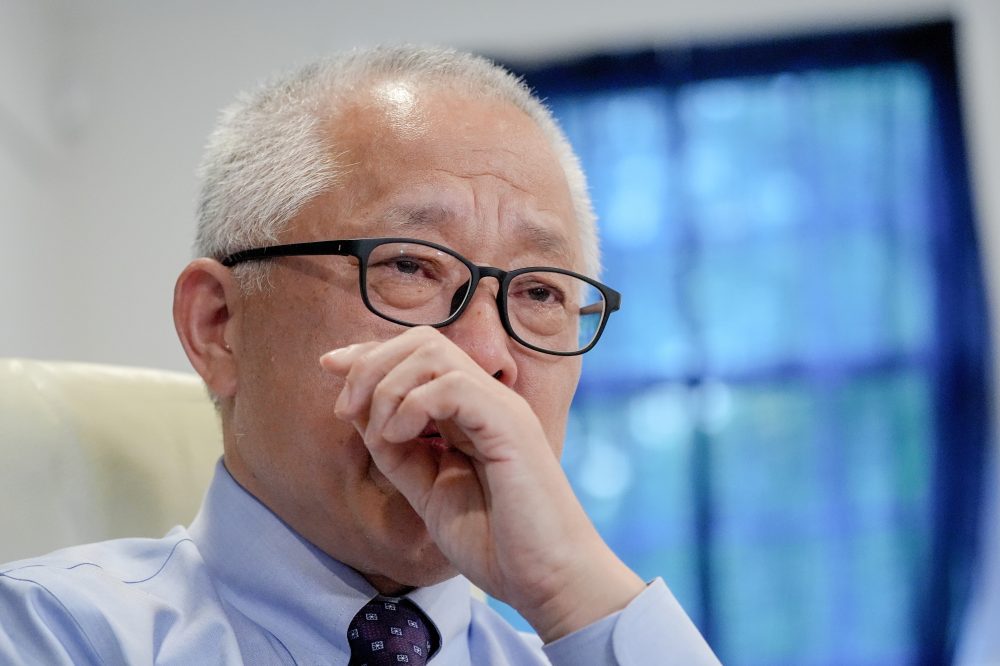

WASHINGTON — On the morning of July 3, Chinese Christian pastor Ezra Jin Mingri sat inside a detention facility in southern China, believing he might spend the next 15 years or more behind bars. The 57-year-old had at times wondered whether he would ever walk free again.
Within a single day, everything changed. Jin found himself 15 time zones away in Los Angeles, eating an In-N-Out burger and watching Fourth of July fireworks with his family as the United States celebrated its 250th anniversary.
“It’s so dramatic. It’s unimaginable,” the pastor told The Associated Press near Washington, D.C.
Jin said he was abruptly released after being held since October, then placed on a flight to the United States following President Donald Trump’s decision to raise his situation directly with Chinese leader Xi Jinping during a visit to Beijing in May.
“It’s a miracle,” Jin said this week.
Jin led one of China’s most well-known underground churches — congregations that operate outside the government’s official registration system. His release stands out as a rare case of a prominent Chinese detainee being freed in response to a request from the United States, at a time when Beijing has generally resisted outside pressure.
Jin said Chinese authorities let him go without requiring a confession or putting him through a public trial, instead dropping the charges against him entirely. He said he was unaware of any deal or prisoner swap and gave credit to what he called Trump’s “unique diplomacy.”
“It has results,” the pastor said.
When departing Beijing in May, Trump told reporters he had raised Jin’s case and that Xi said he would “strongly consider the pastor.” Trump has also pledged to “save our Great Christian population” around the world.
China’s foreign ministry, when asked about the release, said the country handles religious affairs according to its own laws. “We firmly oppose interfering in China’s internal affairs with so-called religious issues,” the ministry stated.
Jin recounted that on July 3, he was suddenly told to collect his belongings — including a Bible — from the detention center in the southern city of Beihai, where he had been held for 266 days. He was given fresh clothing and a new pair of Nike shoes. His lawyers had informed him weeks earlier that Trump had raised his case with Xi.
“Could it be that these people, now pressured, would put me under home arrest?” Jin recalled thinking. That idea faded when the police vehicle bypassed his old neighborhood and headed to a high-speed rail station instead.
He was escorted alone into a train car with only police officers present, who filmed the journey. Jin said he still could not bring himself to believe he was being freed, since China seldom bends to international pressure and many other pastors and activists remain imprisoned.
“I thought they would move me to a secretive place,” he said. A release was “too good to believe.”
Jin and the officers traveled roughly 470 miles to the southern city of Guangzhou, then continued on to the international airport.
At the airport, a temporary courtroom was set up inside a VIP room. Prosecutors read aloud a formal document that declared “criminal evidence solid and criminal facts established” — then announced they would not be pursuing charges against Jin, which had included illegal business activity and fraud related to operating an unregistered church.
Jin founded Zion Church in 2007, and it expanded into one of the most influential independent congregations in China. Unlike officially approved places of worship, which operate under Communist Party oversight, his church functioned independently.
In 2018, Beijing authorities shut down the church’s main meeting space after members refused to allow surveillance cameras to be installed. Jin sent his family to the United States but remained in China to continue growing the congregation, which held small-group meetings and built a significant online following during the COVID-19 pandemic. In October 2025, Jin and other church leaders were detained in a new crackdown.
At the airport, Jin was handed his passport before boarding a plane. A U.S. diplomat had been waiting there for hours. During the nearly 13-hour flight to Los Angeles, Jin was too overwhelmed to sleep.
Upon landing, he was welcomed by U.S. officials and granted a fee-free one-year visa. He reunited with his family after years apart and held his three grandchildren for the first time — the youngest being barely a month old.
His daughter, Grace Jin Drexel, who had spent months advocating for her father’s freedom, said she almost didn’t recognize him at first because he had lost so much weight and appeared to have aged significantly.
Jin said his focus now is on helping secure the release of the eight other Zion Church members still detained in China, along with other imprisoned Christians. Among them is Wang Yi, pastor of the Early Rain Covenant Church, who is currently serving a nine-year prison sentence.
This week, Jin met with House Speaker Mike Johnson, along with family members of three other Christians detained in China.
“I am free in this country, so warmly welcomed, so I am making a special call not to forget that many more are still detained,” Jin told the AP, his voice breaking. “I hope we will continue to strive for them to be free.”
House Speaker Johnson noted that Jin’s release had drawn bipartisan support. “This is something we all agree on,” Johnson said. “It’s about religious freedom around the world.”
Jin also expressed a deeper hope: that China would one day allow independent churches to operate legally.
“Probably the most important wish in my lifetime is that Chinese churches can be recognized by their own government,” he said.