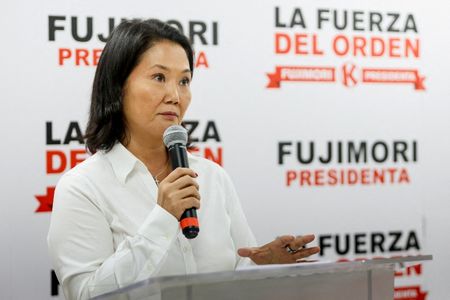

VENTANILLA, Peru, May 19 – As she prepares for her fourth consecutive Peruvian presidential runoff election, Keiko Fujimori is wagering that public anxiety about escalating violence will restore faith in the authoritarian style of governance her father practiced during Peru’s tumultuous 1990s.
During earlier campaigns, Keiko had kept her distance from Alberto Fujimori, her deceased father who spent time behind bars for human rights violations and remains a polarizing figure in Peruvian society.
However, the 50-year-old conservative politician has now restructured her campaign to champion his political approach, promising hard-line security policies, stringent counter-terrorism legislation, and greater military involvement in law enforcement.
Prior to voting in the April 12 first round, Fujimori made a pilgrimage to her father’s burial site. She has drawn parallels between contemporary criminal organizations and the leftist Maoist rebels he crushed during his decade in power from 1990 to 2000, promising to deploy Peru’s intelligence apparatus and elite military units in what she calls a “frontal war” against crime and extortion.
“There is a deep collective memory of Fujimorismo,” said Luis Galarreta, Keiko Fujimori’s running mate and one of her closest allies, in an interview with Reuters. “What was done in the 1990s — the rescue of Peru — still matters.”
Alberto Fujimori’s supporters praise him for bringing economic stability and crushing Shining Path guerrillas during the 1990s, though his detractors condemn him as a dictator. He was found guilty in 2009 of authorizing a massacre and spent 16 years imprisoned before dying in 2024.
EXTORTION A DAILY PROBLEM
Public safety issues have taken center stage in this year’s Peruvian election, reflecting a wider pattern throughout Latin America where increasing violence tied to criminal organizations has boosted support for tough-stance politicians, including El Salvador’s Nayib Bukele and Chile’s Jose Antonio Kast.
In Ventanilla, an extensive northern Lima suburb close to Callao port, local residents interviewed by Reuters described widespread theft and constant extortion demands.
People living in a low-income housing development in Ventanilla that was officially established during Alberto Fujimori’s administration reported that criminal organizations demand daily tribute from even the tiniest enterprises.
“Extortion is being carried out against everyone,” said Rosa Rengifo Zegarra, 39. “There’s a man with a ceviche (fish dish) place, they ask him for 10 soles ($3) a day,” she said.
Across the country, extortion incidents reported to law enforcement increased by approximately 20% last year according to government statistics, while murders in the Lima area more than doubled from 9 per 100,000 residents in 2021 to 23.1 per 100,000 in 2025.
“You can no longer even think about having a business that operates,” said Pilar Cardenas Lopez, 49, who runs a community food kitchen. “Once they see that you have something, that’s it.”
Criminal activity in Peru has surged due to growing organized crime networks and deteriorating government institutions, according to Martin Cassinelli of the Atlantic Council. International gangs like Tren de Aragua have expanded their presence, while the explosive growth of unlawful gold extraction has become a primary source of criminal enterprise.
The government’s capacity to respond has been compromised by years of political chaos and corruption, along with legislation that has reduced prosecutors’ power to investigate and pursue organized crime cases, Cassinelli noted.
Ventanilla locals described broad-daylight shootings, vanishings and mobile phone theft in conversations with Reuters.
“On that corner, at the store, they killed someone,” said Teresa Cardenas, 48, signaling beyond the food kitchen entrance. “In the other block, a young man also disappeared,” she said.
Multiple administrations have relied on temporary emergency declarations and enforcement sweeps to combat rising crime, but these measures have not tackled the root problems, experts say.
For households, danger now influences everyday choices. Zegarra mentioned her 17-year-old daughter frequently comes home late following dance rehearsal.
“You worry,” she said. “One thing is that they snatch the phone — another is that they take her.”
ROOTED IN FUJIMORI’S NAME
The Ventanilla settlement carries the presidential candidate’s name – Keiko Sofia Fujimori. During the 1990s, homeless families were relocated to empty sandy hills north of Lima, and this location was named after Alberto Fujimori’s daughter, whom he designated as his first lady following a dispute with his first wife.
“There was no electricity, no water — just sand,” Cardenas said, remembering her arrival in 1995. She lives in a section called Keiko 1.
Long-time residents remembered Alberto Fujimori’s visits and social assistance programs during his administration. However, they noted his daughter had never personally visited the community bearing her name.
“I’ve been here 27 years, and she has not come personally — not at all,” said Cardenas Lopez.
Keiko Fujimori still maintains backing in the neighborhood, motivated partly by pledges of economic aid, including direct cash payments, should she win office, some residents explained. In April’s first round she captured approximately 22% of votes in Ventanilla, the largest percentage of any candidate in the district.
DOUBLE-EDGED SWORD
Following the completion of first-round counting after weeks of postponements and fraud accusations, Fujimori obtained roughly 17% of the national vote in a divided field, qualifying for a second round against leftist congressman Roberto Sanchez.
An April 26 Ipsos opinion poll showed Fujimori and Sanchez tied for the June 7 runoff at 38% each.
As she intensifies her campaign before the second round, relying too heavily on the Fujimori political brand could present dangers for Keiko, political observers warned.
“Anti-Fujimorismo is the reason Keiko Fujimori has fallen just short of the presidency three times,” said historian and political analyst Daniel Parodi. “That rejection may be weakening, but by how much?”
Eileen Gavin, of consultancy Verisk Maplecroft, described Fujimori’s focus on security as a “double-edged sword.”
Some voters may be receptive to her tough-on-crime message, Gavin said. “But many also expect commitments to the rule of law and democratic institutional rebuilding to be part of any solution.” Commitments to those areas have been “sorely lacking in Fujimorismo,” she added.
Alfaro Rojas Carla, a 48-year old mother of five in Ventanilla, looked back on the time of the elder Fujimori era as one of greater security, when she received financial support for her first child.
“There are many who say (Keiko Fujimori) is like her father, which is why they vote for her,” said Rojas Carla.
“We hope she’ll work in the same way her father did.”