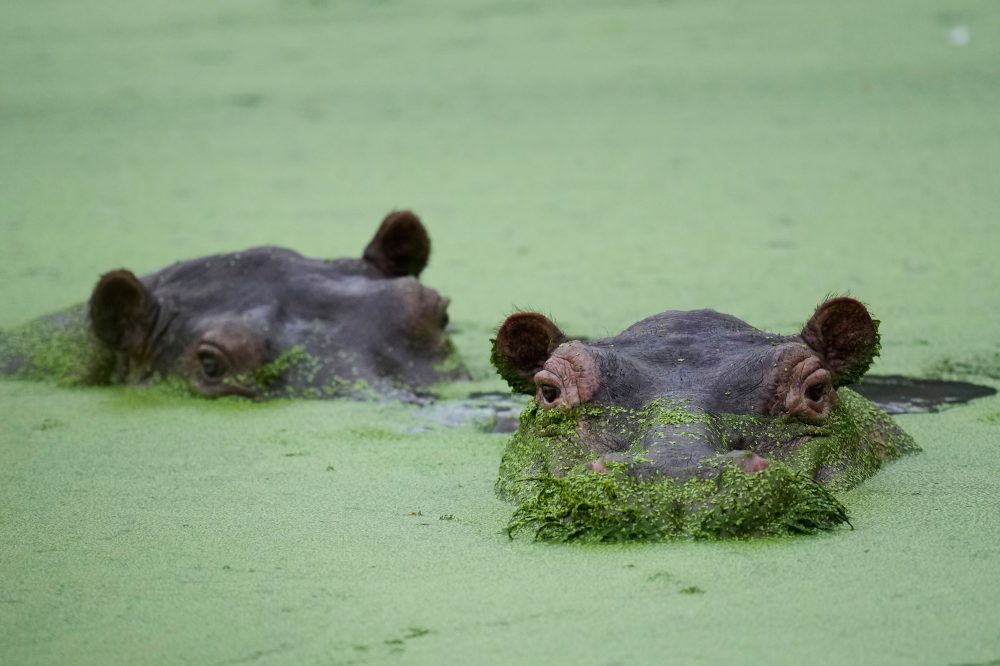

PUERTO TRIUNFO, Colombia — Fishermen navigate Colombia’s Magdalena River with extreme caution as massive hippos emerge from the muddy waters without notice, capable of reaching boats in seconds.
“These hippos are a true nightmare,” fisherman Wilinton Sánchez explained, describing the massive creatures that can swim at 8 kilometers per hour and run 30 kilometers per hour on land. “We were out Saturday when one lunged … reared up and swung its jaws wide. If it ever gets hold of you, it’ll tear you to pieces.”
Yet the dangerous animals also captivate visitors. Tourist boats regularly cruise the waterways multiple times weekly, carrying Colombian and international guests hoping to spot the enormous mammals. While these hippo-watching excursions sometimes end with frightened screams as the animals charge toward vessels, they provide crucial income for local communities.
These invasive hippos represent part of a 200-strong population that breeds without natural controls. The animals descend from creatures illegally imported during the 1980s by deceased drug lord Pablo Escobar for his personal menagerie at Hacienda Nápoles — an expansive ranch featuring its own airstrip that served as his isolated stronghold.
Environmental officials warn Colombia’s hippo numbers could surpass 500 by 2030 without action. Authorities recently authorized plans to kill approximately 80 hippos beginning later this year to address the growing crisis.
This decision has triggered intense controversy. Researchers supporting the culling have received death threats, while animal rights groups condemn the strategy as “murder.” Local residents in Puerto Triunfo, located 200 kilometers from Bogota, worry eliminating the animals will devastate tourism revenue supporting their town.
Diana Hincapié stops her restaurant duties to sit near a wall painting depicting a mother hippo with her baby.
“We don’t want to see a dead hippopotamus. They aren’t African anymore; they are Colombian, born and bred here for over 30 years,” the 48-year-old entrepreneur stated, expressing readiness to protest publicly if the killing plan advances.
Her riverside restaurant along the Cocorná Sur River, which feeds into the Magdalena, welcomes nearly 200 monthly visitors. Most arrive specifically seeking hippos, and Hincapié worries government actions could eliminate regional tourism entirely.
These massive land mammals have now occupied roughly 43,000 square kilometers according to ministry data. Without natural enemies and enjoying consistent rainfall unlike their African homeland, the hippos established their primary base on the “Island of Silence,” a plant-covered river island serving as their breeding center.
Álvaro Molina, 61, whose home sits across from the island, remembers the initial pair arriving about 11 years ago. The population has exploded since then. “One night I saw 12 at once, but I understand they have been migrating,” the fisherman noted.
River encounters occur so regularly that Molina expects them during every fishing trip, particularly at sunset. Several years back, his boat drifted directly over two hippos, which panicked and overturned his vessel. He successfully swam to safety aboard another boat without harm.
“Whether they are killed or taken away, it does us a favor,” Molina stated, explaining how hippos have devastated local fishing as many people quit the profession due to safety fears.
Official control measures encompass containment supported by Puerto Triunfo citizens, international transfers to wildlife facilities, and euthanasia as a final option when other methods prove impossible.
In their native Africa, these large plant-eating animals constantly traveling between water and land “can significantly impact the structure of ecosystems,” explained Daniel Cadena, science faculty dean at University of the Andes, who supports implementing combined control approaches including euthanasia.
However, euthanasia presents challenges. Official procedures involve luring animals with food into enclosures for lethal injection after sedation. Alternatively, officials may use high-powered long-distance hunting rifles, though the weapons must be extremely powerful due to hippos’ notoriously thick, penetration-resistant hide.
Senator Andrea Padilla has pressed officials to emphasize relocation rather than killing.
“It is an extermination; it is a massacre of 80 individuals,” Padilla declared. “This is a legacy left to us by a drug trafficker. How can we possibly close this chapter in the exact same way — by shooting the hippos?”
International relocation efforts have stalled. While some countries initially showed interest, ministry officials report no nations have agreed to accept transfers. Potential host countries cite either prohibitive costs for housing the enormous mammals or domestic laws preventing invasive species importation.