
Asian financial markets took a significant hit on Friday as oil prices surged back above $100 a barrel for the first time in months, driven by a worsening conflict in the Gulf that has threatened two of the world’s most critical oil shipping routes.
Brent crude settled at $100.85 a barrel after jumping 7% overnight to reach a two-month high of $102. The spike came as Iran-aligned Houthi forces attacked Saudi oil tankers in the Red Sea, cutting off a key shipping corridor at the same time Iran has nearly closed the Strait of Hormuz — effectively choking off two major arteries for global oil supplies simultaneously.
The situation has deteriorated rapidly in the two weeks since a temporary ceasefire collapsed. The U.S. military launched airstrikes on Iran early Friday, while Tehran responded by firing on neighboring Arab nations that host American military bases. Brent crude has now climbed nearly 40% just this month alone.
Nigel Green, CEO of financial advisory firm deVere Group, described the situation in stark terms. “Two of the world’s busiest shipping corridors are under threat in the same month, and markets are only just beginning to work out what that means,” he said.
Green added that the breakdown of the ceasefire and oil’s return above $100 could undo the progress that had given the Federal Reserve breathing room. “This looks less like a short-lived spike and more like a genuine reopening of the inflation question,” he said.
Compounding inflation concerns, the U.S. administration announced plans to impose higher tariffs on imports from 60 trading partners. That news pushed 30-year Treasury yields close to their highest point since 2007, while European borrowing costs climbed to levels not seen since 2011.
Investors are now pricing in a significantly more aggressive stance from central banks. Markets are giving a one-in-three chance that the Federal Reserve will raise interest rates as soon as next week — a dramatic shift from expectations just one week ago — while a September rate hike is now considered more than fully expected. The European Central Bank held rates steady overnight, but a September hike is about 70% priced in by markets.
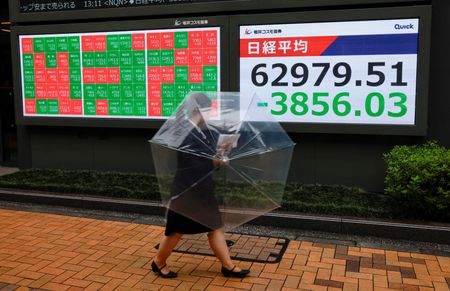
Across Asia, the MSCI index tracking Asia-Pacific shares outside Japan fell 1%, Japan’s Nikkei dropped 2.9%, and South Korea’s KOSPI tumbled 3.7%.
In the U.S., Nasdaq futures edged up just 0.1%, with strong earnings from Intel providing only a brief boost against the broader market anxiety over oil and interest rates. Wall Street had declined overnight after Alphabet and Tesla — the first two of the so-called “Magnificent Seven” megacap technology companies to report this earnings season — alarmed investors by burning through large amounts of cash on artificial intelligence infrastructure spending.
In bond markets, the benchmark 10-year U.S. Treasury yield held at 4.7013% on Friday, just below an 18-month high of 4.7030% reached overnight. The 30-year bond yield stood at 5.17%, just under a 19-year peak of 5.201%.
Rising Treasury yields lent support to the U.S. dollar, with the dollar index holding at 101.46 following a 0.3% gain overnight — its strongest level this month.
Japan’s yen continued to struggle, hovering near 40-year lows at 163.89 per dollar. The U.S. Treasury issued a warning that excessive currency volatility was unwanted. Japan’s finance minister has repeatedly threatened possible intervention in currency markets, having already carried out yen-buying operations in April and May after the currency weakened past the 160 level.
Tony Sycamore, an analyst at IG, was skeptical that any Japanese government action could turn the tide. “Against the backdrop of surging energy prices, the hawkish Fed repricing, and the yen’s loss of safe-haven status, any comments from Japanese officials today about being ready to intervene or faster BoJ rate hike will likely be ignored,” he said. “At this point, trying to support the yen here would be akin to standing in the way of a bullet train.”
Precious metals also took losses. Gold slipped 0.1% to $4,043 an ounce after falling 2% the previous night, while silver held at $57.45 an ounce following a 3.4% overnight decline.