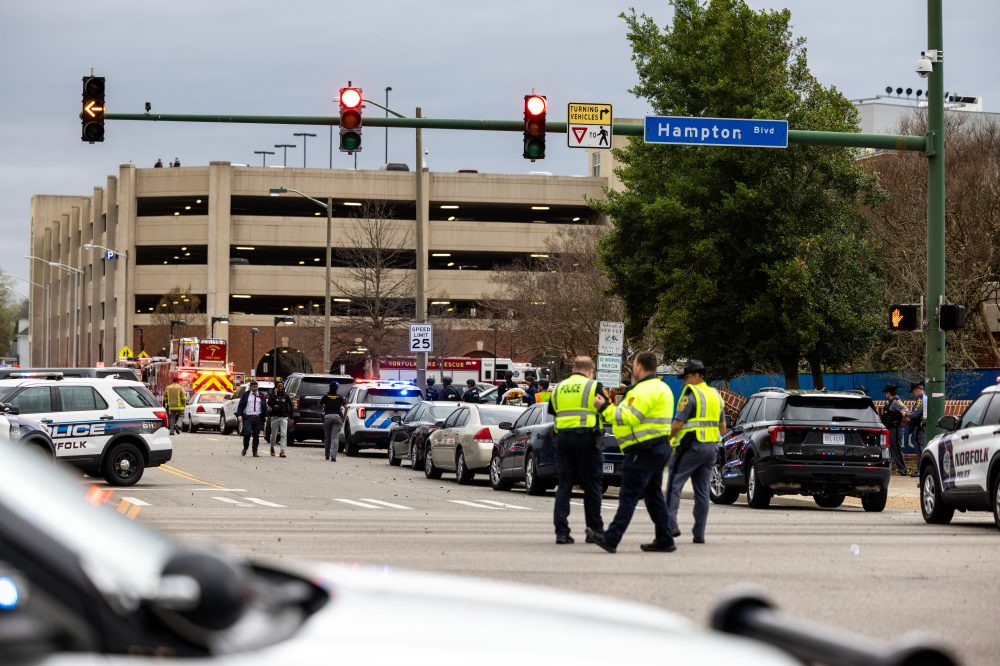

Federal court records reveal that Mohamed Bailor Jalloh had been freed from prison in December 2024 after serving time for trying to support ISIS, less than two years before he carried out a deadly shooting at Old Dominion University in Virginia on Thursday.
ROTC students at the university stopped and fatally wounded Jalloh during the classroom attack that claimed one life and wounded two others. The FBI has confirmed Jalloh as the shooter in the incident.
The violence has sparked concerns from lawmakers about Jalloh’s imprisonment history and release conditions, with many questioning how an individual with documented ISIS connections could execute such an assault.
“The horrific tragedy that occurred today on ODU’s campus never should have happened,” U.S. Rep. Jen Kiggans, who represents the congressional district neighboring the university, wrote on Facebook.
Following his guilty plea in October 2016 for supplying material assistance to the Islamic State terrorist organization, a federal judge imposed an 11-year sentence in 2017, including credit for time already served dating back to his July 2016 arrest.
Federal authorities released Jalloh on December 23, 2024. Officials have not immediately explained the reason for his earlier-than-expected release. While inmates may receive sentence reductions for various reasons, it remains unclear whether this applied to Jalloh’s case.
At the time of Thursday’s attack, he remained under supervised release – similar to probation – which was scheduled to continue until 2029 based on his release date.
Jalloh’s October 2016 guilty plea followed a three-month undercover FBI operation during which the then-26-year-old admitted to an FBI agent that he was considering an attack modeled after the 2009 Fort Hood shooting that killed 13 people. The investigation began after Jalloh contacted ISIS members in Africa earlier in 2016.
During conversations with the informant, Jalloh revealed that ISIS had approached him about participating in an attack. He attempted to contribute $500 to the organization, but the funds were actually deposited into an FBI-controlled account, according to court filings.
Jalloh subsequently attempted to purchase an AR-15 assault rifle from a Virginia firearms dealer but was denied due to incomplete documentation. Court documents show he returned the following day and successfully bought a different assault rifle. Unknown to Jalloh, prosecutors stated the weapon had been disabled before he left the store. Authorities arrested him the next day.
In 2017, Justice Department prosecutors sought a 20-year prison term for Jalloh, citing his repeated efforts to join ISIS and his attempt to obtain weapons for a murder conspiracy.
“The defendant was fully aware of what he was doing, and the consequences of those actions. His only misgivings seemed to be a fear that he would waver at the critical moment,” prosecutors wrote in a sentencing memorandum.
They added: “By putting the idea of this murder plot into religious terms, and by suggesting that murdering members of the US military would be a path to heaven, the defendant showed how strongly committed he was to the deadly ideology” of the Islamic State.
Defense attorneys requested a 6½-year sentence and asked that Jalloh be placed in a facility offering residential drug treatment for inmates struggling with addiction and substance abuse.
U.S. District Judge Liam O’Grady, appointed by former President George W. Bush, instead imposed the 11-year prison sentence.
The judge also mandated Jalloh’s participation in substance abuse testing and treatment programs, along with mental health treatment, and recommended evaluation for the federal prison system’s residential drug program.
The federal Bureau of Prisons allows inmates who complete the Residential Drug Abuse Program to reduce their sentence by up to one year. It remains unclear whether Jalloh qualified for this program, as inmates serving terrorism-related sentences typically are not eligible.
Additionally, well-behaved inmates can earn up to 54 days of good conduct credit annually toward sentence reduction. However, the 2018 First Step Act prison reform law excludes inmates convicted of terrorism-related charges from such credits.
Public information about Jalloh, a naturalized U.S. citizen originally from Sierra Leone, is limited. Court records describe him as a troubled individual who became radicalized by Anwar al-Awlaki, a prominent American imam turned al-Qaeda propagandist.
The Virginia Army National Guard verified his service as a specialist from 2009 to 2015, when he received an honorable discharge. According to a 2016 FBI affidavit in his criminal case, Jalloh told a government informant he left the National Guard after listening to al-Awlaki’s lectures.
In a letter to the federal judge overseeing his sentencing, Jalloh expressed remorse: “I feel deep regret in having been driven by my emotions rather than my intellect and becoming involved with such an evil organization. … I reject and deplore terrorism and any groups associated with it, especially ISIL.”
He explained that drug use began after his girlfriend ended their six-year relationship.
“The pain I felt internally was unbearable, and drugs and alcohol were the only things that took that pain away,” Jalloh wrote. “I started doing marijuana, coke and mushrooms using one of them at least on a daily basis in order to kill the pain I was in and to fill in the void I felt internally.”
While the complete letter remains sealed, his attorney included portions of it in the sentencing memorandum.