
As communities across the country come together Friday to mark Juneteenth, former President Barack Obama’s presidential center is welcoming its first public visitors in Chicago.
Situated on a sprawling campus on Chicago’s South Side, the center dedicated to the nation’s first Black president was built with a mission to inspire visitors to drive change in their own communities — a theme that resonates deeply with the spirit of Juneteenth, which commemorates the end of slavery in America.
Juneteenth honors June 19, 1865, the day Union troops arrived in Texas at the close of the Civil War carrying an order declaring that enslaved people in the state were free with “absolute equality” — a full two and a half years after the Emancipation Proclamation had freed enslaved people in the Confederate South.
“Juneteenth represents not just a commemoration of the end of slavery but it’s also part of the ongoing struggle for absolute equality and that ideal in American life,” said W. Caleb McDaniel, a Rice University professor and author of the Pulitzer Prize-winning book “Sweet Taste of Liberty.”
The grand opening of the Obama Presidential Center has been marked by several days of festivities, including a dedication ceremony held Thursday. The public opening arrives at what many see as a symbolic moment — a meeting point of legacy and liberation — as the country wrestles with deepening political divisions and renewed debates over racial progress, particularly following Supreme Court decisions that have weakened the Voting Rights Act and threatened Black political representation in Congress.
The campus spans nearly 20 acres and includes a museum with a life-sized replica of the Oval Office, a garden designed by former first lady Michelle Obama that features lettuce and strawberry plants, a professional basketball court, a picnic area equipped with grills, and a new branch of the Chicago Public Library.
Beyond spaces meant to bring people together, the campus — which organizers expect to attract up to one million visitors each year — is also designed to encourage personal reflection. Louise Bernard, the museum’s director, has described the experience as “inviting people to bring change home, however change may be defined, both small or large.”
Visitors can explore high-tech and hands-on exhibits tracing Obama’s campaigns, significant moments from his presidency, and everyday life inside the White House.
This year marks the fifth Juneteenth since former President Joe Biden, who served as Obama’s vice president, signed legislation designating the day as a federal holiday. The celebration, however, has deep roots in Black American culture, with origins in Texas before spreading nationwide. Traditionally, the day is spent with family and friends at picnics and cookouts.
The holiday’s name blends “June” and “nineteenth,” marking the day U.S. Maj. Gen. Gordon Granger and his soldiers arrived in the Texas port city of Galveston carrying General Order No. 3, which declared freedom for enslaved people.
As the Civil War entered its third year, President Abraham Lincoln had issued the Emancipation Proclamation declaring freedom for “all persons held as slaves” in Confederate states still in rebellion. For many, however, that proclamation did not bring immediate freedom — it was a promise that depended on a Union victory.
“It really required the force of arms and the success of U.S. armies to enforce the Emancipation Proclamation,” McDaniel said.
Roughly six months after Granger’s troops reached Galveston, the 13th Amendment, which formally abolished slavery, was ratified.
Galveston, recognized as the birthplace of Juneteenth, is holding a full day of festivities at a local park, including music, fireworks, a parade, and a worship service at a historic Black church. Nearby Houston is hosting a lineup of musical performers and a domino tournament at Emancipation Park, which was established in 1872 by a group of formerly enslaved men.
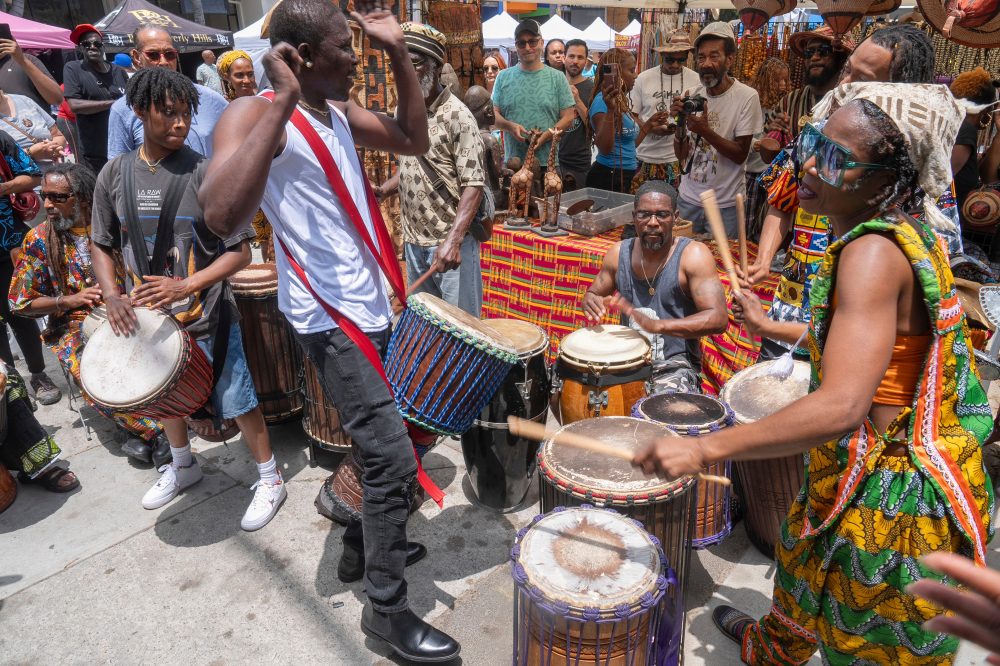
Celebrations across the country over the long weekend include a parade in Atlanta, a bike ride in Los Angeles, and a festival on Martha’s Vineyard.
A number of cities will also host walks named in honor of Opal Lee, the Texas woman who campaigned for years to make Juneteenth a federal holiday. Walkers will cover 2.5 miles, symbolizing the two and a half years it took for the Emancipation Proclamation to be enforced in Texas. Lee, widely known as the “grandmother of Juneteenth,” is turning 100 this year.
Black Texans embraced the anniversary of Granger’s arrival as a day of celebration, and by the 1880s, McDaniel noted, “it was difficult to find a significant community in Texas where it wasn’t being marked by African Americans.”
“They made it a community celebration, they made it a celebration of not only freedom but also a demonstration of community empowerment and institution-building,” he added.
Corey D. B. Walker, dean of Wake Forest University’s divinity school, said Juneteenth gives Americans an opportunity to acknowledge the country’s “complex history” and reflect on the meaning of citizenship — particularly as President Donald Trump’s administration has moved to challenge how Black history is taught and remembered.
“I think it really reminds people the importance of understanding a fuller, more robust portrait of our nation’s history and the many contributions of many individuals who have contributed to America’s experiment with democracy,” Walker said.