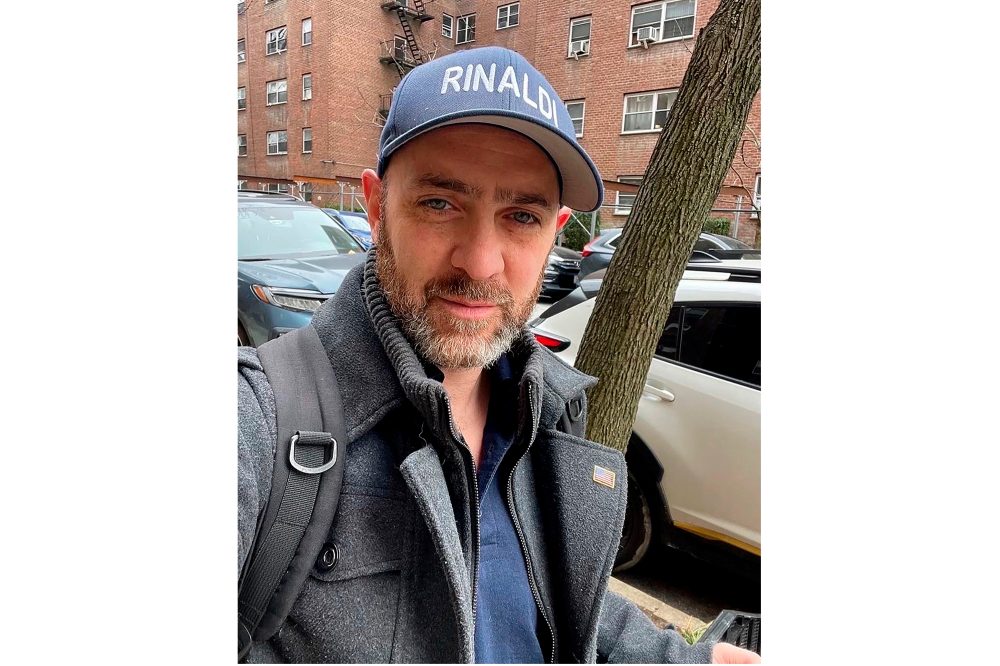

A former New York City Council candidate is now facing criminal charges after prosecutors say he turned to artificial intelligence to manufacture fake political endorsements and phony news stories, then spread them across social media.
Jonathan Rinaldi, 47, was taken into custody outside his home on Wednesday. He ran as a Republican for a Queens council seat last year but lost. If convicted on the forgery charges against him, he could spend up to two years in prison.
Despite speaking with The Associated Press by phone on Wednesday, Rinaldi declined to confirm or deny that he created the posts or generated the images in question. He framed the arrest as a free speech matter — even though the First Amendment does not typically shield fraudulent statements from legal consequences.
“I got arrested for social media posts,” Rinaldi said. “This is an issue that strikes at the heart of our First Amendment freedoms — not just for me, but for everybody.”
Prosecutors say many of the false posts appeared on Facebook and Instagram. One claimed that the Queens Jewish Alliance had endorsed him, and allegedly used the organization’s real logo along with a convincing-looking endorsement document. According to the complaint, the head of the Queens Jewish Alliance confronted Rinaldi in a recorded phone call, to which he responded, “When you are trying to fight against the establishment, I have to use every available tool that’s at my disposal.”
In another instance, Rinaldi allegedly fabricated a New York Post article claiming that then-Council Member Robert Holden, a Democrat, had crossed party lines to endorse him, according to the Queens district attorney. The fake story was paired with a doctored photo that appeared to show Holden shaking Rinaldi’s hand — an image allegedly created by prompting an AI platform to swap one person’s face onto another.
The AI prompt cited in the charges read: “just change the face the head is ok they are both bald just change the face.”
“In today’s world it is important to hold people accountable for materially misrepresenting facts,” District Attorney Melinda Katz said in a statement. “As alleged, the defendant used AI to replace factual political support and launched fabricated attacks against his opponent as fact in a deliberate effort to mislead voters ahead of a City Council election.”
The charges also allege Rinaldi used AI to produce images of his Democratic opponent, Lynn Schulman, wearing a shirt with a message that prosecutors say was designed to damage her standing in the predominantly Jewish neighborhood of Forest Hills, where both candidates were campaigning.
Additionally, Rinaldi is accused of posting AI-generated videos that falsely depicted endorsements from a local police precinct and an elementary school — two public institutions that are prohibited from making political endorsements.
The legal statutes Rinaldi is charged under — third-degree forgery and possession of forged instruments — were written long before AI existed. Under New York law, third-degree forgery occurs when someone falsely creates, alters, or completes a written instrument with the intent to deceive or defraud. The law defines written instruments to include online content that could benefit or harm another person.
New York passed a law in 2024 requiring campaigns to disclose the use of deepfakes in political materials, and giving targeted candidates a legal avenue to seek court orders blocking their distribution.
The issue of AI in elections is not unique to New York. More than half of U.S. states have enacted some form of regulation on AI use in political campaigns, with many requiring disclosure and some imposing criminal penalties. In a Republican congressional primary in Kentucky, for example, an AI-generated advertisement depicted a sitting U.S. representative going on a date and to a hotel room with two Democratic congresswomen.
Rinaldi’s legal troubles extend beyond the forgery case. He also appeared on the ballot in Tuesday’s Democratic primary for a state Assembly seat, where he was defeated by a wide margin by incumbent Andrew Hevesi. During that race, Hevesi accused Rinaldi of fraudulently altering his party registration documents to make himself eligible for the primary. Rinaldi told The New York Times he denied submitting the paperwork. Hevesi later had Rinaldi’s registration changed back.