
BISMARCK, N.D. — North Dakota will receive nearly $28 million from the federal government to resolve a legal dispute over law enforcement expenses stemming from large-scale demonstrations against the Dakota Access oil pipeline that took place almost ten years ago, the state’s top legal official revealed Thursday.
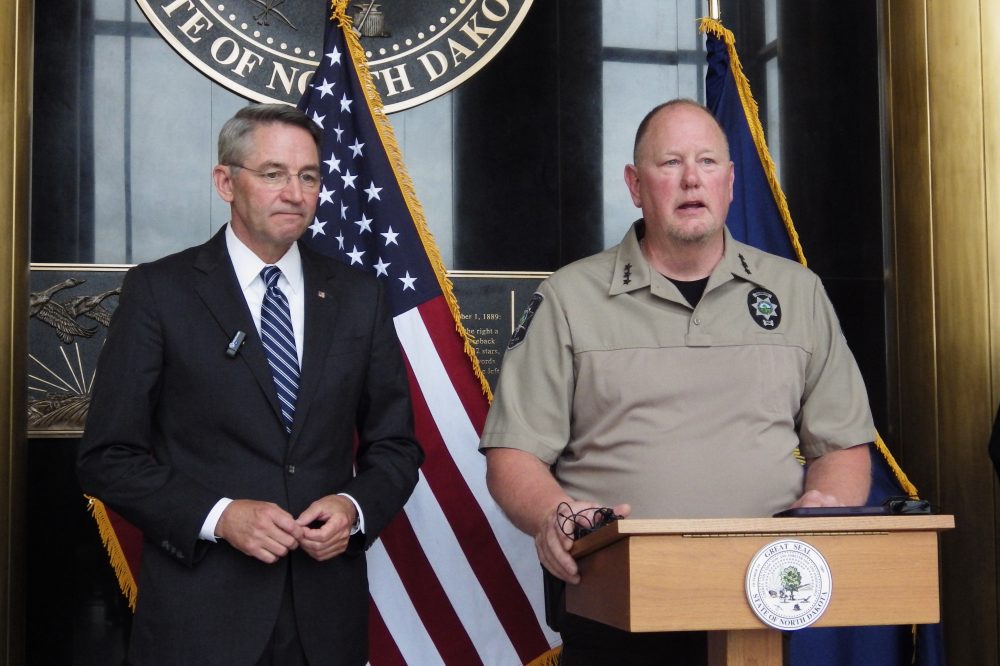
The settlement amount matches what a federal judge awarded the state following a trial last year. Federal officials also agreed to drop all pending appeals and issue a formal acknowledgment recognizing “that the people of North Dakota, including, centrally, our law enforcement officers, endured repeated acts of intimidation, violence, property destruction, unlawful conduct associated with encampments established on federal land without authorization,” Republican Attorney General Drew Wrigley explained to the media.
“We deeply appreciate those acknowledgments. They’re a long time coming,” he stated, appearing alongside legal counsel and investigators from his department.
Wrigley indicated that North Dakota is now “made financially whole” and that the settlement funds will cover outstanding debts from loans obtained through the state-owned Bank of North Dakota.
Republican Gov. Kelly Armstrong praised the resolution as “long overdue” and expressed gratitude to Wrigley’s team and others involved in securing the agreement “that removes the financial burden from North Dakota taxpayers and places it on the shoulders of the federal government where it belongs.”
The U.S. Justice Department issued a statement disagreeing with the court’s legal reasoning “but acknowledges in hindsight that, under the Obama Administration, the federal government could have done more to reduce the impacts to the people of North Dakota” from the demonstrations, which sometimes involved “unlawfulness and confrontational violence.”
“To avoid further escalation of unlawful behaviors, the federal government at the time chose not to forcibly remove the protestors from the encampment on federal property. The United States recognizes that this difficult choice had painful consequences for North Dakota and many of its residents,” the department stated.
The agreement comes over a year after U.S. District Judge Daniel Traynor ruled the federal government responsible on all charges, including negligence, gross negligence, civil trespass and public nuisance, awarding approximately $27.8 million.
During 2016 and 2017, thousands of demonstrators established camps and conducted protests on and near federally controlled property close to where the pipeline crosses the Missouri River upstream from the Standing Rock Sioux Tribe’s reservation. The tribe has consistently challenged the pipeline due to concerns about threats to their water resources.
The demonstration participants came from across the United States and internationally, including tribal supporters, Native rights advocates, environmental activists, and fossil fuel opponents. Notable figures like actors Shailene Woodley and Mark Ruffalo and the Rev. Jesse Jackson made trips to North Dakota to show solidarity with the tribe.
The demonstrations led to periodic violent confrontations between protesters and police officers. A state legal representative said the protests triggered a response lasting seven months, involving 178 different agencies, leading to 761 arrests, and requiring four days to clean up the campsite and remove millions of pounds of debris.
North Dakota filed its lawsuit in 2019, requesting $38 million in damages. In 2017, pipeline operator Energy Transfer contributed $15 million toward response expenses. That same year, the Justice Department provided a $10 million grant to help the state cover costs.
The judge determined that Energy Transfer’s payment was a voluntary contribution and deducted the $10 million previously provided by federal authorities when calculating the nearly $28 million judgment.
Last month, Traynor withdrew several earlier rulings, including his 2025 decision, at both parties’ request as they worked toward a settlement.
“The Court does not believe it should stand in the way of a satisfactory settlement between the Parties but should encourage litigants to pursue settlements even when federal government conduct is at its worst,” Traynor stated.
The pipeline began operations in mid-2017 and currently carries roughly 4% of daily U.S. oil production, approximately 540,000 barrels per day.
In May, the U.S. Army Corps of Engineers provided final authorization for the pipeline’s Missouri River crossing near the reservation, six years after a federal judge ordered a more comprehensive environmental assessment. Tribal Chairman Steve Sitting Bear indicated that Standing Rock will evaluate its options to protect treaty rights, ensure water safety, and maintain accountability for government and corporate actions.