
Nine Native American tribes from South Dakota, North Dakota and Nebraska have launched a federal lawsuit against the U.S. government seeking to block exploratory drilling for graphite near a sacred ceremonial location in the Black Hills.
The tribes filed their legal challenge Thursday in South Dakota federal court, targeting the U.S. Forest Service and U.S. Department of Agriculture. They claim these agencies broke federal law by approving a project close to Pe’Sla, a meadow in the central Black Hills where tribes conduct ceremonies, prayers and youth camps throughout the year.
Small groups of protesters have been demonstrating both at the drilling site and at the mining company’s offices since learning that ground was broken on the project in late April.
This legal battle represents the newest conflict between tribal nations and mining companies in the forested Black Hills region, which covers more than 1.2 million acres across southwest South Dakota and into Wyoming.
While the area draws millions of visitors annually to attractions like Mount Rushmore and wildlife parks, it has held sacred significance for Sioux tribes much longer. The tribes call the region He Sapa and view it as “the heart of everything that is,” according to court documents.
Mining activities have previously transformed parts of the landscape, beginning with the 1870s gold rush that developed the area and forced out Native Americans. In recent years, higher gold prices have attracted new mining operations back to the region.
The lawsuit states that the project by Pete Lien & Sons, a Rapid City-based mining company, would interfere with traditional, cultural and religious practices at Pe’Sla. The tribes also argue the Forest Service failed to consult with them before green-lighting the project.
Sioux tribes purchased portions of Pe’Sla in 2012, 2015 and 2018, and worked with the Forest Service to create a two-mile buffer zone on public lands surrounding the site, the lawsuit notes.
The tribes contend the approval breaks both the National Historic Preservation Act and National Environmental Policy Act because Pe’Sla wasn’t considered as an affected area and no environmental assessment was performed.
Pete Lien & Sons, which provides materials including limestone, sand and gravel, did not respond to requests for comment Thursday or Sunday.
Frank Star Comes Out, president of the Oglala Sioux Tribe, described the lawsuit as “a historic demonstration of unity” among the nine tribes in a written statement. While these tribes are separate, federally recognized governments with their own territories, they share cultural and linguistic heritage.
“We as Lakota people have been coming and praying and holding ceremony at these places for over 2,000 years,” stated Wizipan Garriott, president of Indigenous advocacy group NDN Collective and a member of the Rosebud Sioux Tribe. “And so us being here is a continuation of countless generations before us. And it’s important that these sacred places be protected for future generations to come.”
The Forest Service issued the project permit in February without requiring an environmental assessment, claiming it qualified for a categorical exclusion due to its duration of less than one year and supposed lack of environmental and cultural impacts.
However, tribal opponents dispute that these conditions were satisfied and warn that exploratory drilling typically leads to future mining operations.
Along with the tribal lawsuit, NDN Collective and other environmental organizations have requested a temporary restraining order and preliminary injunction to stop the project.
According to NDN Collective, some drilling platforms are located within the buffer zone around the sacred site. The project allows the company to drill as many as 18 holes extending approximately 1,000 feet underground to gather samples.
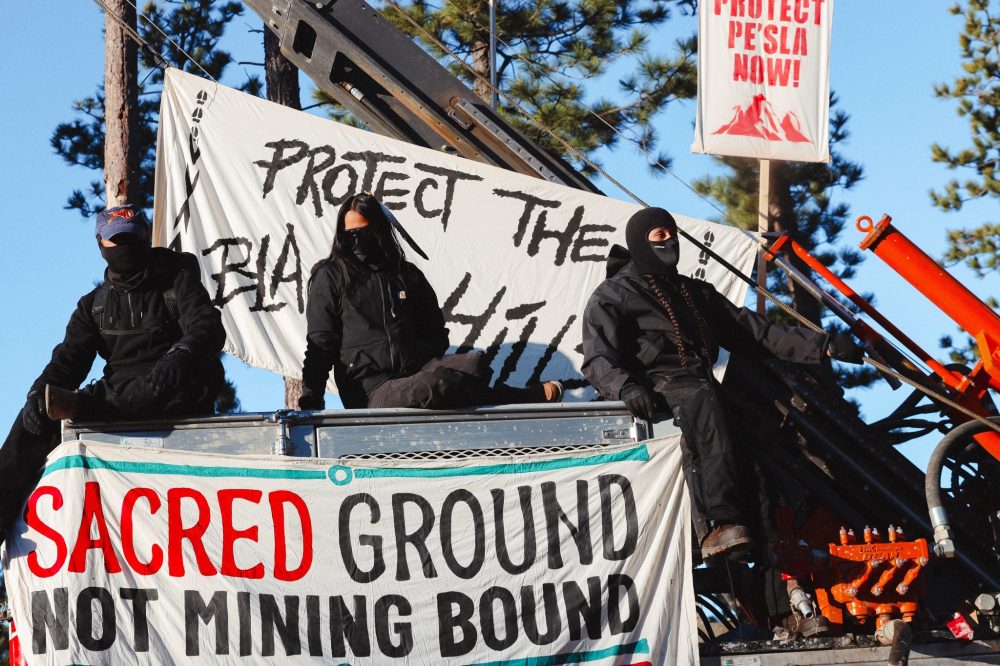
On Thursday, protesters carried signs reading “Protect Pe’Sla” and “Sacred ground not mining bound” near two drilling platforms to prevent access. NDN Collective reported that the Forest Service informed them drilling was suspended for the remainder of the day and contractors were dismissed.
When asked for comment about the project, the Forest Service declined to provide details.
“The Forest Service does not comment on the specifics of the case or on issues that are part of ongoing legal proceedings,” the agency stated.
While it remains unclear exactly when drilling operations began, NDN Collective discovered active drilling platforms last week. The organization plans to continue protest activities as necessary to safeguard Pe’Sla.
“As Lakota, we pray as long as we need to,” Garriott said.