
ALBUQUERQUE, N.M. — New Mexico’s governor announced Monday that the state may pursue billions of dollars in civil damages following revelations that agents with the U.S. Drug Enforcement Administration repeatedly allowed fentanyl shipments to pass through drug-troubled communities while trying to build larger criminal cases.
Democratic Gov. Michelle Lujan Grisham pledged to bring her anger “right to the White House and Congress” to demand guarantees that the DEA is no longer employing the dangerous tactic in New Mexico — and that it isn’t being used anywhere else in the country. Overdose rates have climbed sharply in New Mexico even as fentanyl-related deaths have dropped in other states.
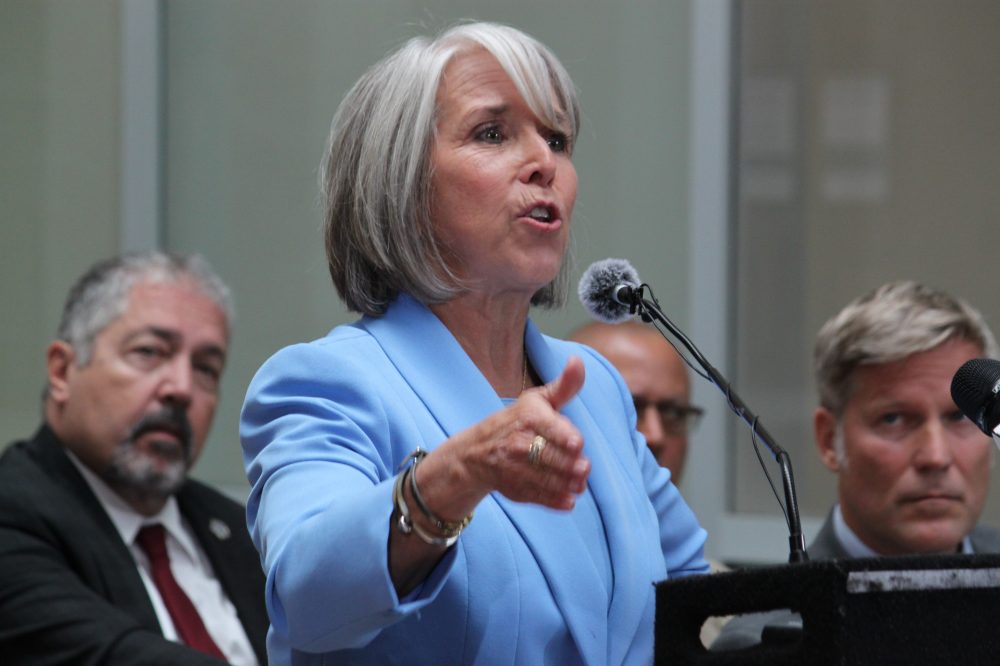
“This is a stunning failure by the federal government,” the governor told reporters at a press conference held at the state medical examiner’s office in Albuquerque, where she was joined by state and local law enforcement officials demanding accountability. “It’s disgusting and despicable.”
The White House and DEA did not respond to requests for comment.
The governor’s statements came one week after the Associated Press revealed that DEA agents had repeatedly watched — without stopping — fentanyl shipments as part of a strategy to pursue bigger criminal targets between 2023 and 2025.
Both current and former DEA agents, including whistleblower David Howell, told the AP that the approach was a dangerous gamble with public safety and may have broken U.S. Justice Department rules designed to protect the public. The DEA initially denied Howell’s claims, but later asked the Justice Department’s independent watchdog to launch its own review.
The fentanyl went uncollected even as the DEA was running a public awareness campaign called “One Pill Can Kill,” which warned that even a tiny amount of the substance can be fatal — all during what has been described as the deadliest drug epidemic in U.S. history.
New Mexico’s attorney general last week launched a criminal investigation to determine whether any federal officials violated state law by knowingly exposing residents to the synthetic opioid.
“We’re going to protect the rest of the United States from this kind of foul, ‘I need a big case’ effort no matter what the consequences,” Lujan Grisham said. “We’re angry because it’s immoral.”
Albuquerque Mayor Tim Keller described fentanyl as his city’s “No. 1 challenge,” saying it fuels crime, homelessness, and places enormous strain on health care resources.
“Using us in some sort of uninformed, undisciplined experiment that’s literally killing our people — that’s what this is,” Keller said. “This should outrage every single New Mexican.”
President Trump last week shared a link on his Truth Social account to a story blaming the scandal on the “Biden-run Justice Department.” The Justice Department also stated last week that “the alleged conduct occurred under the Biden Administration’s disastrous open border policies.”
However, whistleblower Howell first raised concerns during the Biden administration in 2023 and was sidelined as a result. He continued to flag uninspected fentanyl shipments as recently as last year. The largest shipment he documented — 1.8 million pills — was one the DEA learned about but chose not to intercept in March 2025, two months into President Trump’s second term.
Lujan Grisham has criticized both administrations for failing to stop the flow of fentanyl into New Mexico. She pointed to the death last year of a 15-month-old girl who reportedly ingested some of her mother’s drugs in Española, a town hit hard by poverty and addiction.
It remains unclear whether any specific fatal overdoses in the state can be directly tied to the DEA’s strategy. While overdose deaths fell 14% nationally last year, New Mexico saw a 21% increase, according to government data.
“Somebody must pay for the damage to the state, the public safety risks that will be shared by everyone here for a decade or more, and pay to try to right the wrongs and put people’s lives back together,” the governor said.
Lujan Grisham, who will leave office at the end of this year after serving two terms, said the hardest part of being an elected official is facing victims of what she called “senseless” loss.
“There are no words that can take away that pain,” she said. “Whatever we can do to prevent the next loss for the next family, is the work that we’re all collectively doing.”