
Maryland officials have officially opened a new state park that celebrates an extraordinary story of resilience and triumph over slavery in the state’s African American history.
Freedman’s State Park in Montgomery County spans just over 1,000 acres and honors the Howard family, whose journey from enslavement to prosperity helped shape Maryland’s Civil Rights Movement. The Maryland Department of Natural Resources, along with the Office of Governor Wes Moore and community partners, held the dedication ceremony.
The parkland sits on property once belonging to Enoch George Howard, his wife Harriet, and their children, who became influential figures in northern Montgomery County, Baltimore, and Canada. Planned restored buildings and new exhibits will share their inspiring story.
“Black history is central to Maryland’s story, and Freedman’s State Park tells an amazing story of resilience rising from the injustice of slavery,” stated Chichi Nyagah-Nash, Deputy Chief of Staff to Governor Wes Moore. “When we preserve a place like this, we are doing more than protecting acreage. We are honoring Black history as Maryland history. And we are making sure that future generations understand that freedom is not merely declared. It is built. It is defended. It is taught. It is prayed over. It is lived.”
The park takes its name from “freedman,” referring to someone who gained freedom from slavery. Maryland lawmakers established the park in 2022 to honor all Marylanders who were emancipated from bondage.
“We rightly honor our well-known historic heroes like Harriet Tubman and Frederick Douglass. At Freedman’s State Park we will explore the story of emancipation through the life of Enoch George Howard, the intrepid spirit of his family, and the community that grew around them,” explained Maryland Department of Natural Resources Secretary Josh Kurtz. “The Howard family’s contributions to our shared history and struggle for freedom is an inspiring addition to the Park Service’s stewardship of our natural, historical, and cultural heritage.”
Before the Civil War, the Gaither family enslaved Enoch George Howard – the same family for whom Gaithersburg was named. Through exceptional farming abilities and business skills, Enoch George accumulated enough funds to purchase his own freedom, followed by his wife’s liberation, their four children’s freedom, and eventually the very land where his wife had once been held in bondage.
“The Howard family lived a complete arc of the African American experience in one generation, from enslavement to emancipation, to land ownership and community leadership,” noted Angela Crenshaw, Director of the Maryland Park Service. “Visitors to Freedman’s State Park can share the immersive experience by walking in their literal footsteps on this land where they made history.”
Enoch George Howard passed the property to his children, including Martha Elizabeth Howard Murphy, who sold her portion and used those funds to help acquire the Baltimore Afro-American newspaper. This became Maryland’s first Black-owned publication and remains a leading civil rights voice today.
Key historical features within the park include the Howard Chapel Cemetery, Howard Family Cemetery containing Enoch George and Harriet Howard’s graves, and remnants of Locust Villa. This 1790s plantation house was purchased by Enoch George Howard for roughly $3,000 in 1862 during the Civil War – the same location where his wife and children had previously been enslaved.
Greenbury Howard, his son, later constructed his own residence nearby modeled after Locust Villa, where descendants lived until recent decades. The Park Service currently oversees restoration work on the Greenbury Howard house.
Multiple organizations collaborated to develop Freedman’s State Park, including Preservation Maryland, the Sandy Spring Museum, Sandy Spring Slave Museum, Maryland-National Parks and Planning Commission, the Baltimore Afro-American and Afro Charities, and the Maryland Historical Trust. Archaeological investigations have revealed numerous details about the Howard family’s life.
The heavily forested areas and farmland previously cultivated by the Howards will be linked by recreational trails for hiking and cycling. This new park was formerly part of Patuxent River State Park and includes land in northeastern Montgomery County around Brookeville, Olney, Sandy Spring, and Laytonsville.
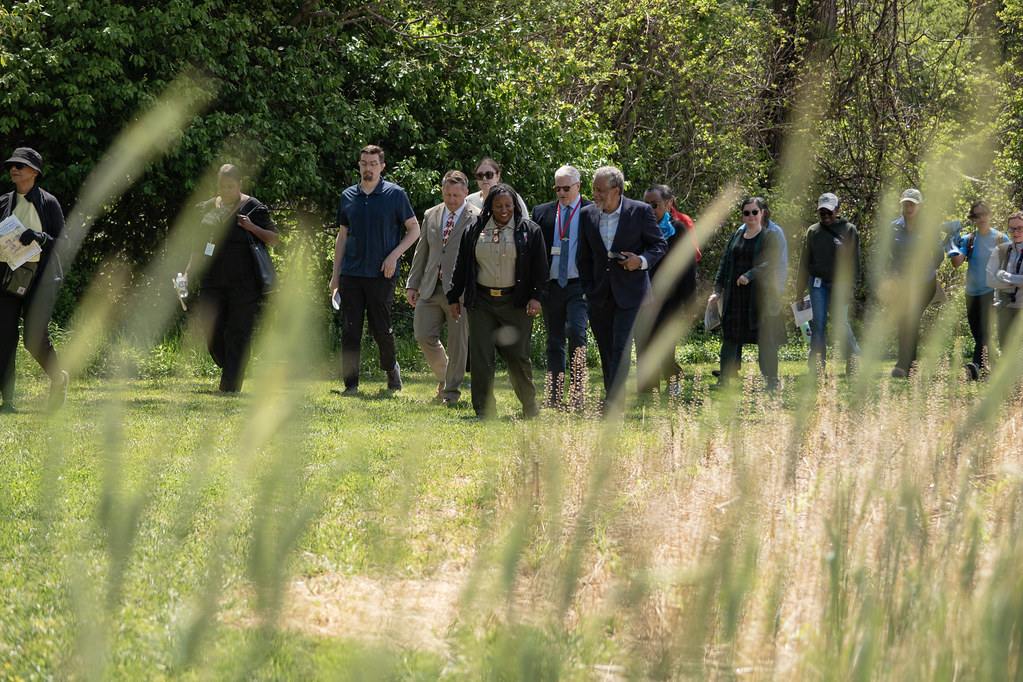
During a recent walkthrough, Crenshaw highlighted a specific trail location near the Greenbury Howard house that overlooks the family’s former property. She calls it a “Lion King moment” – referencing the movie scene where a father shows his son their kingdom – noting its special significance in representing how far the Howard family traveled toward freedom.
Secretary Kurtz and Director Crenshaw led Friday’s May 15 dedication ceremony. Project partners from Gov. Moore’s office, Preservation Maryland, the Afro-American, and Afro Charities, along with Howard family descendants, toured the property following the dedication. Some park areas are currently open for hiking, with public tours to be scheduled later.
Freedman’s represents one of six new state parks or major expansions the Department of Natural Resources is announcing this year. In February, officials opened the historic African American cemetery at Catoctin Furnace in Cunningham Falls State Parks to public access.