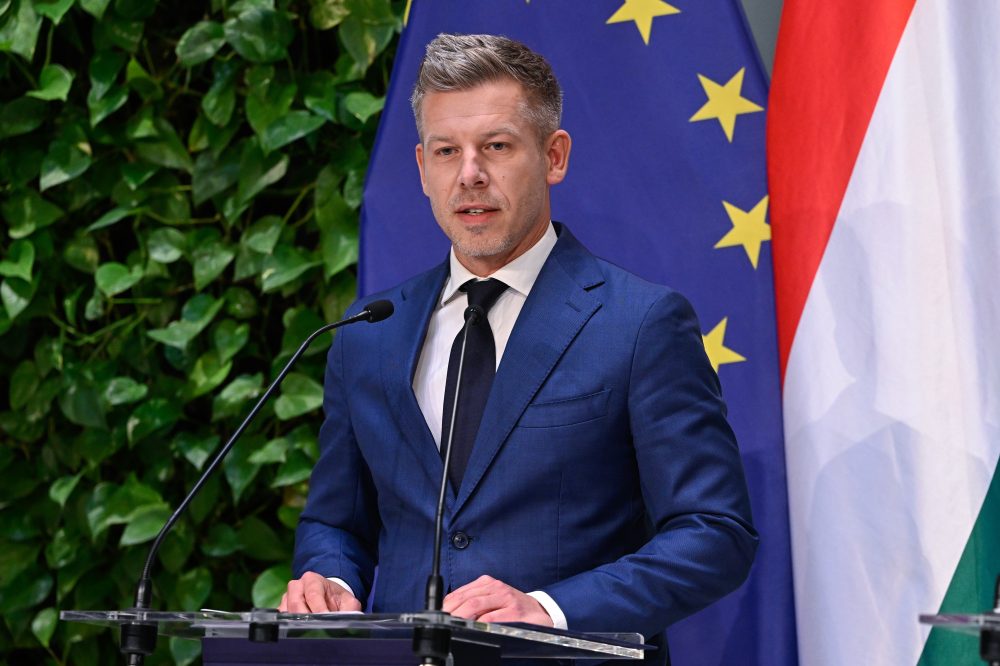

Hungary’s newly elected Prime Minister Péter Magyar embarked Tuesday on his inaugural international journey to Poland, seeking insights from a longtime partner nation whose recent democratic transition offers valuable guidance for reversing years of authoritarian governance.
Magyar, leading the center-right Tisza party that toppled far-right leader Viktor Orbán and his nationalist-populist Fidesz movement in last month’s stunning electoral upset, has promised to tear down the autocratic framework his predecessor constructed over 16 years in office.
This development has sparked optimism throughout Europe and invited parallels to Poland’s 2023 electoral outcome, where Prime Minister Donald Tusk’s center-right alliance ousted the national-conservative Law and Justice party following eight years of rule.
Similar to Magyar’s approach, Tusk acted swiftly to rebuild democratic structures weakened under the former administration, focusing on judicial reform and public broadcasting while pursuing accountability for officials accused of power misuse.
Magyar’s itinerary includes a flight to Krakow in southern Poland on Tuesday, followed by rail travel to Warsaw and then to the Baltic coastal city of Gdansk.
Following his May 9 inauguration, Magyar publicly demanded the resignation or removal of numerous Orbán appointees through constitutional amendment — authority he possesses after Tisza secured a two-thirds parliamentary majority.
Magyar has specifically challenged Hungary’s President Tamás Sulyok, despite the position being largely ceremonial with limited constitutional authority, along with the nation’s attorney general and leaders of both constitutional and supreme courts — officials he has condemned as “Orbán’s puppets.”
Andrzej Sadecki, a researcher with the Center for Eastern Studies in Warsaw, explained to The Associated Press that Magyar’s primary obstacle remains that “some key state institutions are still in the hands of people nominated by Fidesz.”
However, unlike Poland’s situation, “the situation is much easier for Magyar because he has a constitutional majority. This makes it much easier for him to introduce deep changes,” Sadecki noted.
While Tusk assumed leadership through coalition-building in Poland’s 2023 contest, Magyar’s Tisza captured 53% of votes, achieving greater electoral support and parliamentary representation than any party in Hungary’s post-Communist era.
“It’s not just a change of government, it’s a watershed moment,” Sadecki observed.
Orbán’s administration featured an extensive media network that functioned as a devoted propaganda arm for Fidesz while attacking, undermining and harassing political adversaries.
Following his electoral triumph, Magyar condemned public broadcasting under Orbán as “a factory of lies,” announcing his administration would halt their news operations until “the conditions for objectivity are restored.”
This strategy echoes actions by Tusk’s administration, which overhauled state television’s evening programming within a month of assuming power. Poland’s new leadership justified replacing state media executives based on government ownership of public broadcasting.
The process attracted criticism from some liberal organizations, with the Helsinki Foundation for Human Rights in Warsaw stating that “the manner of initiating changes in public media raises serious legal doubts.”
Nevertheless, József Péter Martin, executive director of Transparency International Hungary, argued that the extent of Hungary’s public media failures means “it should be rebuilt, and it can be done within the framework of the rule of law.”
Throughout its tenure, Poland’s Law and Justice party strengthened judicial control by placing loyalist judges in senior positions and disciplining critics through punitive measures.
The party also positioned enough sympathetic justices on the Constitutional Tribunal to obstruct unfavorable legislation through constitutional challenges. Tusk administration attempts to reverse these changes have faced repeated opposition from two consecutive Law and Justice-aligned Polish presidents.
While some progress occurred in certain areas, Poland has not fully restored judicial independence, and Magyar’s government may encounter similar obstacles.
Despite Magyar’s resignation demands, President Tamás Sulyok — an Orbán supporter whose term continues until 2029 — has signaled no intention to leave office.
Additionally, Hungary’s Constitutional Court chief, Péter Polt, widely considered a Fidesz loyalist, will serve until 2037.
Although many Hungarian judges and prosecutors perform their responsibilities properly, judicial leadership — including constitutional and supreme court heads — requires replacement to restore public confidence and neutrality, Martin of Transparency International Hungary stated.
And “not with (Magyar’s) Tisza loyalists, because then we would go from one problem to the other, but with someone who has full integrity and devotion to the Hungarian constitution and to the public interest, and not to the interest of the former autocratic regime,” Martin emphasized.
Even without completely restoring judicial independence, Polish prosecutors have launched investigations and pursued cases against former Law and Justice officials accused of exploiting their positions for political advantage.
In October, Polish prosecutors announced intentions to charge former Justice Minister Zbigniew Ziobro with redirecting funds from a Justice Ministry program for violence victims toward personal and political purposes.
Ziobro’s prosecution stalled when he declared in January that Orbán’s Hungary had granted him asylum. Since Magyar’s electoral victory, Ziobro has relocated to the United States, with Polish officials working to secure his return.
Many of the nearly 3.4 million Hungarians who supported Tisza anticipate the new administration will pursue accountability for Orbán and his political and business associates.
Magyar has committed to establishing the National Asset Recovery and Protection Office, an agency responsible for investigating and recovering public funds allegedly misappropriated during Orbán’s leadership.
According to Martin, rebuilding rule of law and judicial independence would represent “the initial and most essential step” toward ensuring prosecution of past misconduct.
Hungary’s participation in the European Public Prosecutor’s Office, which Magyar has pledged to pursue, would advance this goal, he added.
“If all this is done, then I think there is a good chance that the corrupt perpetrators of the former regime, under an independent judiciary, can be held accountable,” he concluded.