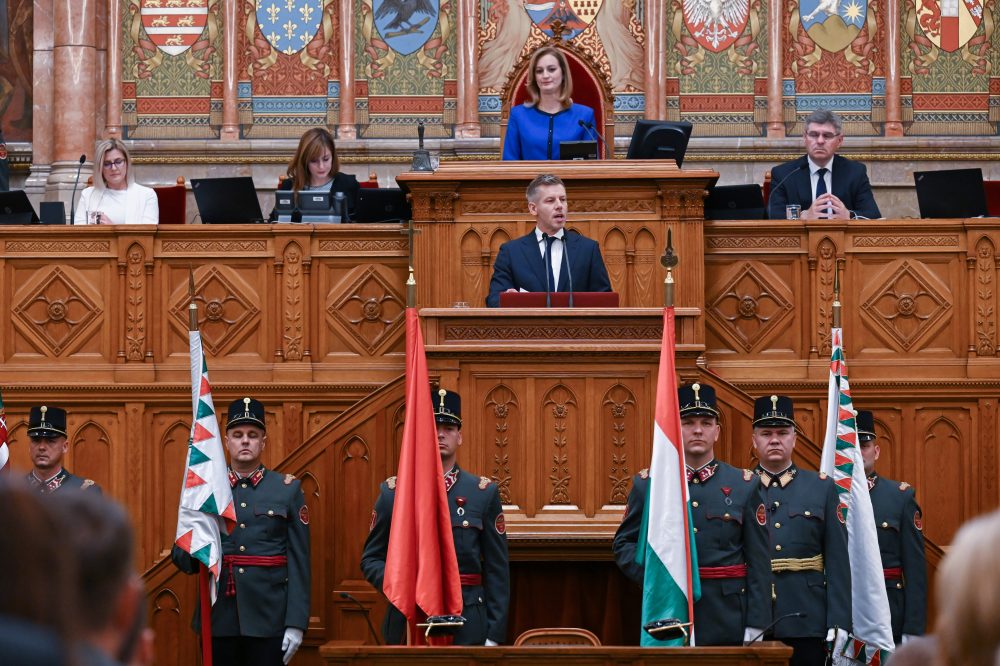

BUDAPEST, Hungary — Hungary completed its historic political transition Tuesday as Péter Magyar’s cabinet ministers officially took their oaths of office, bringing to a close Viktor Orbán’s 16-year reign over the Eastern European nation.
The ceremony installing 16 new ministers occurred just two days following parliamentary committee reviews, demonstrating the 45-year-old attorney’s determination to rapidly dismantle the political framework Orbán established during his extended tenure as leader.
Magyar’s European Union-aligned Tisza party delivered a decisive electoral victory over Orbán’s nationalist Fidesz movement last month, capturing more parliamentary support than any political organization in Hungary’s post-Communist era.
This electoral triumph provided Tisza with a commanding two-thirds parliamentary majority, positioning the party to reverse numerous policies that earned Orbán criticism as an authoritarian leader from the far-right.
Speaking after his ministers’ installation ceremony in Hungary’s legislative building, Magyar declared that “the government now being formed will be the government of all Hungarians” and “a servant of the nation and not of the prime minister,” delivering a clear rebuke to his predecessor’s approach.
“We must repair the destruction, division, backwardness and loss of trust over the past two decades by making Hungary a functioning, livable and self-reliant country again,” he stated.
The electoral results gave Tisza control of 141 parliamentary positions from the total 199 available, while Orbán’s EU-skeptical Fidesz party retained just 52 seats, falling dramatically from their previous 135. The extreme-right Mi Hazánk (Our Homeland) movement secured six positions.
Nearly 3.4 million Hungarian voters who supported Tisza anticipate Magyar will pursue accountability measures against Fidesz leadership and their business partners for alleged wrongdoing and corrupt practices during the previous administration.
Magyar intends to establish a National Asset Recovery and Protection Office, a specialized agency responsible for examining and attempting to reclaim public resources allegedly misappropriated throughout Orbán’s leadership period. He has additionally announced Hungary’s participation in the European Public Prosecutor’s Office, enabling EU investigators to examine fraud allegations and monitor how bloc funding was utilized.
The new leader has also promised to halt operations at Hungary’s state broadcasting network — commonly viewed as Orbán’s party propaganda outlet — until journalistic neutrality can be reestablished.
During his inaugural address, Magyar once again demanded that numerous Orbán appointees holding extended-term positions resign by May 31, specifically naming the president, attorney general, media authority director, and Constitutional Court chief justice.
The incoming administration will oversee 16 ministerial departments, an increase from Orbán’s final government structure of 12. Magyar has committed to substantially reorganizing governmental operations, creating independent ministries for health, environmental protection, and education that were previously consolidated under Orbán’s system.
He has also emphasized restoring democratic frameworks and legal accountability that deteriorated during Orbán’s administration, while pursuing consequences for individuals he claims oversaw and profited from systematic official corruption.
Magyar’s leadership is anticipated to reshape political relationships throughout the European Union, where Orbán frequently disrupted bloc operations by blocking important decisions, particularly regarding assistance for Ukraine.
Supporting these objectives, Magyar’s team has indicated priority efforts to release approximately 17 billion euros ($20 billion) in EU funding that was suspended during Orbán’s tenure due to rule-of-law and corruption issues. These resources are critically needed to revitalize Hungary’s economic performance, which has remained stagnant over the past four years.
In a Facebook video message Monday, newly appointed Foreign Minister Anita Orbán, a diplomatic and international policy specialist, explained her department’s main objective will be to “bring EU funds home” and “consolidate Hungary’s place in Europe and in the EU.”
Other cabinet officials installed Tuesday included Economy and Energy Minister István Kapitány, a former Shell corporation executive, and Finance Minister András Kármán, an economist and previous Erste Bank executive.