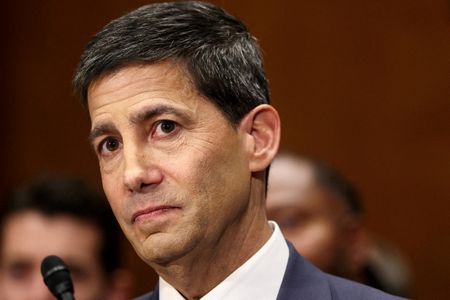

WASHINGTON – The newly confirmed Federal Reserve Chairman Kevin Warsh may find his ambitions to reduce the central bank’s market presence hampered by mounting federal debt and declining appeal of U.S. Treasury bonds, financial experts warn.
The U.S. Senate confirmed Warsh on Wednesday to succeed Fed Chair Jerome Powell. He has championed reducing the central bank’s involvement in markets and scaling back interventions as part of returning to traditional monetary policy approaches that he believes can better focus on inflation control while avoiding market distortions.
While appealing conceptually, this strategy might expose weaknesses in Treasury markets that could either drive up long-term borrowing costs – harming businesses, consumers and government finances – or force the Fed to intervene anyway to keep rates manageable, according to Hanno Lustig, a finance professor at Stanford University’s Graduate School of Business. Lustig’s latest research indicates that leading developed economies like the U.S. have lost their “convenience yield” – essentially lower borrowing rates for countries with risk-free status and independent central banks.
Speaking at a Stanford’s Hoover Institution conference, Lustig emphasized the need for transparency if Warsh and fellow Fed officials want to address this issue when bond yields react to fiscal pressures. “In order to have real price discovery in the Treasury market, we need a central bank that will not intervene,” he stated, rather than claiming market disruptions are temporary hiccups requiring Fed bond purchases.
Since his tenure as a Fed governor over ten years ago, Warsh has criticized how the central bank expanded its balance sheet during emergencies or banking stress periods without clear guidelines on which securities to purchase, in what amounts, or how to subsequently reduce holdings.
The Fed’s asset portfolio has fluctuated through a mix of financial experimentation – testing how much liquidity banks require before rates climb – and comprehensive responses to crises like the COVID-19 pandemic or the 2007-2009 recession and financial meltdown. Currently, the Fed maintains approximately $6.7 trillion in assets, reduced from roughly $9 trillion in 2022, though the total is gradually increasing again to maintain adequate bank reserves.
No widespread consensus exists regarding how Fed bond buying, termed “quantitative easing,” impacts the economy.
Typically, the U.S. central bank limits monetary policy actions to adjusting short-term interest rates that affect consumer and business lending costs. Elevated rates reduce spending when inflation accelerates, while lower rates stimulate spending during economic downturns.
When the policy rate reaches zero and cannot decrease further during economic disruptions, the Fed can deploy its theoretically limitless balance sheet – its money creation authority – for intervention. Purchased assets exit the system and are replaced with cash, helping reduce longer-term rates further to encourage spending and stimulate growth.
Fed officials and others generally acknowledge this approach works to some extent.
However, “they’re overdue for a discussion around how they use the balance sheet and under what circumstances,” said Ellen Meade, a former top Fed adviser who now teaches economics at Duke University. “That’s a nine-to-12-month process, with staff memos and briefings, committee discussions and then agreement.”
Attempting to simultaneously reduce holdings and maintain low rates might also require unusually close coordination with the U.S. Treasury, whose debt-issuance choices could affect rates as the Fed cuts its holdings.
In recent analysis, Bill Nelson, a former Fed staffer and current chief economist at the Bank Policy Institute, determined that if the central bank used regulatory and other modifications to shrink its balance sheet by an additional $2 trillion, the impact on policy rates would depend significantly on implementation methods and Treasury Department responses – potentially ranging from a 0.84-percentage-point rate reduction to a possible increase.
Not everyone views a large balance sheet as problematic as Warsh believes.
Fed Governor Christopher Waller, observing that substantial central bank asset holdings primarily provide adequate bank liquidity, called proposals to reduce holdings to levels where financial institutions compete for reserves “extremely inefficient and stupid.” A recent Brookings Institution survey of 29 top Fed and economic analysts found most respondents said the Fed’s balance sheet size “does not currently pose a problem for the growth or financial stability of the U.S. economy.”
Beyond these concerns, broader debt trends could create additional challenges as Warsh assumes leadership. The Congressional Budget Office projects a federal deficit equivalent to 5.8% of gross domestic product for fiscal year 2026 compared to a 50-year average of 3.8%, with increasing interest expenses driving it higher.
St. Louis Fed research also determined that U.S. Treasuries and bonds from other “risk-free” countries are losing their rate advantages. The study by YiLi Chien, an economist and senior policy advisor at the regional Fed bank, and Kevin Bloodworth, a research associate there, discovered that as the central bank began reducing its balance sheet in 2022, the convenience yield dropped approximately 40 basis points, requiring the U.S. to pay investors that much more for borrowing.
Warsh must determine how to offset this effect to further reduce holdings or justify it as the price of large deficits, which would approach the type of “mission creep” into fiscal matters he has opposed.
Jeffrey Lacker, who led the Richmond Fed during Warsh’s governorship, said Warsh’s balance sheet observations “resonates strongly” with those seeking more restrained central banking, but implementation requires discipline extending beyond Fed offices.
“I think for the Fed to back away from things that amount to debt management would clarify market participants’ expectations and would help make the Treasury market more resilient,” Lacker explained. It would also “aid in sort of the general process of the Treasury as it has to … face the music in essence.”