
Professional basketball officials are whistling approximately 11% more personal fouls per game during this year’s postseason compared to the regular season, creating a gap that ranks among the most significant in league history.
According to the NBA, this increase is completely normal.
Despite ongoing criticism from players and coaches that surfaces every postseason, the league’s senior vice president of referee development and training openly admits there’s a clear distinction between regular-season and playoff basketball — something everyone in the organization would agree with.
However, Monty McCutchen maintains that officiating principles remain unchanged during the playoffs.
“It would be very difficult on our players, on our coaches, most certainly on our referees, if the intensity of a seven-game series that we see in the playoffs exhibited itself over 82 games,” McCutchen said at the NBA draft combine. “NBA playoff basketball is one of the great spectacles of all sport in my opinion. You get the combination of the passion and strength of our players and coaching staffs in tight spaces over seven-game series. And I think that that absolutely makes for a different game.”
With postseason stakes elevated, every moment receives heightened examination and tempers naturally flare.
— San Antonio star Victor Wembanyama received an ejection from a playoff contest this week for elbowing Minnesota’s Naz Reid, prompting Spurs coach Mitch Johnson to note his 7-foot-4 player constantly faces excessive physical contact that eventually forces a response. “At some level, you have to protect yourself,” Johnson said. “Every single play on every single part of the floor, people are trying to impose their physicality on him. I get it. We get it. That’s part of the game.”
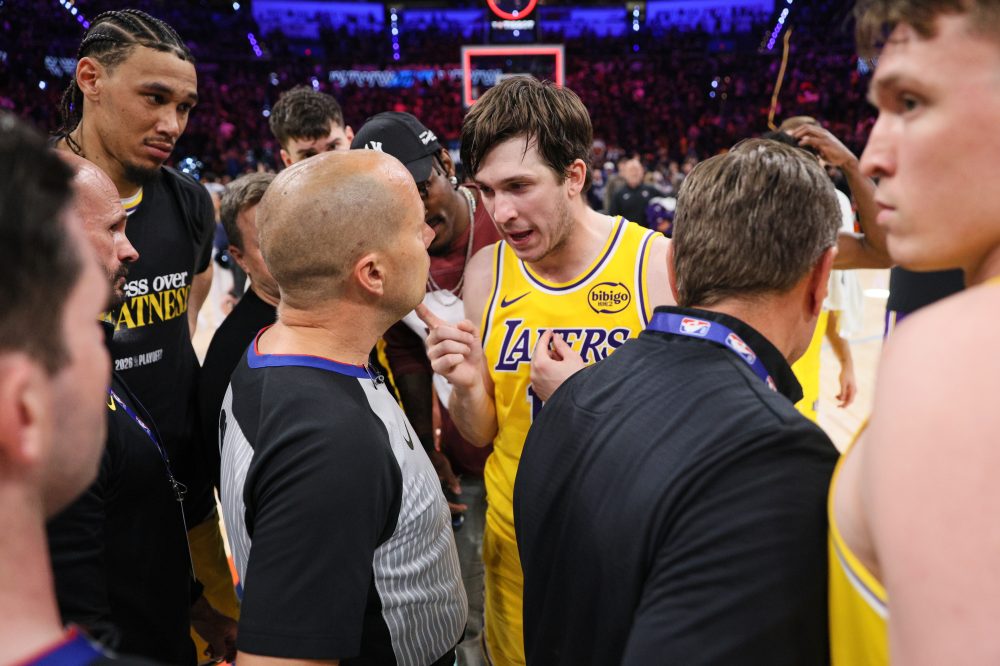
— Austin Reaves and the Los Angeles Lakers conducted an unplanned discussion at center court with officials following a playoff defeat in Oklahoma City to express their concerns.
— Cleveland coach Kenny Atkinson noted that Cavs star guard Donovan Mitchell rarely reached the free-throw line during Games 1 and 2 against Detroit; Mitchell attempted 11 free throws total in those contests (both Cleveland defeats) but averaged 11.5 attempts in the following two games (both Cleveland victories). This observation prompted Pistons coach J.B. Bickerstaff to respond after Game 4.
These represent just a few instances.
“Standing up for your team is a job descriptor of an NBA head coach and most certainly I don’t begrudge a head coach the desire to represent for himself, his team, most certainly his players,” McCutchen said. “That’s part of the voice of an NBA head coach that I have an understanding of. My job is to take those commentaries and decide or see what is true and what is avocation. And now, even if it is true, it’s very important that I’m not putting my foot on the scale of a series.”
Postseason officials — not every referee receives playoff duties, and the group of working officials shrinks after each round based on evaluation — review game footage afterward, identical to regular-season procedures. Every decision undergoes assessment, and McCutchen has repeatedly stated in recent years that the league’s officiating staff continuously works toward improvement.
“We’re not putting our whistles in our pocket,” McCutchen said. “That being said, I think it’s fair to debate, talk about passionately, like many of our fans and people in the media do, about whether that’s the appropriate enough of whistles to blow. But we are trying to meet the moments of the passion of the playoffs in a way that upholds our standards.”
This typically results in additional calls. The NBA has experienced rising foul calls from regular season to playoffs for the 66th occasion in its 80-year existence. This season shows a differential exceeding 10% for just the sixth time in the past 60 years. (The five largest increases in that gap, spanning from 13% to 17%, all occurred between 1949 and 1955.)
McCutchen views the playoffs through this lens: Aggression benefits the game, while roughness does not.
“We don’t like to see ejections,” McCutchen said. “Our goal would be to get through all these games where we meet this right up to the edge of rough and you have this really aggressive, passionate game that is adjudicated and an environment is created in which that environment of aggressiveness is rewarded — because we have the best players in any sport, in my opinion — but that it doesn’t creep over to rough. That’s the goal.”