
When Junelle Lewis needed relief from soaring gasoline costs in the Seattle area caused by the Iran conflict, a smartphone app pointed her toward salvation: the Tulalip Reservation located about 30 minutes north of her residence.
Lewis didn’t think twice about making the drive.
“I purposely drove here just for the gas,” Lewis explained while fueling her Chevrolet Suburban at the Tulalip Market this week, paying $4.84 per gallon — roughly 75 cents below what she’d pay closer to home. “Gas is ridiculous. But I have found, honestly, over the years, this gas station specifically is cheaper than a lot around here. Probably the cheapest.”
Lewis joins countless other motorists who have learned that Native American reservations often feature some of the nation’s most affordable fuel options.
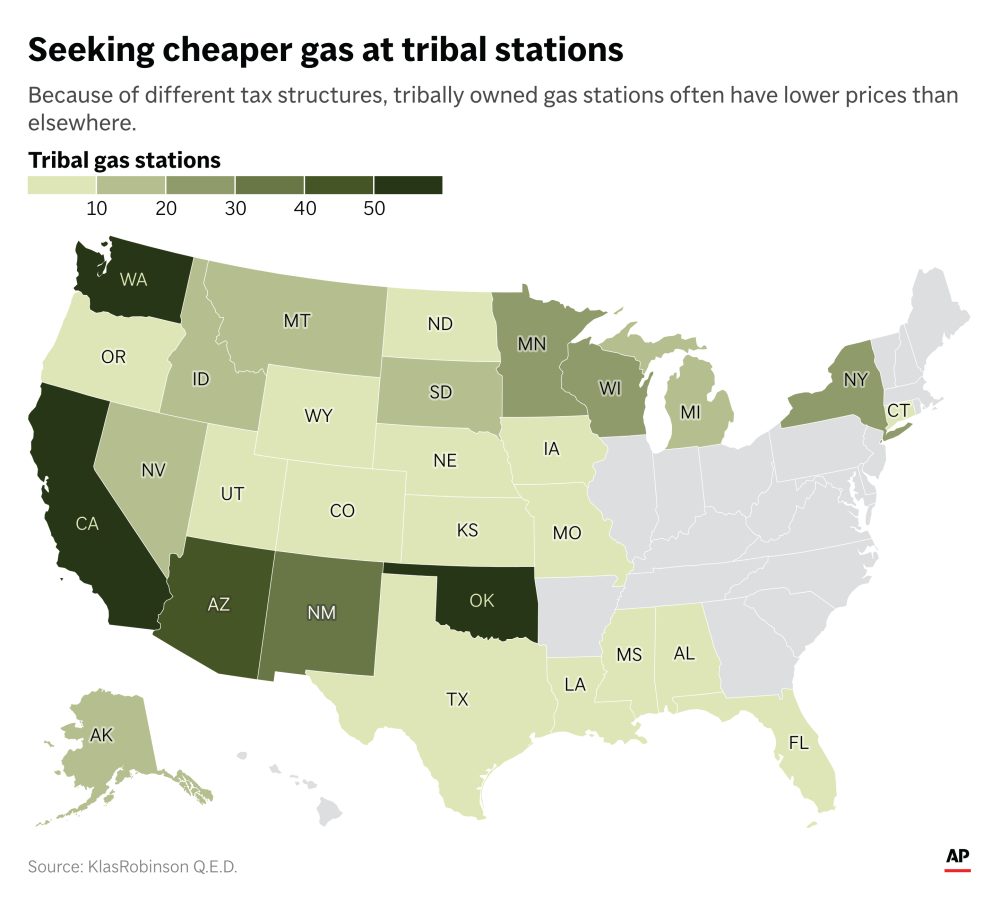
This trend is particularly noticeable in states like California, New Mexico, New York, Oklahoma and Washington — regions hosting numerous tribal-operated fuel stations, including locations along major travel routes. These tribes benefit from state fuel tax exemptions, enabling them to undercut nearby competitors significantly.
Mobile applications like Gas Buddy have made locating these bargain prices simpler than ever before.
Across America, gasoline costs have jumped more than $1 since the Iran conflict started February 28, climbing to a national average of $4.15 per gallon, AAA reports.
While prices reached higher levels during summer 2022, exceeding $5, economic experts predict continued increases that will fuel inflation in coming weeks as international tensions remain elevated.
However, bargains exist at many of the nearly 500 tribal-owned convenience stores operating gas stations throughout the United States.
California hosts 55 such locations. The Chukchansi Crossing Fuel Station & Travel Center, positioned between Fresno and Yosemite National Park, offered $5.09 gasoline — 60 cents below surrounding stations.
New Mexico’s Jamie Cross regularly discovers deals on the Mescalero Apache Reservation, where fuel dropped to $3.79 this week.
“I hope we don’t go any higher,” Cross commented Thursday.
In eastern New York, within Cattauragus Indian Territory between Buffalo and Erie, Pennsylvania, multiple stations sold the region’s cheapest gasoline at approximately $3.65 — 50 cents below neighboring communities.
The secret behind tribal pricing advantages? Tax exemptions.
Tribes typically must pay federal fuel taxes of 18.4 cents per gallon for gasoline and 24.3 cents for diesel, costs they transfer to customers. State fuel taxes represent a different situation.
For more than 100 years, American courts have determined that states lack authority to collect taxes from Native Americans on tribal lands, explained Dan Lewerenz, a University of North Dakota assistant law professor specializing in Native American legal issues.
“The Supreme Court consistently held to this view and it’s one of the most enduring principles in federal Indian law,” Lewerenz noted.
Federally recognized Native American tribes operate in 35 states where gasoline taxes vary from 9 cents per gallon in Alaska to 71 cents in California.
Beyond that point, situations become complex depending on where fuel taxation occurs — at terminals or during distributor transactions — and various state-tribal agreements.
Court decisions add another layer. In 2005, the Supreme Court determined that off-reservation Kansas distributors could charge state taxes on tribal fuel sales. However, in 2019, the high court ruled that an 1855 treaty between the United States and Yakama Nation guaranteeing tribal members free travel with goods prohibited state fuel taxes on tribal lands in Washington.
“This is a little bit different than the principle that Indians aren’t taxed within Indian Country because this particular treaty reserved certain off-reservation rights for the Indians as well,” Lewerenz explained.
Convenience store fuel sales generate less profit than drawing customers inside from the pumps.
Snack sales boost earnings. However, tribal enterprises increasingly provide groceries in areas that would otherwise become “food deserts” distant from supermarkets.
“Sometimes these gas stations and convenience stores are the nearest, best place to purchase affordable food or household supplies,” said Matthew Klas from Minneapolis-based consulting firm Klas Robinson Q.E.D.
Klas conducts market research and advises tribal businesses while tracking the 245 tribes that operated 496 convenience stores with gas stations as of 2025.
Oklahoma, California, Washington, Arizona, New Mexico, Wisconsin, Michigan and New York lead in numbers. Several tribes, including Oklahoma’s Choctaw Nation and New York’s Oneida Indian Nation, operate their own retail chains.
Drive-through tobacco shops, car washes and truck stop facilities also generate income. Additionally, 205 tribal-owned gas stations operate at or near casinos.
Some tribal casinos function as resorts featuring gas stations. Other tribal fuel stops operate as “gasinos,” establishments with limited gambling machines.
Tribal-owned enterprises serve as major income sources for Native American reservations. On the Seattle area’s Tulalip Reservation, increasing fuel sales revenue gets reinvested locally, supporting roads, police services, healthcare, education, housing and other community needs, according to Tulalip Tribes Federal Corporation CEO Tanya Burns.
“Like any government, we provide critical services to our people,” Burns stated.
“It’s terrible,” said Todd Hall from Paden, Oklahoma, regarding diesel costs while spending approximately $90 to fuel his tow truck at the Citizen Potawatomi Nation station roughly 30 miles west of Oklahoma City.
However, he added: “They’re cheaper here than anywhere else.”
Hall paid $4.57 per gallon for diesel, noting that many area locations charge over $5.
Mark Foster estimates weekly savings of about $5 purchasing fuel at the tribal station. Yet he remains loyal because the tribe serves as an excellent community partner.
“I like the way the tribe operates,” he said. “And the price is good too.”
At the Tulalip Market north of Seattle, Jared Blankenship complained not about pricing but about needing gasoline at all.
“Yeah, well, my electric car just got totaled,” Blankenship said. “So this sucks. This is new. It’s either Costco or looking wherever’s cheap, like the rez. So here we are.”