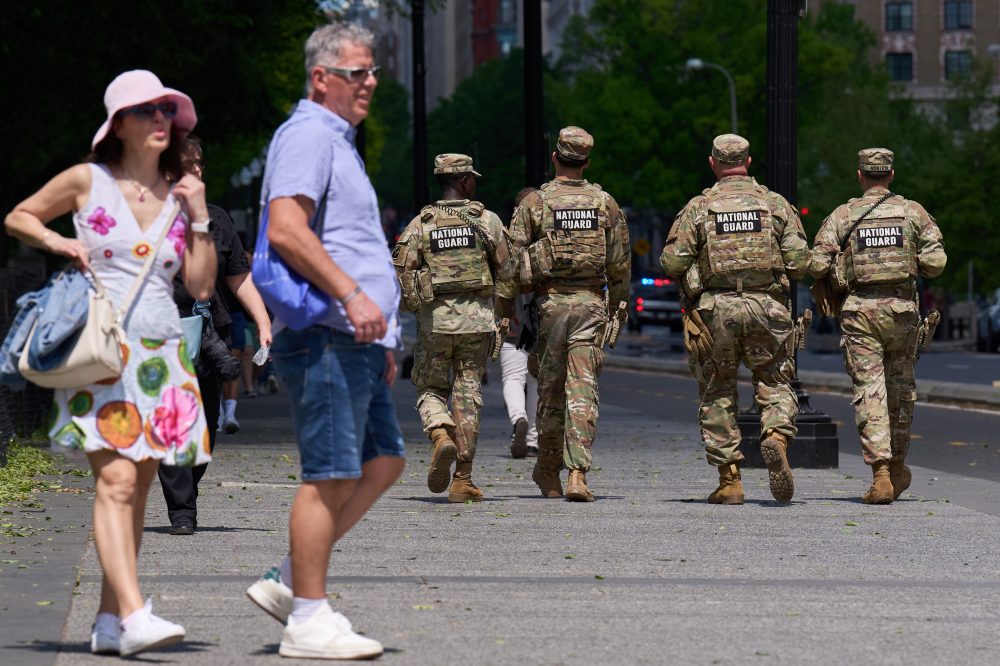

WASHINGTON — While cherry blossom season typically brings over a million tourists to the nation’s capital each spring, this year’s visitors to the Tidal Basin encountered an unusual sight: armed soldiers in military fatigues patrolling between iconic monuments.
More than 2,500 National Guard personnel continue operating throughout Washington D.C., eight months following President Donald Trump’s declaration of a crime emergency that activated the military deployment. The operation has become a fixture in the city with no definitive conclusion planned.
While similar military deployments in other metropolitan areas have concluded or faced court-ordered suspensions in states like California and Illinois, Washington’s National Guard presence persists. Soldiers continue patrolling subway systems, popular tourist destinations, residential areas, and public spaces throughout the district.
Despite approaching critical elections, the extended military presence receives minimal attention during city council sessions or from political candidates seeking mayoral and congressional positions. This silence may indicate both competing governmental priorities and local leaders’ limited authority to challenge the deployment. Without judicial intervention, military personnel will likely remain stationed through year’s end or beyond.
“Taxpayers are paying more than a million dollars a day to have them walk around,” said Phil Mendelson, chairman of the District of Columbia Council, in an emailed response to questions.
He added, “the presence of armed soldiers on American streets is not a good look.”
The Republican president issued his executive directive last August addressing what he characterized as a criminal crisis. This order activated National Guard units alongside hundreds of additional federal law enforcement personnel.
Throughout their deployment, military members have responded to medical situations, supported arrest operations, assisted local police with youth curfew enforcement, and participated in community improvement initiatives. D.C. Guard units also aided snow clearing efforts during January’s significant winter storm.
Although Guard personnel cannot conduct arrests independently, the Trump administration maintains their support contributes to reduced criminal activity. Administration officials report the task force has facilitated 12,000 arrests since beginning operations, including 62 identified gang members, while confiscating thousands of illegal weapons.
White House spokesperson Abigail Jackson said the president’s crime task force in the city has “yielded tremendous results for local communities.”
“Every local leader should want to mimic this success in their own locales,” Jackson said.
However, officials dispute the deployment’s actual impact in Washington, a predominantly Democratic city. Statistics indicate criminal activity was already decreasing beforehand, though these numbers face scrutiny amid allegations that local police may have manipulated crime data.
Legal challenges to the Guard deployment continue in court, and without judicial intervention, the operation could persist indefinitely at the administration’s discretion.
When questioned about the deployment’s duration, Jackson stated via email there were “no announcements to make.”
D.C. Attorney General Brian Schwalb’s office, currently contesting the deployment through litigation, refused comment regarding the pending lawsuit. The Pentagon’s National Guard Bureau did not respond to inquiries.
Mayor Muriel Bowser, who is not seeking reelection, has maintained a careful balance regarding the Guard’s presence and broader federal intervention. She has appeared cooperative with presidential initiatives while simultaneously resisting certain demands, such as local assistance with immigration enforcement.
Prominent candidates competing to succeed Bowser and the city’s 18-term non-voting congressional delegate Eleanor Holmes Norton have emphasized housing costs, statehood aspirations, and federal agency accountability regarding the security surge.
The District Council, including at least four mayoral or delegate candidates, unanimously passed legislation increasing federal law enforcement operation transparency. While the military deployment appears occasionally on campaign materials and advertisements, it remains secondary among current campaign priorities.
Additional city challenges, including unemployment and revenue losses from federal workforce reductions, have taken precedence. Municipal primaries are scheduled for June 16, alongside a special election for an at-large council position.
Some residents report decreased frustration with the Guard following an ambush attack on two West Virginia contingent members near the White House, which killed 20-year-old Specialist Sarah Beckstrom and critically wounded her partner.
Kevin Cataldo, a neighborhood commissioner who recently accompanied Metropolitan Police during community patrols, said he already treated Guard members respectfully, acknowledging them since they didn’t choose their assignment. The shooting incident intensified his sympathy for military personnel. “That was just horrible,” he said.
District Council member Brianne Nadeau noted constituents still question the Guard’s continued presence, though complaints have significantly decreased since deployment began.
“It would be great if the federal government would use its money and resources to help the District on the things we need help with and not act like an invading army,” Nadeau said in an email.
Council colleagues and mayoral candidates Janeese Lewis George and Kenyan McDuffie have expressed similar concerns, particularly regarding excessive costs.
Recent public opinion surveys specifically addressing attitudes toward uniformed military personnel in American cities remain limited.
Multiple organizations are organizing May 1 demonstrations opposing the federal surge, including continued National Guard presence, according to Keya Chatterjay, co-founder and executive director of Free DC, an advocacy organization promoting city autonomy. Their objectives include “an end to the military occupation of D.C. before the June election.”
Chatterjay argued normalizing the Guard’s presence facilitates dissent suppression and could “tilt the playing field” during elections.
Armed military personnel could create intimidating conditions during voting, Chatterjay suggested. Citizens must intervene and “number one, we have to help our neighbors feel safe voting.”
Scott Michelman, legal director at the American Civil Liberties Union of the District of Columbia, said the situation highlights the city’s self-governance limitations.
Washington operates as a federal district with restricted autonomy where Congress maintains authority over municipal laws and budget control, and where the president directly commands the D.C. Guard and can authorize unlimited military deployments with minimal local government resistance.
“We should have local control and local democratic accountability for the people who enforce our laws,” Michelman said. “D.C. is uniquely disempowered in our system in many ways.”