
HOUSTON — Four astronauts successfully concluded humanity’s first journey to the moon in more than five decades Friday, touching down in Pacific waters to wrap up the historic Artemis II mission.
Mission Control experienced rising anxiety as the crew aboard their spacecraft drew closer to Earth for the critical reentry phase.
Focus centered on the capsule’s protective heat shield, which must endure extreme temperatures during atmospheric reentry. During the spacecraft’s previous unmanned test in 2022, the shield returned with a heavily damaged, crater-like surface.
The crew — Commander Reid Wiseman, pilot Victor Glover, Christina Koch, and Canada’s Jeremy Hansen — approached Earth’s atmosphere at Mach 32, reaching speeds 32 times faster than sound. This velocity matched the breakneck pace last achieved during NASA’s Apollo missions from the 1960s and 1970s.
The astronauts planned to let their automated Orion capsule, named Integrity, handle the landing without manual intervention unless emergency situations arose.
Lead flight director Jeff Radigan expected to experience some natural anxiety, particularly during the six-minute communication blackout before parachute deployment. The recovery vessel USS John P. Murtha stood ready along with military aircraft and helicopters.
This marked the first joint NASA-Defense Department lunar crew recovery operation since Apollo 17’s return in 1972. Artemis II approached Earth at 34,965 feet per second — equivalent to 23,840 mph — before decelerating to 19 mph for ocean touchdown.
Following their April 1 launch from Florida, the astronauts achieved multiple milestones during NASA’s long-awaited return to lunar exploration, marking the initial phase toward establishing a permanent moon base.
While Artemis II didn’t include lunar landing or orbital operations, the mission surpassed Apollo 13’s distance record. Wiseman and his teammates became the humans who have traveled farthest from Earth, reaching 252,756 miles. In an emotional moment, the crew requested permission to name two lunar craters after their spacecraft and Wiseman’s deceased wife, Carroll.
During their record-setting flyby, the astronauts documented unprecedented views of the moon’s hidden side and witnessed a total solar eclipse aligned with their launch timing. “It just blew all of us away,” Glover remarked about the eclipse experience.
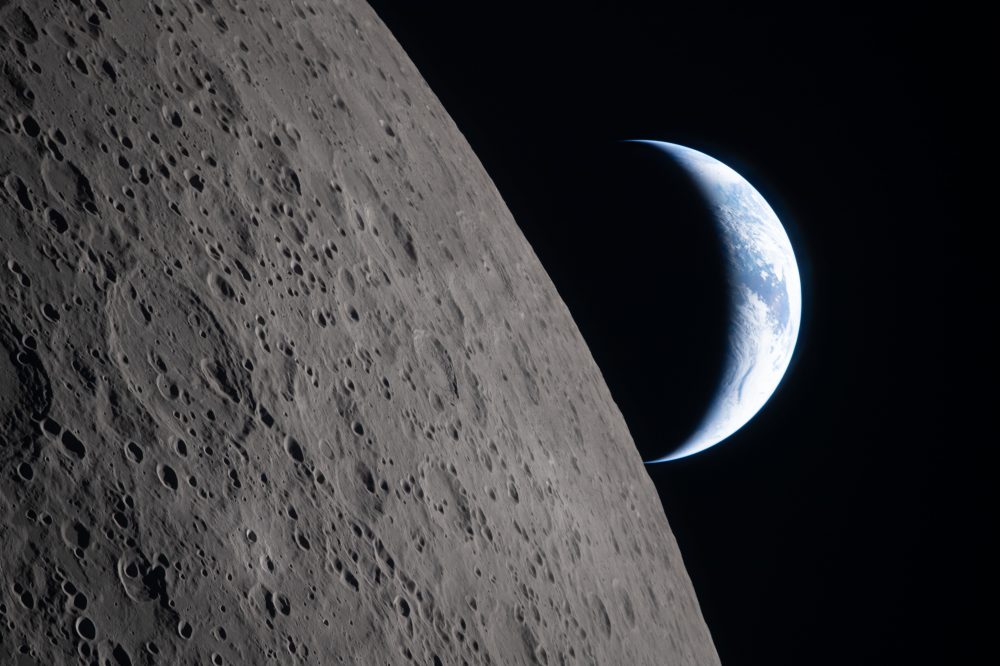
The crew’s sense of amazement and affection impressed observers worldwide, along with their spectacular photographs of Earth and the moon. The Artemis II team echoed Apollo 8’s pioneering lunar explorers by capturing an Earthset image, displaying our blue planet disappearing behind the gray lunar surface, similar to Apollo 8’s iconic Earthrise photograph from 1968.
“It just makes you want to continue to go back,” Radigan commented before splashdown. “It’s the first of many trips and we just need to continue on because there’s so much” more to discover about the moon.
The mission attracted worldwide attention and celebrity endorsements from President Donald Trump, Canadian Prime Minister Mark Carney, Britain’s King Charles III, actor Ryan Gosling from “Project Hail Mary,” Marvel star Scarlett Johansson, and William Shatner from the original “Star Trek” series.
Despite significant scientific achievements, the nearly 10-day journey encountered technical challenges. The capsule experienced valve malfunctions in both water and fuel systems. Most notably, toilet complications prevented normal bathroom use throughout most of the trip, requiring the crew to use traditional collection bags and funnels.
The astronauts maintained positive attitudes despite these setbacks.
“We can’t explore deeper unless we are doing a few things that are inconvenient,” Koch explained, “unless we’re making a few sacrifices, unless we’re taking a few risks, and those things are all worth it.”
Hansen added: “You do a lot of testing on the ground, but your final test is when you get this hardware to space and it’s a doozy.”
The updated Artemis program plans for next year’s Artemis III mission to have astronauts practice connecting their capsule with lunar landing vehicles while orbiting Earth. Artemis IV aims to land two crew members near the moon’s south pole in 2028.
Wiseman emphasized the crew’s dedication to future Artemis teams.
“But we really hoped in our soul is that we could for just for a moment have the world pause and remember that this is a beautiful planet and a very special place in our universe, and we should all cherish what we have been gifted,” he said.