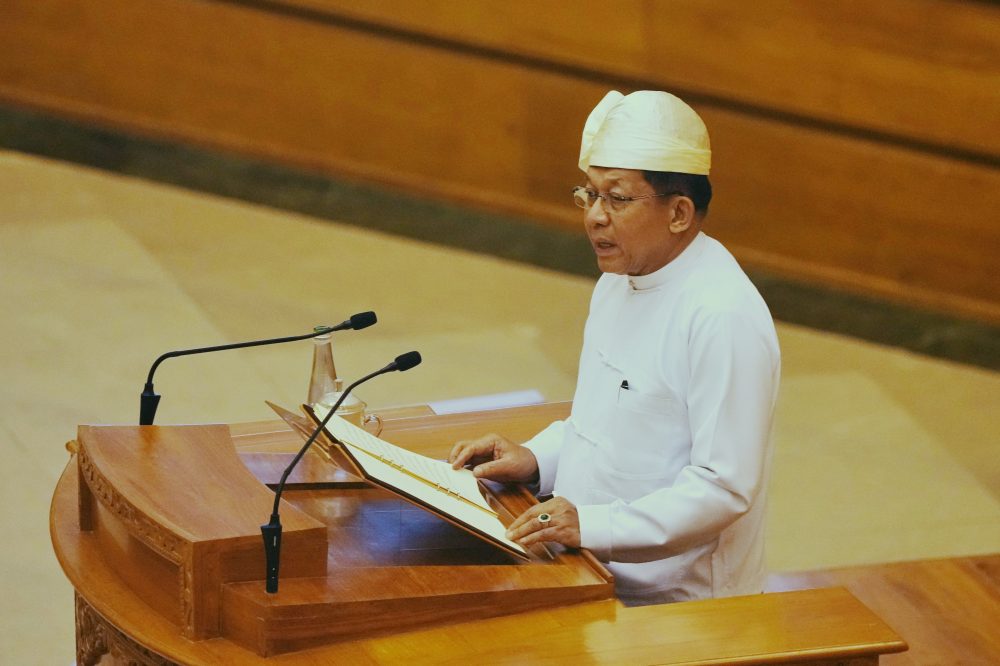

BANGKOK — The military leader who orchestrated Myanmar’s 2021 coup was formally installed as president Friday, marking another chapter in the Southeast Asian country’s troubled political landscape.
Min Aung Hlaing, 69, took the presidential oath after winning what international observers and human rights organizations have denounced as a fundamentally flawed electoral process. The December and January voting excluded Aung San Suu Kyi’s widely supported National League for Democracy and numerous other opposition groups.
The ceremony represents what analysts describe as a calculated move to maintain military dominance while creating an appearance of civilian governance. This pattern mirrors historical precedents where Myanmar’s military rulers have sought to validate their authority through manipulated democratic processes.
Following his parliamentary selection on April 3, Min Aung Hlaing will serve a five-year presidential term. The swearing-in ceremony also installed 28 new cabinet ministers, nearly all of whom are active or retired military officers, representatives from the military-aligned Union Solidarity and Development Party, or veterans of previous military administrations.
Military-backed politicians now control approximately 90% of legislative seats across both parliamentary chambers.
“Myanmar is back on the path to democracy and moving toward a better future,” Min Aung Hlaing declared during his inaugural address.
The new president also committed to pursuing peace negotiations with armed ethnic opposition groups and rebuilding diplomatic ties with the Association of Southeast Asian Nations, which has imposed pressure on Myanmar due to ongoing political turmoil.
The inauguration took place in Naypyitaw’s recently restored parliament facility, which sustained earthquake damage last year. Min Aung Hlaing was joined by First Vice President Nyo Saw, a former military commander and trusted advisor, along with Second Vice President Nan Ni Ni Aye, an ethnic Karen representative from the USDP.
International election monitors delivered harsh assessments of the voting process, noting significant geographical limitations due to active conflict zones.
“The junta’s elections were held in only 42% of Myanmar’s territory, under a restrictive legal framework that barred legitimate political competition to the advantage and benefit of the military-aligned Union Solidarity and Development Party,” stated the Asian Network for Free Elections, a Bangkok-based nonpartisan organization, in Friday’s analysis.
“Every aspect of the staged elections, from its election management body to the design of the electoral system and the selection of political parties, was carefully engineered to ensure a predetermined outcome,” the report continued.
Constitutional requirements forced Min Aung Hlaing to step down from his senior general position and military leadership role before assuming the presidency. General Ye Win Oo, a close associate, has assumed command of the armed forces.
Min Aung Hlaing’s military career includes overseeing a brutal 2017 operation targeting the Rohingya Muslim population under Suu Kyi’s administration, which forced hundreds of thousands to flee to Bangladesh. International authorities have characterized the campaign as potentially genocidal.
The Assistance Association for Political Prisoners, a human rights monitoring organization, reports that military actions since the 2021 takeover have resulted in nearly 8,000 civilian deaths and left approximately 22,208 political prisoners in detention. Experts believe total casualty figures from the ongoing conflict are significantly higher.
Eighty-year-old Suu Kyi remains imprisoned on a 27-year sentence stemming from charges critics dismiss as fabricated and politically driven. Her party achieved overwhelming victories in 2015 and 2020 before being forced to disband in 2023 when it refused compliance with new military registration requirements.