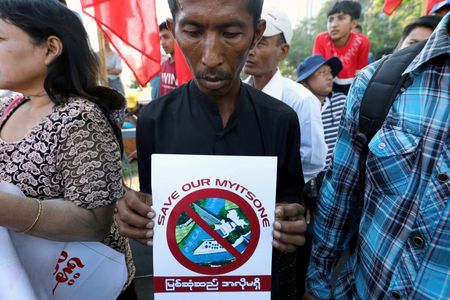

Myanmar’s new government is planning to restart a deeply controversial $3.6 billion dam project at Myitsone in the country’s northern Kachin state, with a target of completing the work within approximately eight years, according to two sources familiar with remarks made by Khet Htein Nan, the region’s top administrator.
The push to revive the project follows a trip last month by junta chief-turned-president Min Aung Hlaing to China, which has long championed the massive hydropower development in the war-ravaged country’s northernmost province.
Htet Paing Htoo, a member of the Kachin State parliament, told Reuters that the long-dormant construction effort is about to get underway. “It will begin shortly,” he said, referring to work that was suspended in 2011 after an unusually strong wave of public protest against what would have been Myanmar’s largest hydropower project. “An official announcement will be released. The president himself has already stated that it will be restarted.”
The 2011 halt frustrated China, but widespread resentment toward Beijing’s heavy influence in Myanmar — combined with environmental worries about flooding an area roughly the size of Singapore — ultimately won out over plans to export 90% of the dam’s 6 gigawatts of electricity output to China. That generating capacity would place Myitsone among Southeast Asia’s biggest hydropower projects, though it would still fall well short of China’s Three Gorges Dam, which has an installed capacity of 22.5 gigawatts.
A spokeswoman for the presidential office confirmed that restarting the dam was part of discussions during Min Aung Hlaing’s China visit. She noted the project could supply more than half of the 10 gigawatts of electricity that a country facing serious power shortages desperately needs. The spokeswoman, Khaing Khaing Soe, said the government is carefully weighing concerns about flooding and the displacement of local communities. “We are analysing these matters in detail, evaluating the extent of the benefits versus the negative impacts, to strike a balance,” she said on Tuesday.
Khet Htein Nan’s office and China’s foreign ministry did not respond to requests for comment. The two sources who described the administrator’s remarks asked not to be identified, as those discussions were held privately.
If the Myitsone dam moves forward, the price tag could be dramatically higher than originally projected. Based on the International Renewable Energy Agency’s most recent average construction cost estimate of $1,914 per kilowatt for Asian hydropower projects outside China and India, a revived Myitsone dam could run as high as $11.5 billion — more than three times its 2009 price.
Three officials, including the Kachin State lawmaker, confirmed that Min Aung Hlaing’s government — which came to power in April following a widely criticized election won by a military-aligned political party — is actively working to bring the project back to life. The effort comes against the backdrop of an ongoing civil war sparked by the military’s 2021 coup, in which Min Aung Hlaing’s forces overthrew the elected government of Nobel Peace Prize winner Aung San Suu Kyi, who had herself opposed the Myitsone dam.
In Myitkyina, the state capital located about 37 kilometers (23 miles) from the dam site, Khet Htein Nan has made clear in private conversations that the government is determined to move forward, the two sources said. At a June 23 discussion on the dam, the chief minister reportedly told attendees that China is now prepared to address environmental concerns using new technology. “They will use technology to ensure it can withstand such risks,” one source quoted the minister as saying. “There is nothing to worry about.”
Those assurances come as concerns about seismic risk have grown. A powerful 7.7 magnitude earthquake that struck central Myanmar last March and killed thousands has heightened fears about building a massive dam in a geologically unstable region. The proposed structure would stand 152 meters (500 feet) tall and span 152 meters (500 feet) wide at the point where the Mali and Nmai rivers meet.
A third source with direct knowledge of internal government discussions cited the chief minister’s remarks at a June 22 meeting, where he reportedly described the Myitsone project as a potential “historic achievement.” That source added: “The chief minister mentioned that China fully supports and encourages the resumption of the Myitsone project.”
Reuters was unable to determine whether Myanmar’s original arrangement — which called for sending most of the dam’s electricity to China — had been revised.
Meanwhile, the government has been working to build public support in areas now under military control. Following a visit to Myitkyina in April by the former deputy military chief, at least 26 public meetings were held across Kachin State in favor of the project, according to two members of a government-backed committee. “What we want is to provide the public with accurate information and allow them to make their own decisions,” said committee member Naw Khon.
Despite those efforts, resistance remains strong. A coalition of 49 civil society organizations recently called for the project to be abandoned entirely. In a joint statement issued on May 5, the groups declared: “It offers no benefits to the public and will only result in the severe destruction and loss of people’s lives, homes, and property.”