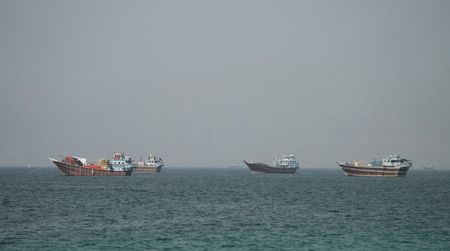

Iran doubled down Friday on its claim to control maritime traffic through the Strait of Hormuz, while also issuing a warning to Gulf nations not to take sides with the United States — all of this coming just one day after a ship was struck near Oman, casting doubt on a shaky preliminary peace agreement.
Tehran was firing back at what it described as an “interventionist, irresponsible and provocative” joint statement issued by the U.S. and six Gulf nations, which rejected Iran’s position that it could collect tolls from vessels passing through the strait.
Iran’s Deputy Foreign Minister Kazem Gharibabadi took to X to make his country’s position clear: “Safe passage through the Strait of Hormuz cannot be guaranteed under ambiguous arrangements, parallel routes or decision-making that does not take Iran’s role as a coastal state into account.”
Oil prices slipped lower on Friday, even as conflicting interpretations of last week’s interim agreement between Iran and the U.S. circulated, and shipping traffic through the strait — a critical corridor through which roughly one-fifth of the world’s oil and liquefied natural gas typically flows — continued to slow.
Meanwhile, Saudi Aramco restarted crude oil loading operations Friday at the Ras Tanura terminal in the Gulf, the largest oil port on the planet, following a suspension that had lasted nearly four months, according to shipping data.
U.S. Secretary of State Marco Rubio, who was concluding a visit to Gulf nations aimed at easing regional concerns about the interim agreement, told reporters Thursday that any Iranian move to threaten or block ships in the strait would mean “we’re going to have a problem.”
In their joint statement, Rubio and the Gulf Cooperation Council called for “free, unconditional, and unrestricted navigation” through the Strait of Hormuz, rejecting any tolls or “attempts to assert control.” They also stated that a lasting peace agreement must address Iran’s ballistic missile program, drone capabilities, and backing of proxy forces in the region.
Iran’s foreign ministry responded Friday by pointing to the U.S. military presence in the Gulf as the root cause of regional instability and division, and argued that the strait should be governed jointly by Tehran and Oman under the terms of the interim deal.
“We warn against the continuation of hostile and interventionist policies in the region,” the ministry said in a statement.
Iran gained effective control over the waterway after U.S.-Israeli strikes on Iran on February 28 sparked the war, sending shockwaves through global energy markets and the broader economy.
Taiwan’s Evergreen Marine announced Friday that its Singapore-flagged vessel, the Ever Lovely, had been struck by an “unknown object” near Oman on Thursday while traveling a route recommended by the British navy agency UKMTO. No one aboard was injured, and the ship eventually continued on its way out of the strait.
Two U.S. officials told Reuters that Iran had fired on the vessel. Iran’s Persian Gulf Strait Authority — a body established by Tehran to oversee ship transit requests through the strait — responded by stating that travel through unauthorized routes would be “the responsibility of the owner, operator, and vessel commander.”
No immediate response came from the U.S. government. Earlier this month, U.S. President Donald Trump had warned that if Iran failed to honor the interim deal — including reopening the strait — the U.S. would likely resume bombing the country.
Beyond the dispute over the strait, other unresolved issues continue to cloud the framework ceasefire agreement, including disagreements over financial incentives for Iran, nuclear inspections, and Israel’s ongoing military campaign in Lebanon. The deal has established a 60-day window for negotiations on these more complex matters, including Iran’s nuclear program.
Back in the United States, the conflict is becoming an increasing political concern for President Trump as November midterm elections approach, with control of Congress at stake.
The International Maritime Organization, a United Nations agency, temporarily halted its ship escort operations through the Strait of Hormuz following the Oman incident. Earlier in the week, the IMO and Oman had unveiled a new southern transit route through the strait to help clear hundreds of vessels stranded by the conflict — a move that drew sharp criticism from Tehran.
South Korea’s President Lee Jae Myung announced Friday that three South Korean ships would depart the Strait of Hormuz over the weekend, after the country’s Oceans Ministry reported that eight additional South Korean vessels had already exited the waterway.
Shipping data showed two Very Large Crude Carriers operated by Saudi Arabia’s shipping arm Bahri loading crude at Ras Tanura, with a third vessel waiting nearby. Each of these massive tankers is capable of carrying 2 million barrels of oil. Ras Tanura, located on Saudi Arabia’s eastern coast and west of the Strait of Hormuz, previously exported more than 5 million barrels per day before the conflict began.