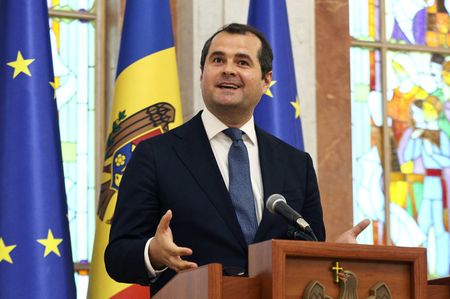

Moldova’s parliament gave its approval Tuesday to a newly formed government headed by Prime Minister Vasile Tofan, following his presentation of the cabinet’s agenda — one centered on economic revival and continued pursuit of European Union membership.
The Eastern European nation, considered among the continent’s poorest, saw its gross domestic product grow by 2.4% last year. Economists expect that growth to continue at around 2% this year, though the country faces added instability due to the ongoing war in neighboring Ukraine.
Addressing lawmakers, Tofan laid out his vision clearly. “Our program is called ‘The European Economy, an Effective State’. This is the commitment we will work toward, and it is by this commitment that we ask to be judged,” said the 45-year-old financier.
The vote passed with support from 53 members of President Maia Sandu’s Party of Action and Solidarity, known as PAS, which holds a majority in the 101-seat parliament. Opposition lawmakers chose to abstain rather than vote against the appointment.
Among the new government’s top priorities is signing a formal EU accession agreement before the close of 2028, with full membership targeted for 2030. To move that process forward, Tofan said his cabinet intends to open all remaining negotiation areas with the EU this year. Moldova, which has been accepted as a candidate for EU membership alongside Ukraine, has so far opened two of six so-called “clusters” in those negotiations.
Tofan’s rise to the top post follows the unexpected departure of his predecessor, Alexandru Munteanu, who stepped down after only eight months in the role.
On the economic front, Tofan pledged to bring down Moldova’s budget deficit — currently sitting at 20 billion lei, or roughly $1.1 billion — by two percentage points before 2029. He also called for tax reform, a reduction in bureaucratic red tape, and improved access to financing for businesses.
Additional goals outlined by the new prime minister include privatizing at least 10 state-owned companies, encouraging investment in technology and artificial intelligence, growing exports of higher-value goods, and shrinking the country’s shadow economy.
Moldova is situated between Ukraine and Romania, an EU member state. The country has a Romanian-speaking majority alongside a sizeable Russian-speaking minority, and its political landscape has long been divided between those favoring closer European ties and those preferring stronger relations with Moscow.