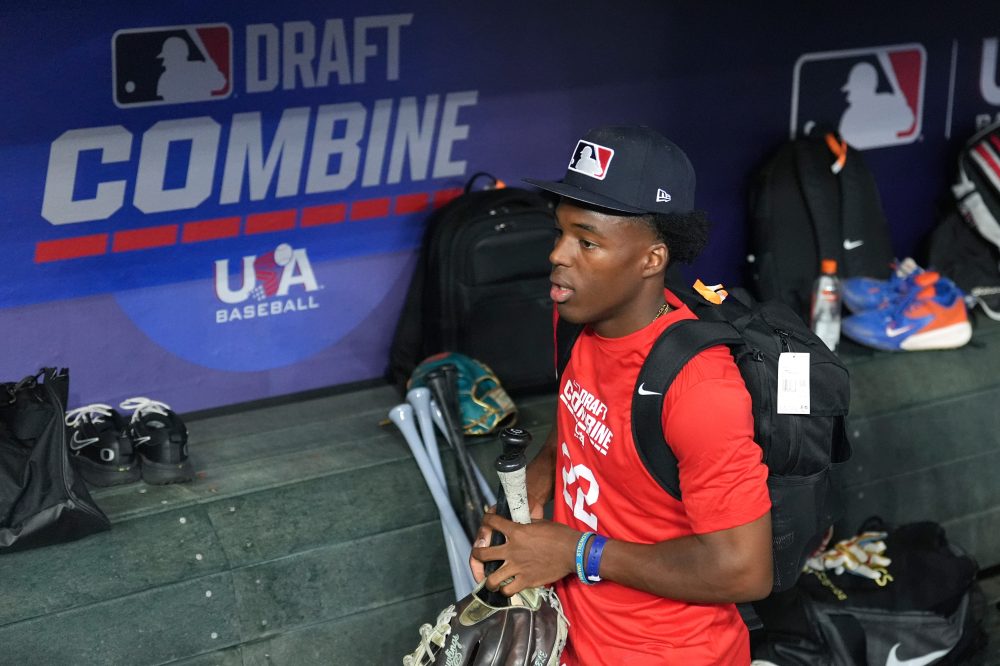

PHOENIX — Eighteen-year-old shortstop James Clark had a strong showing at the MLB draft combine at Chase Field on Tuesday, smoothly fielding ground balls and throwing to first base with ease. The California native has a realistic shot at being taken in the first round of next month’s draft.
If he’s not ready to turn pro, though, Clark has a fallback plan — a commitment to play baseball at Duke, a program with both athletic success and a strong academic standing.
“It’s going to be a difficult decision,” Clark said. “But it’s a good one to have.”
That kind of choice, however, may not exist for future high school prospects if MLB gets what it wants.
Team owners have recently put forward a proposal as part of collective bargaining negotiations that would bar high school players from signing with major league organizations. The plan would also raise the minimum age for international amateur players and significantly reduce signing bonus pools.
Under the proposal, starting in 2028, any player eligible for the amateur draft would need to be at least 20 years old by September 1 of his signing year and at least two years out from his high school graduating class. That rule would also exclude players who had only completed one year of junior college.
Many of today’s biggest MLB names signed as teenagers, including Pete Crow-Armstrong, Mike Trout, and Bobby Witt Jr. More recently, Pirates phenom Konnor Griffin made his MLB debut at just 19 years old.
Crow-Armstrong was 18 when he was selected 19th overall in the 2020 draft out of Harvard-Westlake High School in Los Angeles. He had been committed to Vanderbilt but chose to launch his professional career instead. The All-Star center fielder hopes young players will continue to have that same opportunity.
“I got an opportunity to grow up in a really real-life setting and I was really grateful for it,” Crow-Armstrong said earlier this week. “I think if there’s any sport you can go straight from high school, it’s this one. You’re afforded a lot of time in the minor leagues to develop, and that’s kind of the point.”
Cubs pitcher Ben Brown knows that experience firsthand. He was drafted by the Philadelphia Phillies as a 17-year-old in the 33rd round in 2017 — a round that no longer exists after MLB trimmed the draft to 20 rounds in 2021. The owners’ latest proposal would cut the draft even further, down to just 12 rounds beginning in 2027.
Brown looks back fondly on his early days in the minor leagues — sharing hotel rooms with teammates, managing money on a tight budget, and figuring out life on his own.
“It was the greatest blessing in the world for me to go into pro ball at a young age,” Brown said. “I had to work in the offseasons. I did plenty of things just to show up to spring training early. And the Phillies took amazing care of me as a young kid.”
Of course, for every success story like Brown or Crow-Armstrong, there are countless high school draftees who never made it to the big leagues. And many players genuinely prefer going to college first, earning a degree, and pursuing a professional career afterward if the opportunity comes.
Shortstop Roch Cholowsky was a highly regarded prospect out of an Arizona high school in 2023, but chose to attend UCLA instead. After three standout seasons with the Bruins, he’s now considered a potential No. 1 overall pick in next month’s draft.
“It’s different for everybody — whatever is best for you,” Cholowsky said. “A guy like myself needed to go to college. I got to play three years of unbelievable baseball at UCLA, learn a lot and really grow up.”
College baseball has seen significant growth in recent years. NCAA programs can now offer up to 34 scholarships, a major jump from the old limit of 11.7. Some name, image, and likeness money is also available at top programs, though generally not at the levels seen in football or basketball.
The Mississippi baseball coach, who has led the program for 26 years and guided it to a national championship in 2022, said the college game has become increasingly attractive to young prospects. He believes an MLB ban on high school signings would only strengthen the college game further. All four of his sons played college baseball.
“Even if they had been potential first-round draft picks, I would have made them go to college,” the coach said. “At the major college level, you’re playing the best amateur baseball in the world. You’ve got a support system that’s different than the minor leagues and you’re getting educated in lots of different ways.”
In the 2025 MLB draft, 56 of the top 90 picks came from college programs.
The gap between college and professional baseball has narrowed considerably, driven by money and technology. That convergence is part of why the San Francisco Giants recently hired a manager who had never worked or played in a professional organization before — a first in MLB history.
Recent college standouts have also proven they can reach the majors quickly. The Athletics’ Nick Kurtz, who played at Wake Forest, won last year’s AL Rookie of the Year award after needing just 210 minor league plate appearances before putting up 36 home runs, 86 RBIs, and a dominant debut in 117 games.
Pittsburgh Pirates right-hander Paul Skenes starred at LSU before being drafted in 2023, needing only 34 minor league innings before reaching the majors. He went on to win NL Rookie of the Year in 2024 and the Cy Young Award in 2025.
From MLB’s standpoint, allowing prospects to develop in college before drafting them reduces the cost and risk of signing teenagers to large bonuses and waiting years to see how they develop. Each team currently operates five levels of domestic minor league affiliates, which carries substantial expense. MLB already cut 40 minor league affiliates in 2020, and while the league has said it won’t reduce the current 120 teams in the top four levels when new agreements are negotiated in 2030, the makeup of those rosters would look very different without any high school signees.
“These guys trust (college) programs,” Arizona State’s coach said earlier this spring. “They say, ‘We’ll just watch them in college in three years at a Power 4 program, see how they develop and then we’ll go get them.’”