
KHARTOUM, Sudan — The conflict that has torn through Sudan for three years has left its mark not only on the landscape, but on the bodies and minds of those who survived it. Thousands have been killed. Millions more have been forced from their homes.
Associated Press reporters spent over a week in and around the capital city of Khartoum following the army’s recapture of the city last year. Fighting continues in other parts of the country as the military battles the paramilitary Rapid Support Forces. A member of the military media was present during the AP’s visit, including during interviews, though the AP maintained full editorial control over its reporting.
These are some of the people they met, and the stories those survivors shared.
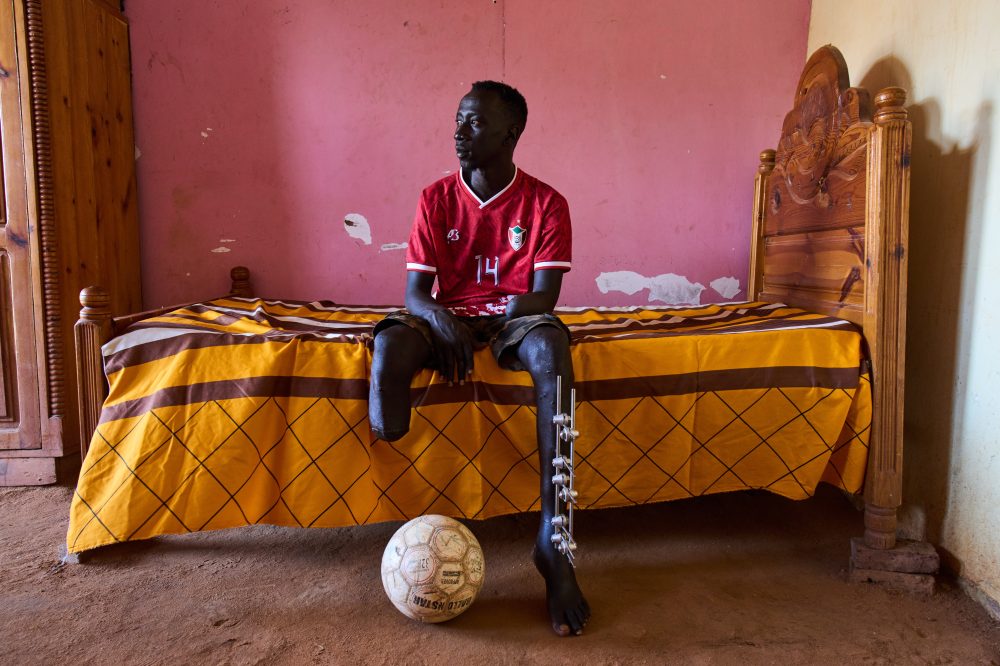
Omer al-Toum once held onto a dream of representing Sudan on the national soccer field. That dream was shattered in October when an unexploded weapon detonated inside his home while he was attempting to use it to drive a nail. The blast took part of his right leg and left arm, and his remaining leg was severely damaged.
Despite everything, the 33-year-old remains calm and warm-spirited, finding joy in his 8-month-old daughter and working to maintain a positive outlook.
“When I knew that my leg had been amputated, my family expected more of a reaction from me but I didn’t show them how affected I was,” he said.
Today, al-Toum cannot bathe or leave his bed without assistance, and some doorways in his home are too narrow for his wheelchair. He hopes to obtain prosthetic limbs, but getting quality ones requires traveling outside the country.
He has found a new sense of purpose coaching young soccer players, encouraging them to stay in school so they always have other paths available to them.
“As long as you are still breathing, you are still capable of doing many things. And when God takes something away from you, he will surely compensate you with other things,” he said.
Noon Madani had not wanted to leave home that August day nearly three years ago, but her older sister urged her to go. Paramilitary forces had taken control of their neighborhood outside Khartoum, yet an overdue bill needed to be handled.
On the way back, a missile struck, killing her 18-year-old sister and crushing the legs of 16-year-old Madani.
Speaking quietly from her wheelchair, her legs still in casts, she described lying motionless next to her sister, looking at missile fragments embedded in her sibling’s head.
“You can’t imagine when someone suddenly tells you that your daughters were hit by an artillery shell. You enter a phase of breakdown,” said their father, Omer Bakar.
Madani spent six months in a hospital undergoing surgeries, fighting infections, and sometimes waiting for medical care as doctors fled the area. Physicians now believe she will eventually be able to walk again. Her younger brothers push her wheelchair to school each day, where she studies science and hopes one day to become a doctor.
“We are trying to forget the war,” her father said, “the nightmare we finally woke up from.”
Fatma Ageb, 38, recalls the morning of February 2025 when her home was hit by shelling. Her husband had been sleeping. Her older daughters had just been talking about what to get their baby sister as a birthday gift. That is the last thing she remembers from that day.
The attack killed her husband and their two older daughters, aged 10 and 12. Shrapnel tore through Ageb’s body, and their 8-year-old daughter was seriously hurt as well.
“If it wasn’t for Zeinab I wouldn’t want to live. She’s always calling for her sisters and father,” Ageb said, wiping tears from her face.
The young girl’s face was scarred in the attack, and she lost her right eye, now replaced with a glass one. At the hospital, Zeinab sat beside her mother wearing a necklace featuring a character from the movie “Frozen,” shyly holding up a drawing she had made while wincing as a doctor tended to her injuries.
Friends and family have pooled together money to help cover the cost of the girl’s surgeries, but more procedures are needed and her mother has no idea how she will pay for them. While Ageb tries to stay strong for her daughter, Zeinab’s scars serve as a constant reminder of all they have lost.
Tariq Abuzeid had devoted years to helping people in need — running soup kitchens from his home, raising funds, and delivering medicine to the sick. When the war reached Khartoum, the construction worker continued his efforts to assist others.
In December 2023, while returning from distributing food during heavy shelling, he lost his right leg.
Now 52 and surrounded by family, he tries to stay composed, but breaks down when he reflects on how drastically his life has changed.
“I used to serve people. … Now I feel like I am a burden,” he said.
The attack caused severe blood loss, which he says has weakened his immune system. He takes dozens of medications daily but remains in constant pain. Finding a quality prosthetic leg and a wheelchair has proven difficult in Khartoum.
Even so, his volunteer efforts have not stopped. Large metal bowls were stacked in his yard as he prepared to serve others their next meal.
By July, the hunger inside the besieged town of Dilling in South Kordofan had become unbearable. A 50-year-old woman fled with her two daughters, only to be abducted by members of the paramilitary RSF.
With their hands bound and faces covered, they said they were transported for hours to a makeshift camp in the desert, where more than a dozen other women were also being held. The woman said she was gang-raped there until she bled and was beaten repeatedly over the course of months.
The AP does not identify individuals who have been sexually assaulted. The United Nations has described sexual violence as one of the defining features of the Sudan conflict.
Each night, she said she would tense up at the sound of fighters’ footsteps approaching the room where the women were held. The men would select a woman and take her away.
When they came for her daughters — aged 25 and 20 — she pleaded for them to take her instead.
One night while the fighters were away, she and her daughters slipped out and fled into the desert. Frightened and physically depleted, they walked for days before reaching another town where they found help.
The RSF did not respond to a request for comment.
The woman and her daughters are now staying at a center for women in Khartoum. In tears, she said a doctor told her that the injuries she sustained from the sexual assaults were so severe that her uterus may need to be removed.