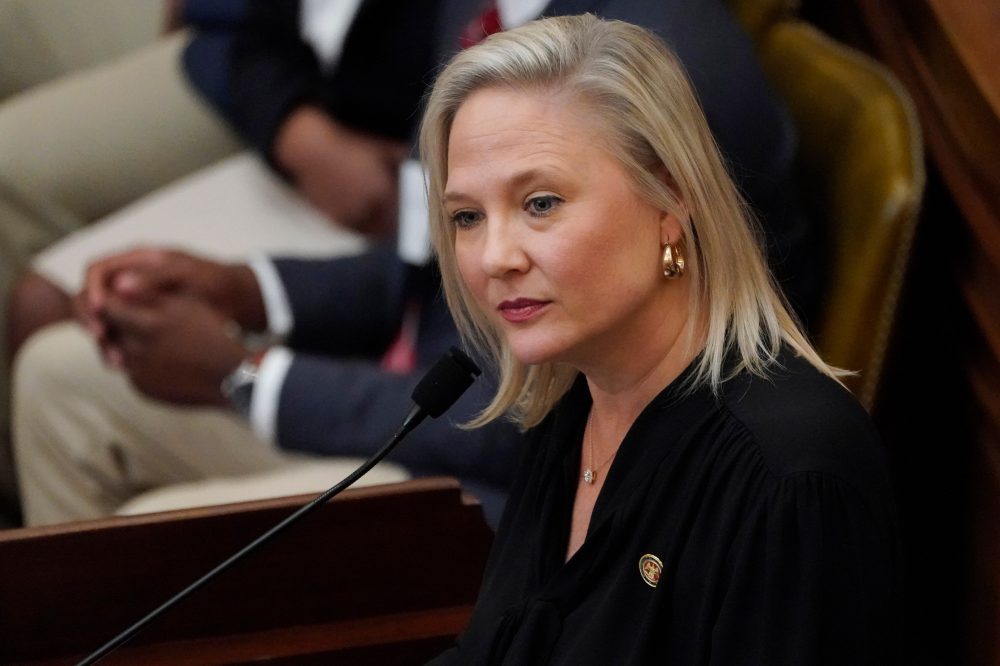

Mississippi’s legislature has approved legislation that would make distributing abortion-inducing drugs a felony offense carrying up to a decade in prison, sending the measure to Republican Governor Tate Reeves for his signature.
Legal scholars warn the criminalization could result in the imprisonment of desperate Mississippi residents and discourage physicians from prescribing these medications for legitimate medical uses, including treating postpartum bleeding and managing miscarriage complications.
The restrictions on abortion pills were incorporated into broader drug trafficking legislation that received approval Tuesday with a 76-38 House vote and 37-15 Senate passage. The GOP holds majorities in both legislative chambers.
“I think we’re going to end up trapping a lot of people into the criminal justice system simply because they want to have autonomy over their own bodies,” said Rep. Zakiya Summers, a Democrat from Jackson, who voted against the bill.
Republican Representative Celeste Hurst from Sandhill, who authored the amendment, stated her goal was preventing abortion medications like mifepristone and misoprostol from reaching Mississippi.
“The intent is to keep doctors from out of state from circumventing our current law,” Hurst told Mississippi Today.
However, Mississippi faces virtually insurmountable challenges in prosecuting out-of-state providers who mail abortion pills across state boundaries, according to Mary Ziegler, an abortion law specialist and professor at University of California at Davis School of Law. Protective legislation in states where abortion remains legal shields providers, patients and assistants from external investigations, legal action and criminal charges, Ziegler explained to Mississippi Today.
“I think lawmakers are imagining this will be primarily used against doctors or drug manufacturers in blue states,” Ziegler said. “But it will be much harder for prosecutors to actually get those people into court than it will be for them to get someone whose partner has these drugs.”
The legislation’s ambiguous wording makes it particularly problematic, Ziegler noted. While the bill specifies that possession becomes criminal only with distribution intent, Ziegler anticipates Mississippi residents using the medications personally could face prosecution.
The clinical exemption language also lacks clarity. The measure states Mississippi healthcare providers would face charges only when prescribing abortion-inducing medication specifically to terminate pregnancies, not when treating miscarriages or stopping hemorrhaging. Even with this exception, the bill will likely create a chilling impact on medical care, Ziegler warned.
In both scenarios, Ziegler explained, “the differentiator is intent, which is really, really hard to prove.”
Such legislation stems primarily from anti-abortion advocates’ frustration that abortion rates have risen in recent years, Ziegler observed.
The Supreme Court’s 2022 Dobbs ruling in a Mississippi case eliminated constitutional abortion protections. While initially hailed as a major anti-abortion victory, national abortion numbers have actually climbed since then, largely through expanded access to mailed abortion medications.
“That’s kind of a hollow thing for the state if that happens and then the number of abortions doesn’t go down,” Ziegler said. “It’s like, what did you really accomplish?”
Republican Senator Daniel Sparks from Belmont, among six legislators who finalized the bill’s language, told Mississippi Today he backed the amendment to strengthen enforcement of Mississippi’s abortion prohibition.
“The state of Mississippi has been pretty clear of where they are about their pro-life position,” Sparks said. “If people are circumventing that through the mail or through other mechanisms, then I think we’re trying to be consistent with what the law is.”
Democratic Senator Bradford Blackmon from Canton, who opposed the legislation, called it “outrageous,” “ridiculous” and “unnecessary” to classify abortion medication alongside controlled substances and impose one to ten-year prison sentences. Ultimately, Blackmon argued, the law will disproportionately harm low-income women.
“The wealthy Mississippians are still going to be able to go where they want to get abortions,” Blackmon said.