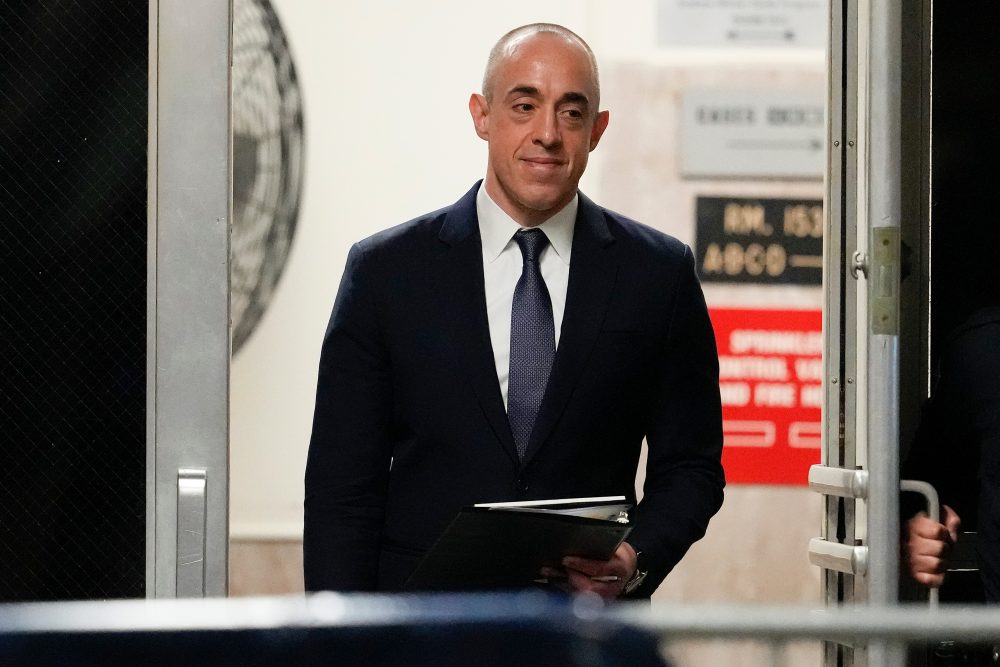

Legal representatives for Mahmoud Khalil, a former graduate student at Columbia University battling removal from the United States, have requested that Judge Emil Bove remove himself from the appeals court panel considering his case due to Bove’s prior position as a senior Justice Department administrator who handled investigations of student demonstrators.
This week, Khalil’s legal team petitioned the entire bench of 3rd Circuit Court of Appeals judges — excluding Bove — to examine and overturn a January decision by a three-judge 3rd Circuit panel that moved the Trump administration closer to detaining and removing the pro-Palestinian advocate.
In his capacity as Principal Associate Deputy Attorney General at the Justice Department, Bove “directed immigration enforcement investigations and decisions against student protesters on college campuses,” including Columbia University, according to Khalil’s attorneys.
The immigration enforcement activities overseen by Bove “demonstrates the existence, or at least the appearance of, a conflict of interest” that should prevent him from participating in Khalil’s appeal, his lawyers argued.
Since September, Bove has served as a judge on the Philadelphia-headquartered 3rd U.S. Circuit Court of Appeals. Before joining the Justice Department, he worked as one of President Donald Trump’s defense attorneys, handling his criminal cases including the New York hush-money prosecution that resulted in Trump’s conviction on 34 felony charges.
The recusal determination rests solely with Bove. Justice Department attorneys representing the government in Khalil’s appeal “sees no basis for recusal but defers to Judge Bove,” court documents indicate.
Speaking through the 3rd Circuit court, Bove refused to provide comment.
When undergoing judicial confirmation, Bove recognized that his Justice Department role, which involved supervising criminal and civil cases nationwide, “could give rise to actual or potential conflicts” and pledged to step aside “in cases that I was personally involved in should any such matter come before the court.”
Khalil, who holds legal permanent residency status, became the first individual whose detention was made public during enforcement actions targeting non-citizens who openly opposed Israel and its military operations in Gaza.
He continues living in the United States with his American citizen wife and their infant son while challenging the January decision that determined a New Jersey federal judge who ruled in his favor lacked authority to handle the case. Federal statutes mandate that detention and removal challenges must first proceed through the separate immigration court system, the ruling stated.
The three-judge panel’s 2-1 ruling did not address the central question in Khalil’s case: whether the Trump administration’s attempt to remove Khalil from the country based on his campus activities and criticism of Israel violates constitutional protections. He subsequently spent three months confined in a Louisiana immigration detention facility, causing him to miss his son’s birth.
The Trump administration has characterized Khalil as leading activities “aligned to Hamas,” although they have not provided evidence supporting this assertion and have not charged him with any criminal wrongdoing. They have also alleged he failed to provide complete information on his permanent residency application.
Khalil, who was born in Syria to Palestinian parents and possesses Algerian citizenship, has rejected these accusations as “baseless and ridiculous,” characterizing his arrest and detention as a “direct consequence of exercising my right to free speech as I advocated for a free Palestine and an end to the genocide in Gaza.”
The government justified Khalil’s arrest using a rarely invoked law that permits the removal of non-citizens whose political views are considered threatening to U.S. foreign policy objectives.
In February 2025, one month prior to Khalil’s arrest, Bove helped write a memorandum regarding the Justice Department’s creation of a task force focused on “Investigating and prosecuting acts of terrorism, antisemitic civil rights violations, and other federal crimes committed by Hamas supporters in the United States, including on college campuses.”