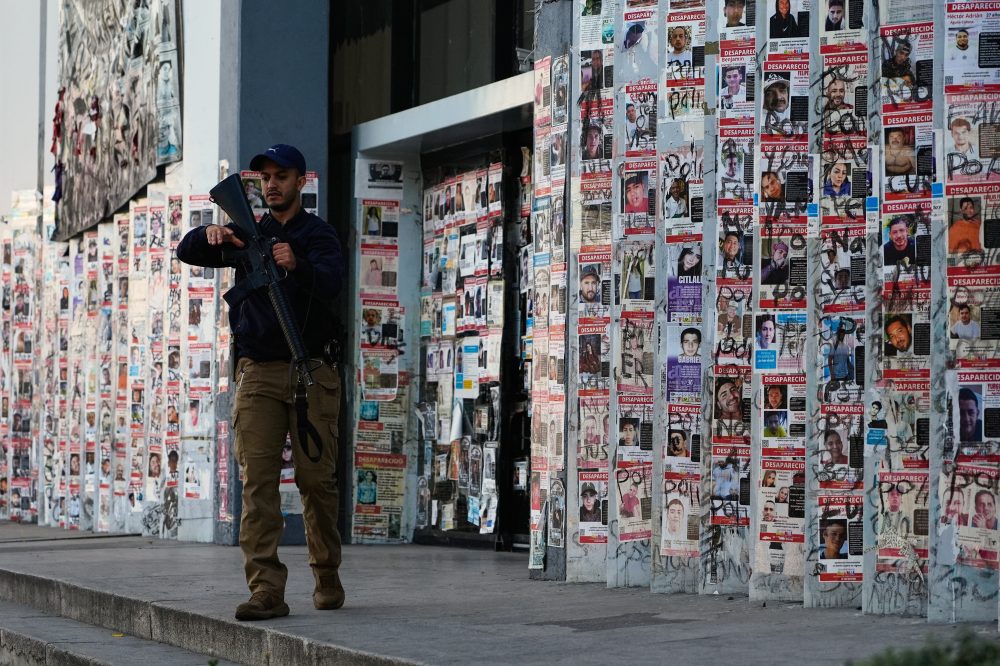

GUADALAJARA, Mexico — Thousands of missing person flyers cover every available surface throughout Mexico’s second-largest city, creating a haunting reminder of the country’s disappearance crisis.
Messages reading “We miss you,” “have you seen her?” and “we’re looking for you” blanket buildings, monuments, streetlights, parking meters, planters and transit stops across Guadalajara. Daily commuters walk past them in crowds, basketball players compete on courts encircled by them, and vehicles drive by them continuously.
These posters have become part of everyday existence in Jalisco state, the epicenter of Mexico’s forced disappearance emergency. The region, which experienced a surge of violence this week after the death of Mexico’s most influential cartel boss known as “El Mencho,” records among the nation’s highest numbers of missing individuals with 12,500 confirmed cases.
Families who post these flyers while searching for missing relatives now claim they face government pressure to remove the images before the FIFA World Cup arrives, with Guadalajara serving as a host location in June. As battles between criminal organizations and Mexican security forces have suspended search operations for the missing throughout Jalisco, several local legislators are advancing legislation that would simplify removing the signs.
“They don’t want people coming to the World Cup, people coming from abroad, to see” the fliers, said Carmen López, a woman looking for her brother and nephew, who went missing in two separate incidents. “It’s not in their interest, because they would get their hands dirty. It makes the government look bad in front of the entire world.”
Mexico records nearly 131,000 missing individuals, sufficient to populate a small municipality. Criminal organizations have historically used forced disappearances as a strategy to establish dominance through fear while hiding murder statistics.
Many view the forced disappearance emergency as representative of inadequate justice systems and extensive corruption that persist throughout Mexico, particularly evident in states such as Jalisco.
Families such as López’s frequently handle investigations independently, coordinating searches for remains and displaying flyers to maintain their efforts and pressure local officials.
“Little-by-little it kills a part of your soul. They don’t only disappear your loved one, but also you as a father, or as a mother along with them,” said Héctor Flores, a leader of one of Jalisco’s many search groups, Luz de Esperanza, or Light of Hope.
Flores began posting flyers throughout Guadalajara following his 19-year-old son’s forced disappearance by officers from the Jalisco state prosecutor’s office. A Mexican court later acknowledged the 2021 forced disappearance, motivating Flores to establish the organization representing 500 families investigating missing relatives.
His organization ventures into Jalisco’s capital streets and posts between 2,000 and 5,000 flyers each weekend. The notices display smiling photographs of individuals ranging from teenage girls to middle-aged men, including identifying characteristics such as tattoos plus the date and location where they vanished.
Search organizations continuously post signs because the materials are routinely removed.
“This is an act of searching in real time, with the hope that people who see these ID cards, they can provide us with information that will help us locate our families,” Flores said. “It’s also an act of visibility.”
Families now express concern about facing additional obstacles following this week’s cartel violence that has heightened security worries before the summer’s World Cup.
In December, legislators proposed changes to legislation originally designed to protect the flyers from removal. Local politicians attempted to alter the law in ways families believe would create forbidden public areas for posting the materials.
Carmen López, Flores and other relatives claim the local administration is attempting to sanitize the missing persons issue before the international sporting competition. They argue this continues years of official efforts to minimize Mexico’s disappearance crisis.
“We’re aware that the city doesn’t look beautiful because of the search IDs, but they’re not trash,” said López, who wore a shirt with the faces of her two missing family members. “But what are we supposed to do? We’re doing everything in our power to find them.”
State legislator Norma López, a member of President Claudia Sheinbaum’s Morena party, along with other lawmakers promoted the modification.
The state representative denied the accusation during a Thursday interview with The Associated Press, calling it a “bad interpretation” of the proposal by search groups. She stated her intention to support families searching for missing relatives and mentioned that one of her own family members also disappeared.
She explained that if approved, the law would permit poster removal from locations including public universities, the state legislature, the Supreme Court, museums, churches and similar venues without penalties. She noted they would remain permitted in other areas.
“My proposal is not a basis for banning them,” she said. “We are all concerned about what is happening in Jalisco. The disappearances also pain me.”
Mexican officials have faced questions regarding Guadalajara’s capacity to host World Cup games.
Sheinbaum declared this week there was “no risk” for visitors, but Thursday brought the cancellation of the Diving World Cup scheduled for a Guadalajara suburb in March due to security concerns. Earlier this week, the Portuguese soccer federation announced it was “closely monitoring the delicate situation” before a friendly match against Mexico’s national team in Mexico City.
Meanwhile, some Jalisco search groups report suspending investigations of potential secret burial sites because Mexico’s federal government informed them that security forces providing team protection cannot assist temporarily due to the violence.
Mexico’s National Search Commission for the disappeared did not respond to requests for comment.
Flores’ group and others have reported canceling search operations at grave sites around Guadalajara, leaving many feeling justice is more distant than previously.
The count of missing persons continues increasing hourly. City residents passing signs during daily travels barely notice them.
“Now, it’s just normal,” said Jacinto González, 47, walking past hundreds of signs covering a wall Wednesday.
After several minutes of conversation, he mentioned casually that his sister-in-law disappeared six years ago.