
A Cuban military-controlled business empire has become the focal point of escalating tensions between Washington and Havana, with Secretary of State Marco Rubio placing blame squarely on the conglomerate for the island nation’s struggling economy.
The organization in question is GAESA, a military-run business network that Rubio, a Cuban American politician, accuses of being the true power behind Cuba’s economic troubles.
“Cuba is controlled by GAESA,” Rubio declared Wednesday in a Spanish-language video directed at Cuban citizens. “A ‘state within the state’ that is accountable to no one and hoards the profits from its businesses for the benefit of a small elite.”
Cuban leadership seldom discusses GAESA in public forums. Officials have consistently maintained that such privacy is essential when operating under a U.S. trade and financial embargo that significantly hampers the nation’s international business relationships.
Understanding GAESA’s Structure
The acronym represents Grupo de Administración Empresarial, which translates to ‘business administration group.’ This extensive network of military-operated enterprises is widely regarded as the most profitable and well-run business entity on the island.
The organization oversees numerous luxury hotels throughout the Caribbean nation, operates the major Mariel port facility, runs the primary commercial banking institution, and manages extensive networks of grocery stores, fuel stations and money transfer services.
This closely monitored umbrella organization came into existence during the 1990s under then defense minister Raúl Castro’s direction and remains under the authority of the island’s Revolutionary Armed Forces.
Until his passing in 2022, Luis Alberto Rodríguez López-Calleja, who was formerly Raúl Castro’s son-in-law, served as GAESA’s leader. His replacement, Brigadier General Ania Guillermina Lastres, recently faced U.S. sanctions imposed by President Donald Trump’s administration earlier this month.
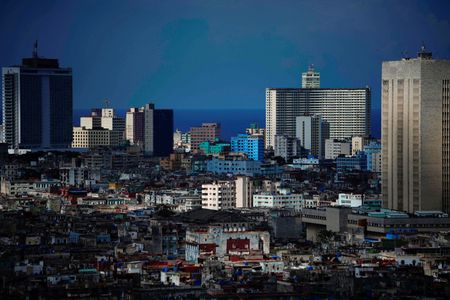
The organization’s influence is perhaps most dramatically illustrated by Torre K, a 42-floor structure housing the luxury Iberostar Selection La Habana hotel, which stands as the island’s tallest building. This GAESA-connected construction project was finished in 2025 during a period of declining tourism, and the tower and hotel currently remain unoccupied.
Washington’s Position on GAESA
During his five-minute address to Cuban citizens, Rubio referenced GAESA eight separate times.
The Trump administration claims GAESA accumulates earnings from the nation’s most lucrative sectors and channels these resources to benefit military leadership and Cuban elites.
“The real reason you don’t have electricity, fuel, or food is because those who control your country have plundered billions of dollars, but nothing has been used to help the people,” Rubio stated.
Washington has consistently targeted GAESA enterprises with sanctions, which effectively bars American tourists from staying at GAESA-operated accommodations.
Cuba’s Response Regarding GAESA
Cuban officials reject claims that GAESA corruption or profit-hoarding has caused the current economic difficulties, instead highlighting recent United Nations expert statements that Trump administration fuel restrictions have created “energy starvation” with serious implications for human rights and development.
Beyond this defense, the government provides minimal information about the business group. A review of the leading Communist Party publication Granma revealed only seven mentions of “GAESA” across two decades, with these references containing little substantive detail.
Cuban government representatives rarely make public statements about GAESA, and the organization’s financial information does not appear in the communist government’s official budget documents.
Multiple government officials have indicated over time that maintaining secrecy is crucial for operating strategic enterprises that generate foreign currency while facing extensive U.S. sanctions.
In 2024, Gladys Bejerano, who served as Cuba’s comptroller general and chief auditor, informed Spanish news agency EFE that GAESA fell outside her oversight responsibilities and characterized the military-led enterprise as having “superior discipline and organization.”
GAESA’s Economic Impact
No official data exists regarding what portion of Cuba’s economy falls under GAESA’s control. External analysts estimate the figure ranges between 40% and 70%.
Rubio claimed GAESA generates income that exceeds Cuba’s national budget by three times.
“Today, while you suffer, these businessmen have $18 billion dollars in assets and control 70% of Cuba’s economy,” he stated.
Recently, Cuba’s embassy in the UK responded on X to a Miami Herald article citing the $18 billion amount, asserting the report had exaggerated GAESA’s wealth by 24 times.
“Basic accounting dismantles this ‘bombshell,’” the embassy posted. “Why the deception? Inventing a secret $18 billion hoard provides a convenient political excuse to tighten the very illegal sanctions that suffocate the Cuban population.”